From Paper Lists to Predictive AI: The Information Revolution Transforming

Sarah Martinez
Logistics Correspondent
April 14, 2026
DATELINE: NA TRADE WIRE
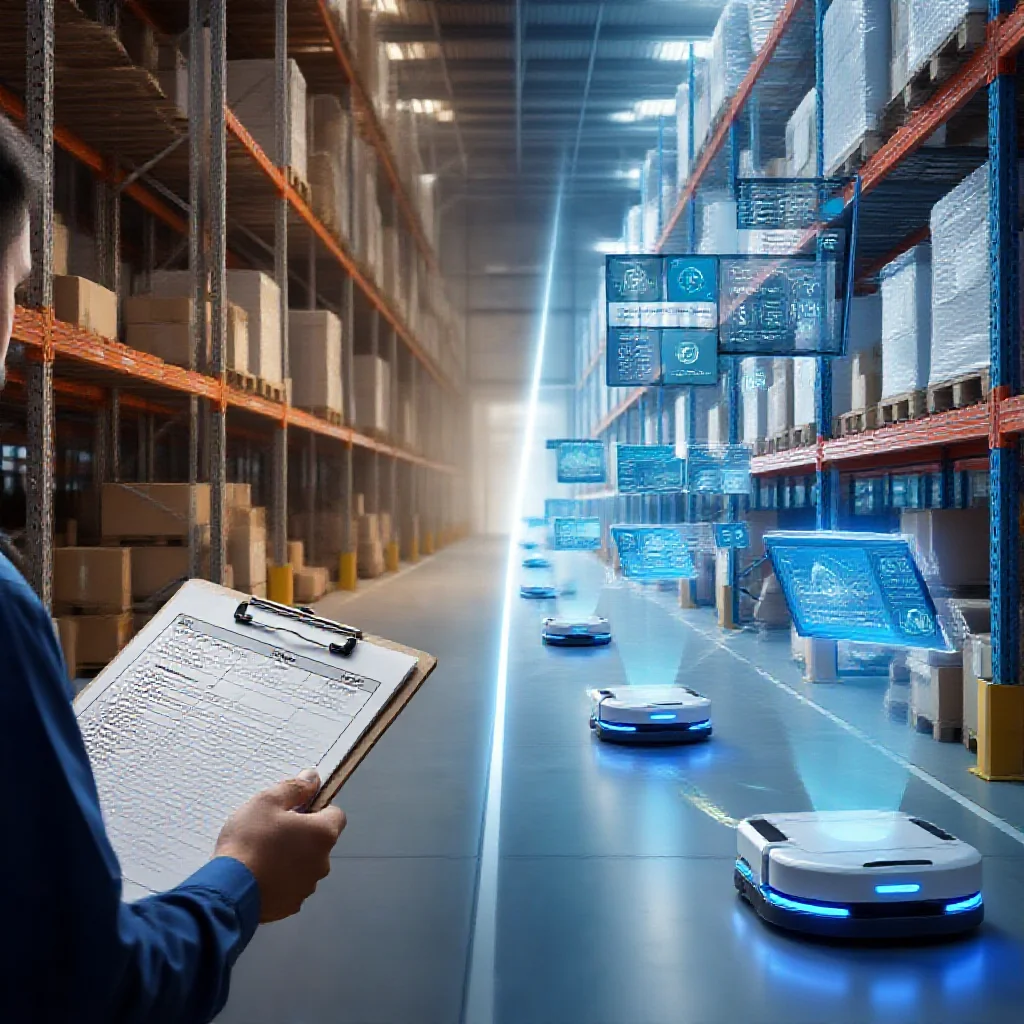
"Warehouse management has undergone a fundamental paradigm shift, evolving"
From Paper Lists to Predictive AI: The Information Revolution Transforming Warehouse Management
Introduction: The Paradigm Shift from Physical to Informational
The evolution of warehouse management represents a fundamental paradigm shift, transcending mere technological upgrades. The core transformation is a change in the primary subject of management: from physical inventory to the information that describes it. Where operations in the 1970s were governed by paper lists and manual coordination, contemporary facilities are orchestrated by real-time data streams. This article traces that journey, analyzing the economic logic of each phase and concluding that the future competitive advantage in logistics will be determined by the quality of information flow, not the speed of physical movement. The warehouse has evolved from a store of goods to a store of data.
The Manual Era: Managing Space and Muscle (1970s-1980s)
Operations in this period were defined by physical constraints and human latency. Workers relied on paper pick lists, updated stock records manually on log sheets, and communicated across vast warehouse floors via physical means such as golf carts or intercoms. The economic logic was straightforward: labor and real estate were the primary variable and fixed costs, respectively. Efficiency was measured in physical throughput per man-hour, and decision-making was inherently reactive, based on outdated or incomplete information.
This era can be characterized as the "Information Dark Ages" for the warehouse. Data existed in static, siloed forms—on clipboards, in filing cabinets, or in the experience of long-tenured staff. Error rates were high due to miscounts and mispicks, and visibility into inventory accuracy or order status was delayed by days. The core management challenge was the optimization of space and the direction of muscle, with information playing a passive, archival role.
The Digitization Wave: Tracking Becomes Tangible (1990s-2000s)
The introduction of Warehouse Management Systems (WMS) and ubiquitous barcode scanning in the late 1980s and 1990s initiated the first true information revolution. For the first time, a "digital twin" of inventory—recording its identity, location, and quantity—could be maintained. The WMS translated this data into directed tasks, optimizing pick paths and labor allocation based on logic rather than intuition.
This wave extended beyond location tracking. Technologies like voice picking and Radio-Frequency Identification (RFID) digitized the interaction between the worker and the item, further reducing errors and capturing data without manual entry. The economic logic shifted: the capital investment in hardware and software was justified by dramatic reductions in labor cost per unit handled and significant improvements in inventory accuracy.
A new core challenge emerged. The problem transitioned from a lack of information to managing a constant influx of real-time data points. The warehouse began generating more data than could be easily synthesized for actionable insight, setting the stage for the next evolutionary phase.
The Integration Era: The Warehouse as a Data Ecosystem (Present)
The current state of warehouse management is defined by integration. The convergence of WMS, Warehouse Control Systems (WCS), Internet of Things (IoT) sensors, and autonomous mobile robots (AMRs) creates a continuous, multi-layered data stream. IoT sensors monitor environmental conditions and equipment health in real-time. WCS software directly orchestrates the movements of conveyors and robots. The WMS provides the overarching business logic, fed by data from all subsystems.
The critical, often hidden, trend is that the primary product of this ecosystem is the integrated data stream itself. Physical movement—picking, packing, sorting—becomes an output or execution layer driven by this information flow. Consequently, the "information flow" has supplanted the "pick path" as the primary optimization target. Bottlenecks are no longer solely physical congestion points but also delays or inaccuracies in data transmission between systems. Resilience is now a function of data integrity and system interoperability as much as physical redundancy.
The Predictive Future: Autonomous Decision-Making and the AI Orchestrator
The logical progression from an integrated data ecosystem is a predictive and autonomous one. The next frontier involves applying artificial intelligence (AI) and machine learning (ML) to the vast historical and real-time data sets now available. The focus shifts from reporting what has happened or what is happening to predicting what will happen and prescribing or executing optimal responses.
Potential applications are systemic. Predictive analytics will forecast order volumes, flag potential equipment failures before they occur, and dynamically re-optimize slotting based on seasonal trends and purchasing patterns. This will evolve into prescriptive analytics, where the system not only predicts but also generates optimized work plans. The culmination is autonomous decision-making, where closed-loop systems self-correct in real-time—for example, rerouting robots around a sudden congestion point or reallocating labor based on a shift in order priority, all without human intervention.
The economic logic will pivot from cost reduction to value creation through agility and resilience. The ability to anticipate and adapt to supply chain volatility will become a primary source of competitive differentiation.
Conclusion: The Centrality of Information Flow
The trajectory from paper lists to predictive AI underscores a fundamental truth: the physical warehouse is now an information processing hub. Each evolutionary phase—manual, digitized, integrated, predictive—has been driven by the increasing recognition that controlling the flow of goods is impossible without first mastering the flow of information. The future warehouse will be judged not by its square footage or its fleet of robots, but by the latency, accuracy, and intelligence of its data operations. The final evolution is the complete inversion of the original model: where once information served the physical operation, the physical operation now exists to execute the decisions of an information-centric command system.
Trade Metrics
Related Datasets
Q4 Cross-Border Logistics Report
PDF • 4.2 MB
Automotive Parts Supply Chain Index
CSV • 1.1 MB