From Control to Coordination: How Real-Time Orchestration is Redefining Warehouse

Sarah Martinez
Logistics Correspondent
April 21, 2026
DATELINE: NA TRADE WIRE
"Warehouse Control Systems (WCS), designed for fixed automation, are no longer"
From Control to Coordination: How Real-Time Orchestration is Redefining Warehouse Intelligence
Summary: Warehouse Control Systems (WCS), designed for fixed automation, are no longer sufficient for modern dynamic operations. The new frontier is real-time orchestration software, a layer that integrates WMS, WES, WCS, and diverse assets like AMRs and labor. This article explores the evolution from siloed control to holistic coordination, driven by AI and real-time data. It examines how platforms like LocusOne and Swim ESP enable cross-domain decision-making, improving throughput, resilience, and asset utilization. The future lies not in replacing WCS, but in embedding it within a broader, intelligent orchestration architecture that makes the entire warehouse behave as a single, responsive system.
---
The Limits of Legacy: Why Traditional WCS is Struggling in a Dynamic World
Warehouse Control Systems (WCS) were engineered for a deterministic operational environment. Their primary function was the real-time coordination and control of fixed hardware assets, such as conveyors, sorters, and palletizers. This architecture was effective for linear, high-volume workflows where variability was minimal. The modern fulfillment center, however, operates under fundamentally different conditions. It is characterized by a heterogeneous mix of Autonomous Mobile Robots (AMRs), Automated Storage and Retrieval Systems (AS/RS), vision systems, and flexible human labor, all operating within a single facility.
The core limitation of a traditional WCS in this context is its architectural premise: reactive, siloed control versus proactive, system-wide coordination. A WCS manages its assigned domain efficiently but lacks the contextual awareness and authority to optimize interactions between disparate systems. For instance, an AMR fleet managed by one system and a conveyor network managed by a WCS may compete for space or priority at merge points, creating congestion. As noted in industry analysis, "Warehouse Control Systems were built for a simpler era." (Source: [Primary Data - Quote 1]) This statement underscores the technological gap between systems designed for fixed automation and the demands of dynamic, multi-agent environments.
The Orchestration Layer: The Brain for the Modern Warehouse Ecosystem
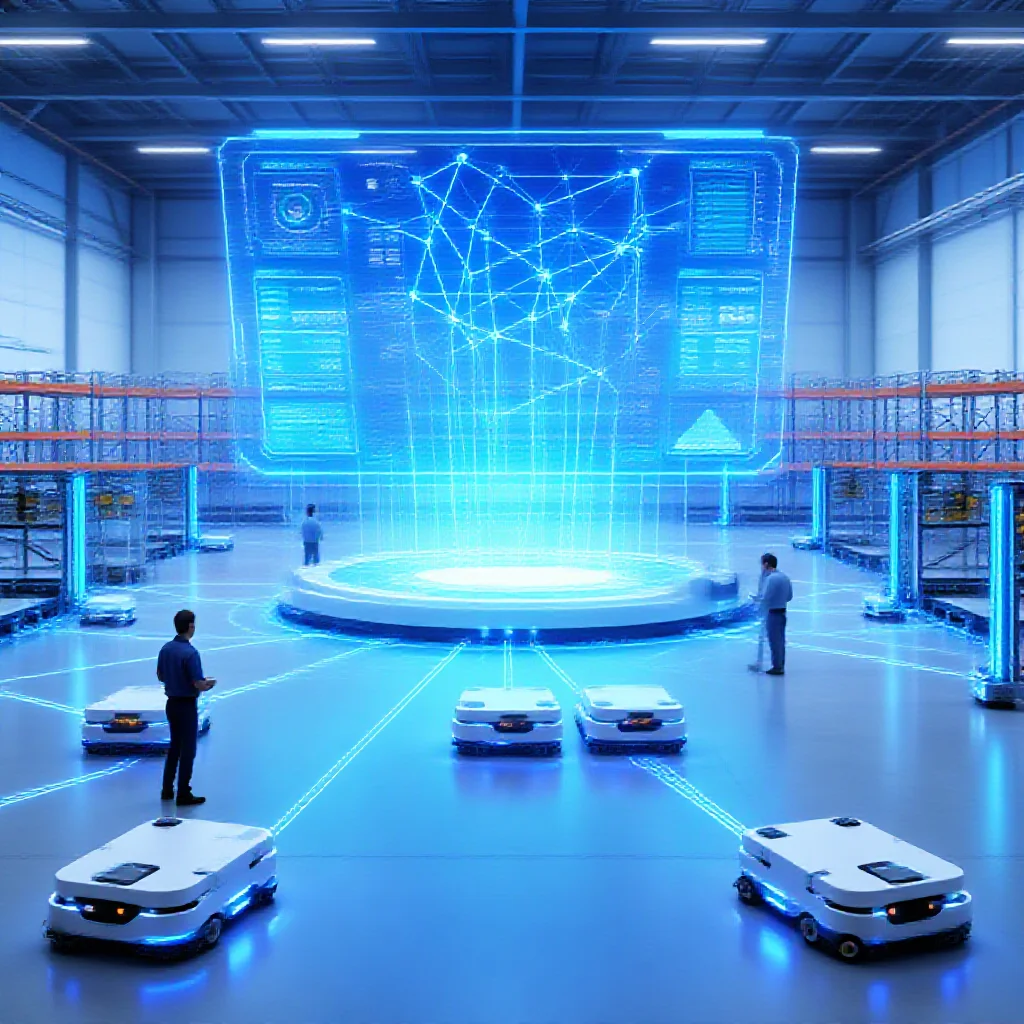
The response to this complexity is the emergence of real-time orchestration software. This layer operates above the Warehouse Management System (WMS), Warehouse Execution System (WES), and WCS, functioning as a central decision-making cortex. Its core mandate is to coordinate priorities, enable dynamic routing, and manage exception recovery across all operational domains—people, robots, and processes—in real time.
The modern warehouse software stack is thus hierarchical. The WMS handles inventory and order planning, the WES manages order release and task sequencing, and the WCS executes device-level commands. The orchestration layer sits atop, ingesting data from all systems to make holistic decisions that balance competing objectives. "Orchestration is the layer that makes the warehouse behave like a coordinated system instead of a collection of disconnected tools." (Source: [Primary Data - Quote 2]) Practical implementations, such as Locus Robotics' LocusOne platform, demonstrate this principle by coordinating robot fleets and warehouse associates within a single, optimized workflow, effectively blending the domains of automation and labor management.
The AI Judgment Engine: From Simple Coordination to Intelligent Optimization
The next evolutionary step moves orchestration beyond basic coordination and into the realm of intelligent optimization. Artificial Intelligence is becoming central as the "judgment" engine within the orchestration layer. While rules-based systems can manage predefined scenarios, AI enables predictive and prescriptive decision-making by analyzing real-time context.
This context is provided by streaming data platforms. For example, Swim ESP for Smart Logistics ingests real-time data from RFID, Real-Time Location Systems (RTLS), and GPS to create a live digital twin of warehouse operations. This continuous stream of context allows the AI-driven orchestration engine to make decisions that optimize for multiple, often competing, Key Performance Indicators simultaneously—maximizing throughput while minimizing cost, optimizing asset utilization, and maintaining operational resilience. The performance of the underlying data infrastructure is critical; in one deployment, Swim ESP achieved sub-second end-to-end latency while also lowering cloud processing costs (Source: [Primary Data - Fact 6]), demonstrating that the intelligence layer must itself be economically and technically efficient.
The Hidden Impact: How Orchestration Reshapes Underlying Supply Chain Economics
The long-term significance of real-time orchestration extends beyond warehouse operational metrics to reshape fundamental supply chain economics. The primary impact is on inventory velocity and capital efficiency. By creating a warehouse that is more responsive and predictable, orchestration software reduces the need for buffer stocks held to compensate for operational variability. This compression of cycle times enables smaller, more frequent deliveries and supports a shift towards on-demand fulfillment models.
Furthermore, the resilience embedded through system-wide coordination and AI-driven exception handling improves overall network reliability. A warehouse that can dynamically reroute workflows around a malfunctioning sorter or a congested zone contributes to a more robust supply chain. The economic logic is clear: orchestration transforms the warehouse from a cost center focused on storage and retrieval into a dynamic hub that accelerates inventory turnover and enhances service-level agility.
Conclusion: The Future Architecture of Warehouse Intelligence
The trajectory of warehouse technology is not defined by the obsolescence of existing systems but by their integration into a more intelligent whole. "The future warehouse is not one where WCS disappears. It is one where WCS becomes one part of a broader orchestration architecture." (Source: [Primary Data - Quote 3]) The WCS will continue to perform its vital role in device-level control, but its directives will be informed by a higher-order intelligence that understands the state of the entire system.
Market adoption will be driven by the increasing complexity of fulfillment, the proliferation of robotic and automated solutions, and the economic imperative for greater asset utilization. The competitive frontier will shift from which automation hardware a company deploys to how intelligently it can orchestrate its entire operational ecosystem. The defining characteristic of the next-generation warehouse will be its behavior as a single, cohesive, and autonomously adaptive system.
Trade Metrics
Related Datasets
Q4 Cross-Border Logistics Report
PDF • 4.2 MB
Automotive Parts Supply Chain Index
CSV • 1.1 MB