Beyond Ownership: How Tesla''s Strategic Vertical Integration Redefines Supply

Sarah Martinez
Logistics Correspondent
April 20, 2026
DATELINE: NA TRADE WIRE
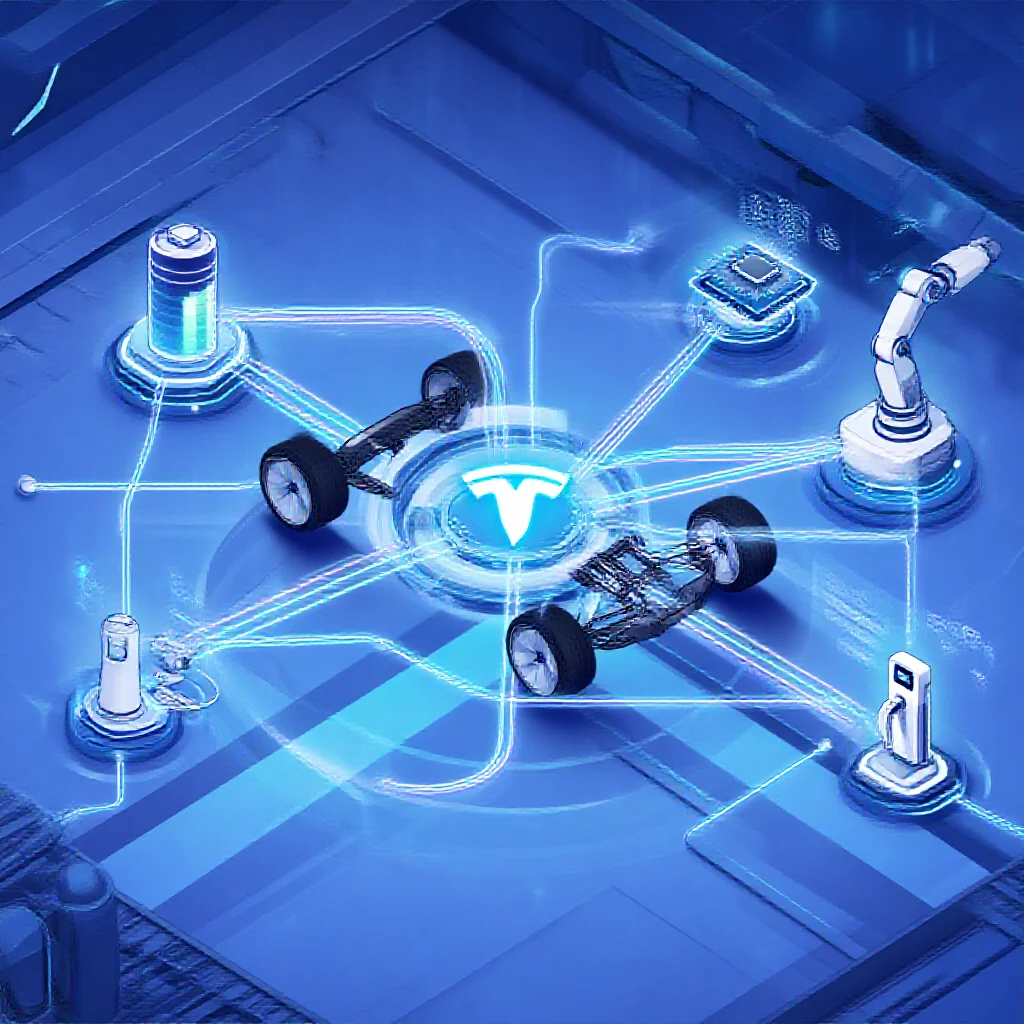
"Tesla's approach to vertical integration is not a blanket philosophy of ownership"
Beyond Ownership: How Tesla's Strategic Vertical Integration Redefines Supply Chain Control
Introduction: The Misunderstood Blueprint of Tesla's Integration
The prevailing narrative surrounding Tesla's operational model often simplifies it to a broad philosophy of vertical integration. This characterization is inaccurate. Analysis of Tesla's structure reveals a targeted strategy of control over specific, critical capabilities, not a blanket policy of ownership. The company functions as a case study in strategic supply chain architecture, where integration is a calculated decision applied to domains deemed vital for differentiation and economic resilience. The most useful lesson from Tesla is not about imitation. It is about supply chain architecture.
The Anatomy of Selective Control: Tesla's Integrated Operating Model
Tesla's operating model demonstrates selective integration across a defined spectrum. Its controlled domains include vehicle design and manufacturing, core software and power electronics, a direct sales and service network, and the global Supercharger infrastructure. A significant upstream move is the in-house lithium refinery in Texas, which began operations in January 2026 (Source 1: [Primary Data]). This represents a strategic push into raw material processing to secure a key battery component.
In battery production, Tesla's strategy is one of supplementation, not wholesale replacement. The company manufactures its own cells to pressure external suppliers, validate costs, and accelerate proprietary technology, while still relying on established suppliers for volume. This hybrid approach allows Tesla to influence the market without bearing the full burden of total self-sufficiency.
The Trade-Offs: Capital, Complexity, and the Burden of Execution
This model imposes significant trade-offs. The capital intensity is substantial. Tesla's 2025 capital expenditures were approximately $8.5 billion (Source 1: [Primary Data]). Reuters reported in January 2026 that Tesla planned to increase capital spending further in 2026 to expand investment in AI, robotics, vehicles, and manufacturing capacity (Source 2: [Reuters, Jan 2026]). This financial commitment is a prerequisite for maintaining and expanding integrated operations.
Operational complexity escalates as the company must master disciplines ranging from chemical refining to AI software development, rather than managing supplier relationships. The resilience gained through integration is contingent upon flawless internal execution across these diverse domains. A failure in any internally controlled link—from lithium processing to software deployment—directly impacts the entire chain.
The Core Economic Logic: Compression, Speed, and Iterative Innovation
The economic rationale for this selective integration is not primarily short-term cost reduction. The core logic is the compression of feedback loops and the acceleration of innovation cycles. Direct control over adjacent processes—from design and engineering to manufacturing and software—enables rapid iteration and problem-solving that is difficult to coordinate across multiple independent suppliers.
Furthermore, control over key customer-facing systems, such as software and the charging network, creates direct monetization pathways and enhances customer lock-in, establishing new economic moats. The value captured through accelerated innovation and ecosystem control justifies the high capital outlay. Vertical integration is not a philosophy. It is a decision about where control matters most.
Conclusion: The Architectural Imperative for Modern Enterprises
Tesla is not a template for every manufacturer. Its model provides a framework for analysis, not a blueprint for replication. The critical exercise for other enterprises is to dispassionately identify which specific capabilities are fundamental to their own competitive differentiation, economic model, and resilience in a volatile global landscape. The future of supply chain strategy will be defined by this architectural thinking—the strategic selection of control points that compress time-to-market, protect core intellectual property, and insulate against systemic disruption. The decision to integrate is, ultimately, a decision about where a company must own its destiny.
Trade Metrics
Related Datasets
Q4 Cross-Border Logistics Report
PDF • 4.2 MB
Automotive Parts Supply Chain Index
CSV • 1.1 MB