Beyond the Cloud: How On-Device AI is Rewriting the Economics of Supply Chain

Sarah Martinez
Logistics Correspondent
March 23, 2026
DATELINE: NA TRADE WIRE
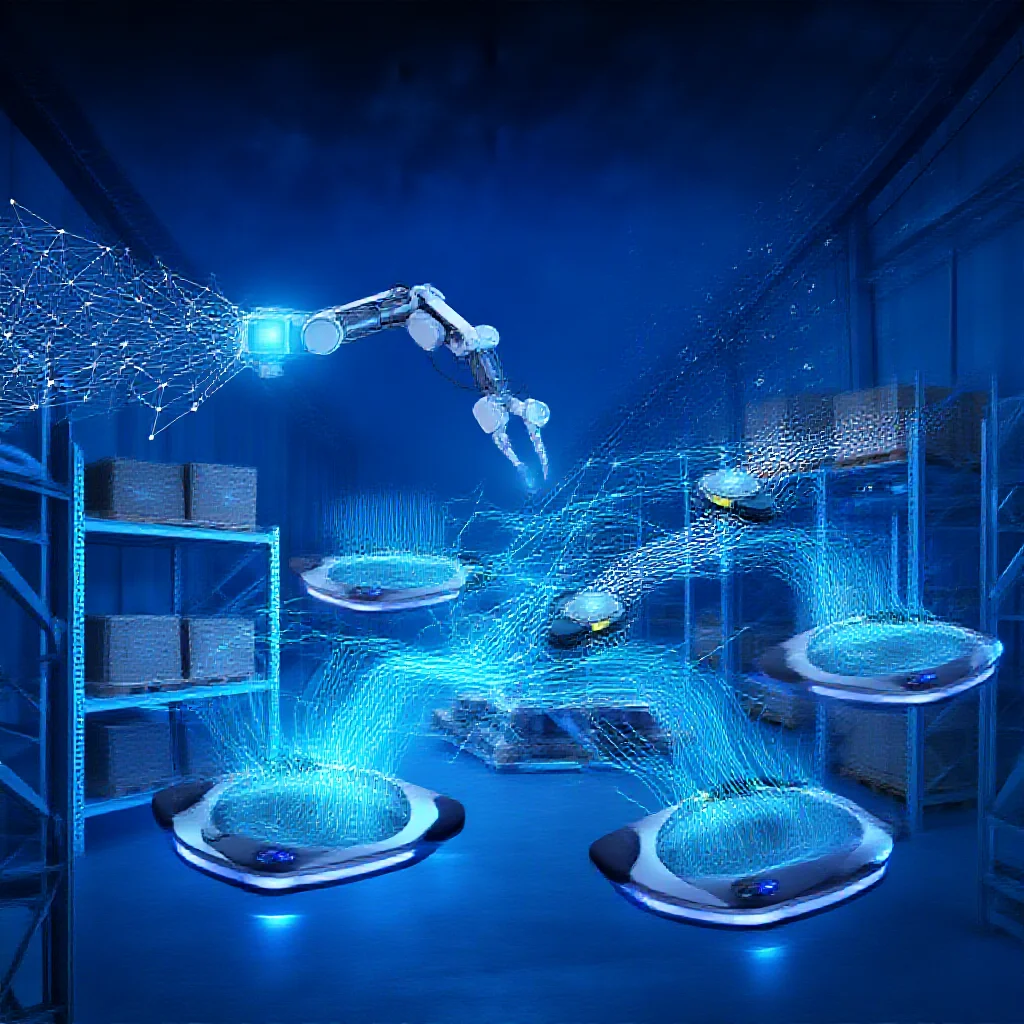
"The migration of AI from the cloud to the edge represents a fundamental shift"
Beyond the Cloud: How On-Device AI is Rewriting the Economics of Supply Chain Management
Introduction: The Silent Revolution at the Edge
The dominant narrative of artificial intelligence has been cloud-centric, focusing on vast, centralized data lakes and remote processing power. A countervailing shift is now underway, moving intelligence from the core to the periphery. In supply chain management, the migration of AI from the cloud to the edge—onto sensors, cameras, gateways, and mobile devices—represents more than a technical upgrade. It constitutes a fundamental economic and architectural realignment. This transition moves the industry beyond centralized visibility toward decentralized, autonomous action, challenging the established paradigm for operational intelligence.
Deconstructing the Promise: More Than Just Low Latency
The stated advantages of on-device AI are clear: reduced latency for real-time decision-making, lower bandwidth costs from minimized data transmission, and improved operational reliability independent of consistent cloud connectivity. An analysis of the underlying economic logic, however, reveals deeper drivers. A primary factor is data sovereignty; processing sensitive operational data locally mitigates exposure risks associated with cloud data transit and storage. Furthermore, it reduces systemic vulnerability to wide-scale cloud outages or cyberattacks that could paralyze a centralized system.
The economic calculus shifts capital expenditure. Investments move away from recurring costs for bandwidth and cloud storage subscriptions and toward smarter, albeit more capable, edge hardware. This model converts variable operational expenses into more predictable capital investments, while also eliminating the latency tax imposed by data traveling to a distant cloud and back. The operational model evolves from constant data reporting to localized event-driven intelligence.
[Infographic Suggestion: A comparative data flow diagram contrasting a cloud-centric model (data from edge → cloud → analysis → command back to edge) with an edge-AI model (data at edge → local analysis & decision → action), highlighting the elimination of round-trip travel and bandwidth consumption.]
The Deep Entry Point: From Predictive to Prescriptive & Autonomous
Conventional analysis often concludes that edge computing enables "faster predictions." The deeper, transformative insight is its enablement of closed-loop, prescriptive autonomy. This marks a shift from insight to immediate action without human or cloud intermediation.
For instance, a high-resolution camera with embedded AI at a receiving dock does not merely flag a potentially damaged package and send an alert to a cloud dashboard. It can instantly instruct the connected robotic sorting arm to reroute that item to a quarantine lane. This decision loop, executed in milliseconds, occurs without a network round-trip. Similarly, an AI-powered vibration sensor on a conveyor motor can execute a prescriptive maintenance protocol—adjusting operational parameters or scheduling a maintenance ticket—based purely on local analysis of its condition.
This technological capability redefines human roles. Workers transition from monitors of delayed alerts to supervisors of autonomous systems, focusing on exception management, system optimization, and strategic oversight rather than routine operational decisions.
[Image Suggestion: A sequence diagram comparing timelines: Edge-AI model shows "Anomaly Detected" → "Local Analysis" → "Local Command to Actuator" within a single, short bar. Cloud model shows "Anomaly Detected" → "Data Transmission to Cloud" → "Cloud Processing" → "Command Transmission Back" → "Command to Actuator" across a significantly longer bar.]
The Long-Term Architectural Impact: Building 'Antifragile' Supply Chains
The long-term implication of proliferating edge intelligence is the creation of inherently more resilient, or "antifragile," supply chain architectures. Decentralized decision-making systematically reduces the single points of failure inherent in cloud-dependent systems. A disruption in one node or regional network does not cascade into systemic paralysis.
This architecture enables hyper-localized adaptation. A fully automated warehouse in Rotterdam can optimize its picking routes based on real-time local order patterns and equipment status, while a facility in Singapore does the same, without waiting for synchronization with or approval from a global central system. This localized responsiveness prevents local inefficiencies from propagating.
The potential evolution points toward a "mesh network" of intelligent nodes. Each node—a pallet, a vehicle, a sorting hub—operates with a degree of operational autonomy while contributing to a broader, emergent system intelligence. This structure is inherently more resilient to logistical disruptions, cyber-physical attacks, and demand volatility, as it can reroute and adapt based on distributed, real-time intelligence.
[Image Suggestion: A global map depicting a supply chain as a neural network. Major hubs and transport routes are interconnected, with countless glowing points (edge devices) along the paths. The network shows multiple pathways, emphasizing redundancy and local decision-making points.]
Evidence & Verification: Grounding the Vision in Current Reality
The vision of an edge-native supply chain is materializing. Industry analysis forecasts robust growth, with one report estimating that the market for AI in supply chain management will exceed $10 billion by 2025, with edge computing being a primary accelerator (Source 1: [Gartner, "Market Guide for AI in Supply Chain"]). Adoption is evidenced in practical deployments.
Global logistics operators provide concrete case studies. Maersk’s implementation of computer vision at port terminals for real-time container tracking and damage inspection leverages on-device processing to enable immediate operational responses. Similarly, DHL’s IoT projects for condition monitoring in transit rely on edge analytics to filter critical events from massive sensor data streams, transmitting only actionable insights to the cloud (Source 2: [DHL Resilience360, "IoT in Logistics"]).
The technological foundation is being laid by semiconductor firms. NVIDIA, Intel, and Qualcomm are producing system-on-chip (SoC) architectures designed explicitly for running sophisticated AI models at the edge with low power consumption. Technical white papers from these entities detail how convolutional neural networks for visual inspection or recurrent neural networks for predictive failure can be optimized for deployment directly on industrial hardware (Source 3: [NVIDIA, "AI at the Edge for Industrial Automation"]).
Conclusion: A New Economic and Operational Calculus
The integration of on-device AI into supply chain management is not merely an incremental improvement in efficiency. It represents a strategic recalibration of the industry's operational and economic calculus. The shift from centralized, cloud-dependent intelligence to distributed, edge-based autonomy reduces systemic latency, operational risk, and recurring cost structures. It enables a new paradigm of real-time, prescriptive action and builds architectural resilience by design.
The trajectory suggests a future where supply chains operate as interconnected, intelligent meshes. In this model, the cloud's role will evolve from being the central brain to being a coordinator for strategic planning, long-term model retraining, and macro-level analytics, while the edge assumes responsibility for real-time execution and adaptation. This rebalancing of computational and decision-making authority will define the next generation of competitive, resilient logistics networks.
Trade Metrics
Related Datasets
Q4 Cross-Border Logistics Report
PDF • 4.2 MB
Automotive Parts Supply Chain Index
CSV • 1.1 MB