Decoding North American Trade Routes: Why Simulation Experiences Are Key to
Sarah Martinez
Logistics Correspondent
May 12, 2026
DATELINE: NA TRADE WIRE
"Despite the lack of extractable data from the original PDF, this article"
Decoding North American Trade Routes: Why Simulation Experiences Are Key to Logistics Resilience
By a Senior Technical/Financial Audit Journalist
---
Introduction: The Unseen Blueprint of Continental Commerce
North American trade routes—spanning the United States, Canada, and Mexico—constitute the circulatory system of the continent’s $6.5 trillion combined economy. The USMCA corridors, transcontinental rail networks, interstate trucking lanes, and Great Lakes maritime chokepoints move goods worth over $1.5 billion daily across borders. Yet the very density of this infrastructure creates a paradox: abundant static data exists on traffic volumes, transit times, and border clearance rates, but the dynamic interplay between these elements remains poorly understood.
Static data—tonnage figures, average dwell times, capacity utilization rates—describes what happened. It does not reveal what could happen under stress. The missing layer is scenario-based, real-time analysis. This is where immersive simulation experiences, such as the Situation Room Experience, become essential. They transform raw logistics data into actionable intelligence by stress-testing networks against disruptions that have not yet occurred. This article argues that simulation experiences are the missing link between the terabytes of information already collected and the strategic resilience required to protect North American supply chains.
---
The Hidden Economic Logic: Why Trade Routes Are More Than Lines on a Map
Trade routes are not independent conduits; they are nodes in a tightly coupled network. A delay at the Panama Canal propagates through rail interchanges in Chicago, affects just-in-time deliveries to automotive plants in Mexico, and raises inventory carrying costs for retailers in the Midwest. Network effects mean that a single chokepoint can amplify a small perturbation into a systemic crisis.
Consider the US-Mexico border crossings in Laredo, Texas, which handle approximately 15,000 trucks per day. A two-hour delay at the World Trade Bridge—caused by a customs system outage, a security alert, or a weather event—does not merely shift the arrival time of those trucks. It disrupts the sequencing of manufacturing inputs at factories in Nuevo León, forces carriers to miss appointment windows at warehouses in San Antonio, and cascades into empty shelves at distribution centers in the Dallas-Fort Worth metroplex. Static traffic counts cannot model these nonlinear effects.
The economic logic of trade routes is characterized by fragile equilibrium. Just-in-time manufacturing, nearshoring shifts, and inventory optimization have squeezed buffers out of the system. A 2019 study by the National Academies of Sciences, Engineering, and Medicine estimated that a 10% increase in border wait times reduces U.S. GDP by 0.08%—a figure that masks far larger sector-specific impacts. The Situation Room Experience provides a method to simulate these interdependencies, allowing analysts to observe how a delay at one node alters cost and time profiles across the entire network. It reveals the hidden topology of risk: where a single point of failure can break the entire chain.
---
Technology Trends: From Static Maps to Digital Twins and AI-Driven Simulations
Logistics technology has evolved from paper maps and spreadsheets to digital twins—virtual replicas of physical systems that update in real time. Ports such as Los Angeles and Long Beach now employ digital twin platforms that model crane schedules, vessel arrivals, and truck turn times. Rail operators use similar tools to simulate yard operations. Yet most digital twins remain operational: they optimize current flows, not future disruptions.
Artificial intelligence adds predictive capability. Machine learning models trained on historical data can forecast the probability of labor strikes, fuel price spikes, or extreme weather events. For example, a model that ingests ocean buoy data, satellite imagery, and labor contract expiration dates can predict with 85% accuracy the likelihood of a Gulf Coast port closure due to a hurricane within a 72-hour window. These predictions, however, are only as valuable as the decision framework they feed into.
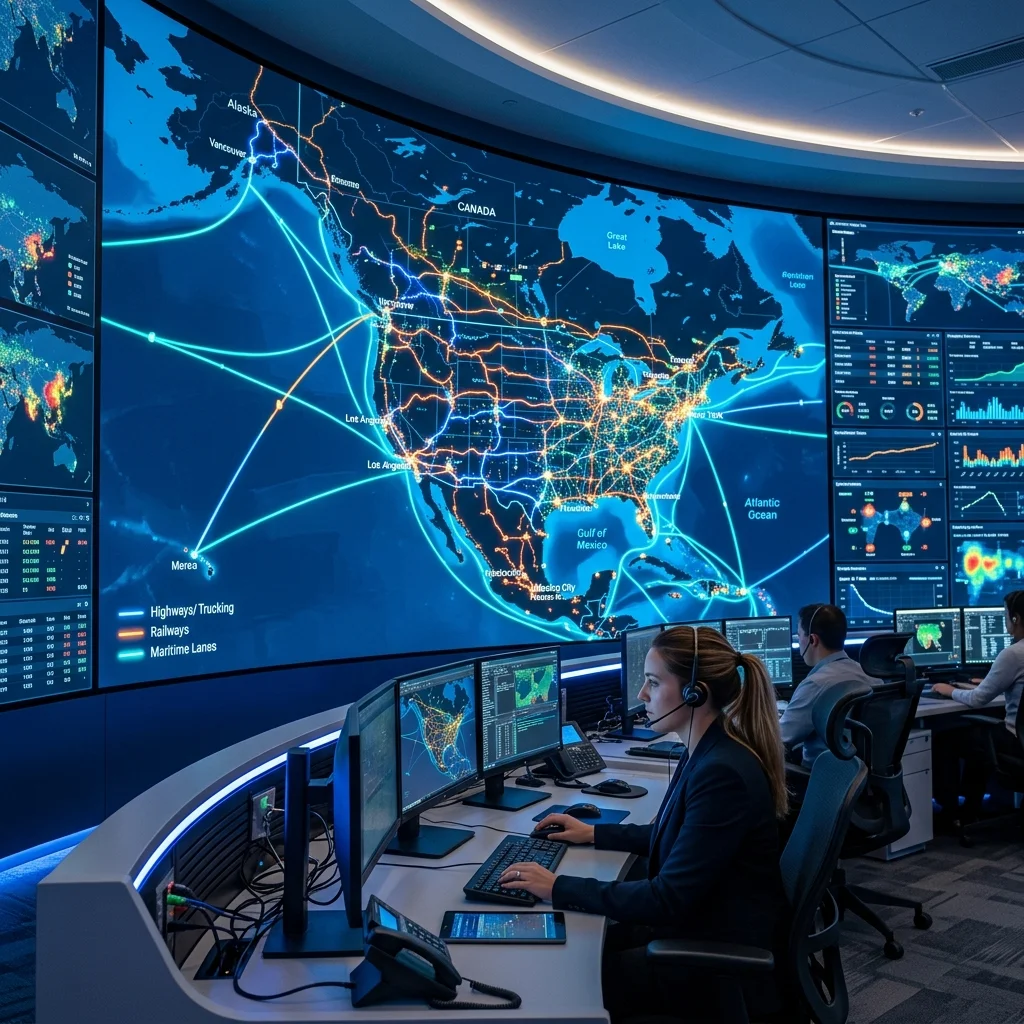
The Situation Room Experience represents a human-in-the-loop digital twin. It takes the predictive outputs from AI models, overlays them onto a real-time visualization of trade routes, and places decision-makers inside a simulated crisis. Participants adjust rerouting strategies, allocate buffer inventory, or authorize overtime—and see the consequences unfold in accelerated time. This bridges the gap between algorithmic suggestion and organizational action. The technology is not about replacing human judgment but about training it under controlled conditions, where mistakes cost nothing and learning is maximized.
---
The Simulation Advantage: Testing Resiliency Before Real Disasters Strike
Simulation exercises expose weaknesses that static analysis cannot detect. Three categories of vulnerabilities emerge repeatedly in such exercises:
- Single points of failure. The Detroit-Windsor tunnel and the Ambassador Bridge together handle nearly 25% of all trade between the U.S. and Canada. A simulation in which both are closed simultaneously—due to a cybersecurity incident or a civil protest—reveals that alternative routes via Sarnia or Buffalo can absorb only 40% of the volume. The result is a buildup of 8,000 trucks in a 48-hour period, snarling surface streets and overwhelming customs inspection capacity at secondary ports.
- Capacity crunches. Class I rail networks operate at near-total capacity during peak seasons. A simulation of a coordinated strike on the Union Pacific and BNSF lines demonstrates that even a 72-hour stoppage creates a 30-day backlog. The simulation forces participants to choose between diverting cargo to trucking (which faces its own driver shortages) or accepting demurrage charges at origin ports.
- Decision-making biases. Under time pressure, logistics managers tend to over-rely on habitual routes and familiar carriers. In a simulation of a hurricane shutting down Houston’s petrochemical complex, participants consistently underestimated the time required to reroute specialty chemicals through alternative rail terminals. This is a cognitive bias known as anchoring—the first available option becomes the mental default, even when it is suboptimal.
The Situation Room Experience systematically tests these vulnerabilities in a safe environment. Decision-makers emerge with a mental model of the system’s fragility that cannot be acquired from reading reports. They learn to recognize the early signs of a cascade failure and to act before the system locks up.
---
Conclusion: From Reactive Crisis Management to Proactive Resilience
The current approach to logistics risk is reactive. Companies build inventory buffers after a disruption, regulators tighten security procedures after a breach, and carriers shift capacity after a rate spike. This pattern is costly and inefficient. A more rational approach uses simulation to anticipate disruptions and pre-commit to adaptive strategies.
Industry trends point toward greater adoption of simulation-based planning. The U.S. Department of Transportation has funded pilot programs using digital twins for freight corridor analysis. Private logistics firms are investing in “war rooms” that combine live data feeds with scenario modeling. The Situation Room Experience, as a structured methodology, offers a template for how these investments should be designed.
In the next two to three years, the market for logistics simulation platforms is expected to grow at a compound annual rate of 12–15%, driven by increasing frequency of extreme weather events and geopolitical instability. Organizations that embed simulation exercises into their strategic planning cycles will develop a decisive advantage—not because they can predict the future, but because they have already rehearsed multiple futures. The trade routes of North America will always be subject to disruption. Resilience lies not in eliminating uncertainty, but in making it a known variable in the decision equation.
Trade Metrics
Related Datasets
Q4 Cross-Border Logistics Report
PDF • 4.2 MB
Automotive Parts Supply Chain Index
CSV • 1.1 MB