Navigating North American Trade: How Blue Chip Logistics Powers Cross-Border

Sarah Martinez
Logistics Correspondent
June 3, 2026
DATELINE: NA TRADE WIRE
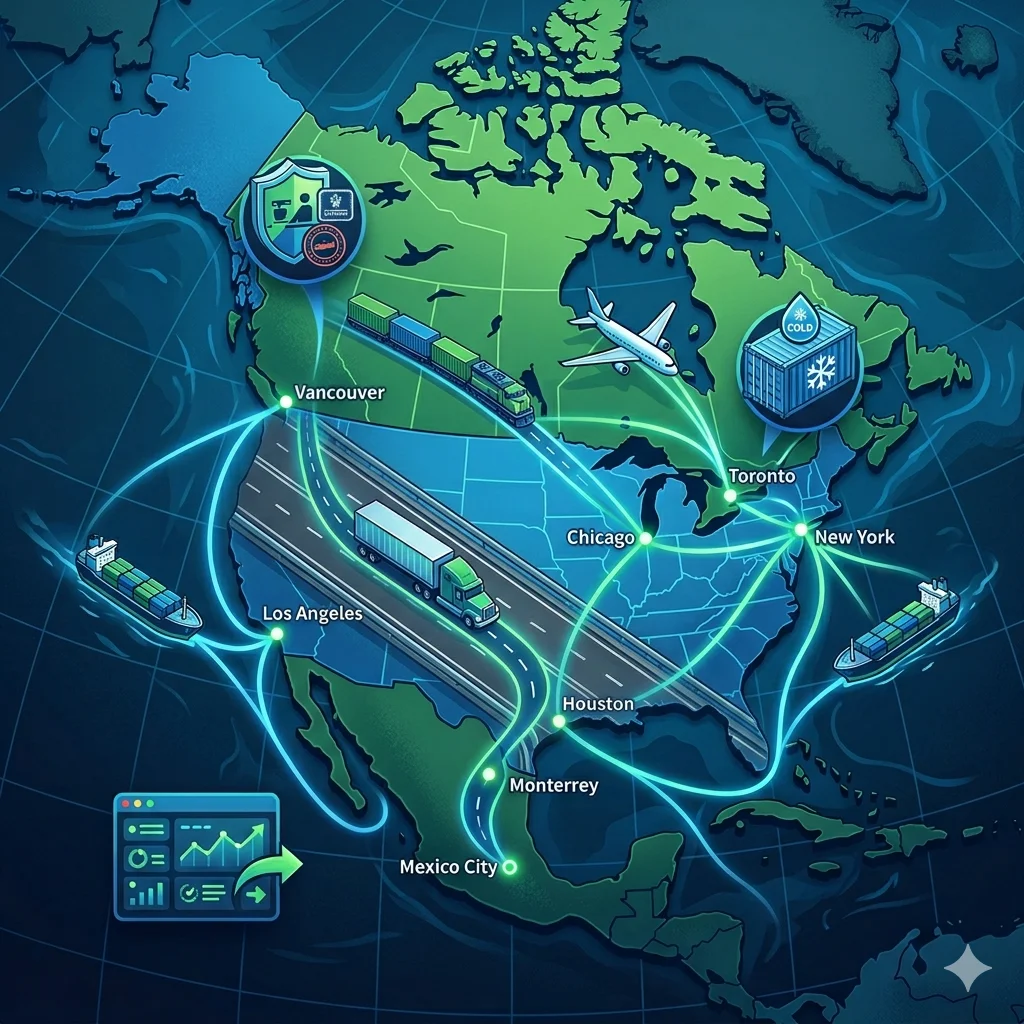
"This article explores the strategic role of Blue Chip Logistics in North"
How Blue Chip Logistics Navigates the New Geography of North American Trade
Nearshoring and USMCA-driven shifts are redefining cross-border supply chains. One logistics provider is building a multimodal, compliance-first backbone from Mexico to Canada.
Introduction: The New Geography of North American Trade
The post-pandemic reshoring wave is not a passing trend. According to the Reshoring Initiative, nearshoring and foreign direct investment into North America surged by over 50% in 2023 compared to pre-pandemic levels, driven by companies seeking supply chain resilience closer to end markets. At the same time, the United States-Mexico-Canada Agreement (USMCA) has reshaped tariff rules, origin requirements, and customs procedures, creating both opportunities and friction points for manufacturers, retailers, and distributors operating across the three nations.
Against this backdrop, cross-border logistics has evolved from a back-office function into a strategic differentiator. Companies that can move goods faster, with fewer border delays and greater visibility, are gaining competitive advantage. Blue Chip Logistics, a multimodal freight provider covering the entire North American corridor, has positioned itself at the center of this transformation. The company offers an integrated suite of services—from Full Truck Load (FTL) to intermodal, air, and ocean—across the United States, Canada, and Mexico.
But its real value, according to clients and internal operations managers, lies not in the breadth of modes alone. It is the combination of regulatory expertise, real-time tracking, and industry-specific specialization that enables Blue Chip to manage the hidden complexities of modern North America trade routes logistics.
[IMAGE: A low-angle photo of a Blue Chip Logistics truck driving across a border checkpoint with flags of US, Canada, Mexico.]
---
The Cross-Border Advantage: Customs, Compliance, and Speed
For any company shipping goods across international borders, customs compliance is the single largest source of risk. A misclassified tariff code, a missing certificate of origin, or a failure to meet USMCA rules of origin can result in weeks of delays, storage fees, or even cargo seizure. Blue Chip Logistics has built its cross-border freight services around deep expertise in these regulatory frameworks.
“We have a dedicated team that monitors changes in USMCA rules, country-specific labeling requirements, and even state-level phytosanitary restrictions,” says Emily C., Regional Operations Manager at Blue Chip Logistics. “That knowledge gets embedded into every shipment we plan. Our customers don’t need to hire a separate customs broker or worry about documentation gaps. It’s part of the service.”
This integrated compliance approach has direct operational consequences. Emily notes that in the past 18 months, “we have had zero instances where a shipment was delayed due to a customs error on our part.” That reliability is critical for industries like automotive manufacturing, where a single missing part can halt a production line costing thousands of dollars per minute.
The speed advantage extends beyond customs. Blue Chip offers expedited shipping options for time-sensitive cargo, including dedicated trucks with drivers who are cross-trained in border crossing procedures. These drivers carry pre-cleared documentation and use dedicated FAST lanes (Free and Secure Trade) for US-Canada crossings and the Nuevo Laredo-Colombia corridor for US-Mexico routes. The result is border clearance times that average 30–45 minutes, compared to industry norms of two to four hours.
As tariffs and trade rules continue to evolve—consider the recent US proposals to raise duties on Mexican-manufactured automotive parts—a single logistics partner that handles both transportation and compliance reduces risk for manufacturers. Blue Chip’s real-time tracking system not only shows the physical location of a shipment but also its customs status, alerting customers to any documentation issues before the truck even reaches the border.
[IMAGE: Dashboard showing a shipment crossing from US to Mexico with real-time customs status updates.]
---
Multimodal Mastery: Matching Mode to Mission
One of the defining characteristics of North America trade routes logistics is the sheer variety of transportation modes required. A single supply chain may use Full Truck Load (FTL) for high-volume, time-sensitive runs from Detroit to Monterrey, intermodal rail for cost-effective long-haul from Chicago to Los Angeles, air freight for emergency medical devices, and ocean containers for seasonal retail goods from Asian ports that dock in Vancouver or Manzanillo.
Blue Chip Logistics offers all of these modes under one umbrella. The company’s multimodal transportation approach allows clients to select the optimal balance of cost, speed, and reliability for each shipment. Below is a comparison of the primary modes and their typical applications across the US-Canada-Mexico corridor:
| Mode | Typical Transit (US–Mexico) | Best For |
|------|----------------------------|----------|
| FTL | 3–5 days | High-volume, just-in-time manufacturing |
| PTL (Partial Truck Load) | 4–6 days | Medium shipments sharing truck space |
| LTL (Less Than Truck Load) | 5–8 days | Low-volume, non-urgent goods |
| Intermodal (Rail + Truck) | 6–10 days | Long-haul, cost-sensitive, non-perishable |
| Air Freight | 1–2 days | Urgent parts, high-value electronics, pharma samples |
| Ocean (via LCL/FCL) | 10–20 days (port-to-port) | High-volume seasonal inventory from Asia |
The hidden economic logic here is that offering both truckload and intermodal under one roof reduces handoffs. Each time cargo changes hands between carriers, the risk of damage, delay, or misrouting increases. By controlling the full journey—whether via dedicated truck, rail carrier, or air cargo partner—Blue Chip maintains zero-damage reliability and a single point of accountability.
Consider an automotive just-in-time line: a Tier 1 supplier in Guadalajara needs to deliver brake assemblies to a Ford plant in Hermosillo every six hours. That requires FTL with dedicated equipment, GPS tracking, and guaranteed cross-border slots. For that same client’s less time-sensitive shipment of raw materials from a steel mill in Pennsylvania, intermodal rail is more cost-effective. Blue Chip handles both, with the same account manager and the same tracking portal.
For retail seasonal spikes, intermodal offers flexibility. A major big-box retailer moving Christmas inventory from distribution centers in Chicago to stores in Mexico City uses Blue Chip’s intermodal network to avoid peak-season truck capacity shortages. The rail portion handles the long haul; then local carrier partners complete the last-mile delivery.
[IMAGE: Infographic comparing FTL, LTL, Intermodal, Air, and Ocean with icons and typical transit times for a Canada–Mexico route.]
---
Industry Specialization: Tailored Solutions for Six Sectors
Not all cargo is created equal. Blue Chip Logistics serves six primary industries—retail, manufacturing, pharmaceuticals, automotive, technology, and agriculture—each with its own regulatory, temperature, and timing requirements. The company’s ability to tailor cross-border freight services to these specific verticals is a key differentiator.
- Agriculture and Food: Perishable goods require refrigerated trailers (reefers) with temperature monitoring. Blue Chip provides fleet-managed reefers for produce moving from the Central Valley of California to grocery distribution centers in Canada, and for avocados from Michoacán to US retail chains. Compliance with USDA and CFIA inspections is handled in advance.
- Pharmaceuticals: Cold chain integrity is non-negotiable. Blue Chip uses temperature-controlled containers with continuous monitoring and alarm systems for vaccines, biologics, and active pharmaceutical ingredients. Shipments crossing US-Mexico or US-Canada borders are pre-cleared with health authority documentation.
- Automotive: Just-in-time and just-in-sequence manufacturing demands precision. Blue Chip’s automotive team coordinates dedicated FTL runs between assembly plants and supplier parks in the Midwest, Mexico’s Bajío region, and Ontario. The company also handles cross-border movements for aftermarket parts via LTL.
- Technology and Electronics: High-value goods like servers, semiconductors, and consumer electronics require tamper-evident seals, GPS tracking, and extra security. Blue Chip offers enhanced liability coverage and priority lane access for these shipments.
- Retail and Consumer Goods: Seasonal peaks, promotional launches, and store replenishment require flexible capacity. Blue Chip uses a combination of FTL, intermodal, and consolidation services to manage these fluctuating volumes.
- Manufacturing and Industrial: Heavy machinery, steel coils, and construction materials require specialized handling and permits. Blue Chip’s flatbed and heavy-haul divisions operate across all three countries with oversize load permits pre-arranged.
The hidden economic logic is that each industry has unique regulatory, packaging, and scheduling requirements. A generalist logistics provider may offer low rates but lacks the expertise to avoid costly errors. Blue Chip’s specialization allows it to charge a premium for reliability, but clients report that total landed costs are often lower due to reduced damage, fewer delays, and lower inventory carrying costs.
[IMAGE: Split-screen photos showing refrigerated trucks for agriculture, a temperature-monitored pharma shipment, and automotive parts loaded in a dock.]
---
Real-Time Visibility: From Tracking to Trust
In an era where supply chain transparency is expected, not optional, Blue Chip’s real-time tracking system stands out. The company provides a dashboard that shows not just GPS location of trucks, but also temperature data for reefers, customs status, estimated time of arrival, and proof-of-delivery documents.
This visibility allows customers to plan production, adjust inventory, and communicate with their own customers proactively. “Our clients can see exactly when a shipment will clear customs, and they can share that information with their plant managers or store receivers,” says Emily C. “It eliminates the phone calls asking ‘Where’s my truck?’”
The tracking system integrates with major ERP platforms, including SAP, Oracle, and Microsoft Dynamics, enabling automated notifications and exception alerts. If a border crossing is delayed due to an inspection, the system automatically recalculates the ETA and notifies the client.
Real-time data also feeds Blue Chip’s own operations. Dispatchers can reroute trucks around congestion, adjust driver schedules, and optimize load consolidation based on live conditions. This operational agility is especially valuable in the USMCA supply chain environment, where shifting trade flows and labor shortages can create sudden capacity constraints.
[IMAGE: Screenshot of a logistics dashboard showing a map of North America with shipment routes, temperature readings, and customs status indicators.]
---
The Future of North American Trade Logistics
As nearshoring continues to accelerate—the US has added over 700,000 manufacturing jobs since 2021, according to the Bureau of Labor Statistics—the demand for seamless cross-border logistics will only grow. Companies that once relied on a patchwork of regional carriers and customs brokers are now seeking integrated partners that can provide end-to-end solutions.
Blue Chip Logistics is betting that its multimodal, compliance-first, and industry-specialized approach will define the next generation of North America trade routes logistics. The company is expanding its cross-dock facilities in Laredo, Texas, and at the Blue Water Bridge in Port Huron, Michigan, to handle growing volumes from nearshoring clients. It is also investing in predictive analytics to anticipate border wait times and proactively reroute shipments.
“The companies that win in this market will be those that treat logistics as a competitive advantage, not just a cost center,” Emily concludes. “We see ourselves as the infrastructure that enables that advantage—moving goods faster, more reliably, and with fewer headaches, across the entire continent.”
For manufacturers, retailers, and distributors navigating the shifting geography of North American trade, that promise of precision and partnership may prove essential.
Trade Metrics
Related Datasets
Q4 Cross-Border Logistics Report
PDF • 4.2 MB
Automotive Parts Supply Chain Index
CSV • 1.1 MB