Greening the Gridlock: Environmental Costs and Mitigation Strategies for North

Sarah Martinez
Logistics Correspondent
April 29, 2026
DATELINE: NA TRADE WIRE
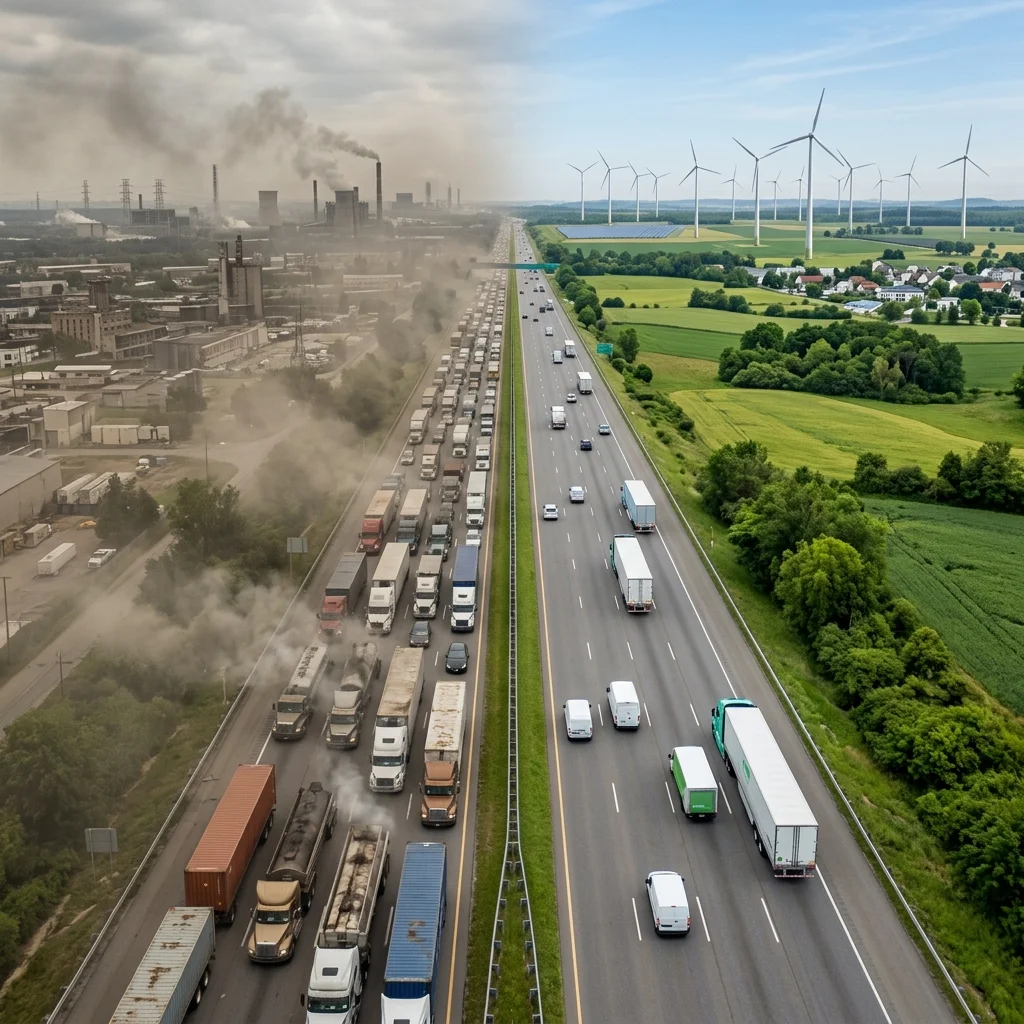
"This article explores the hidden environmental toll of North America’s primary"
Greening the Gridlock: Environmental Costs and Mitigation Strategies for North American Trade Corridors
1. The Hidden Axis of North American Trade
The United States-Mexico-Canada Agreement (USMCA) governs a trilateral trading relationship that moves billions of tons of freight annually across the continent's primary transportation arteries. Highway 401 in Ontario, Interstate 35 from Texas to Minnesota, and the Canadian Pacific Kansas City (CPKC) rail line form the structural backbone of this logistics network. These corridors enable just-in-time manufacturing, agricultural exports, and cross-border supply chains that represent approximately $1.8 trillion in annual trilateral trade flows.
The Commission for Environmental Cooperation (CEC), a trilateral organization established under the environmental side agreement to NAFTA, published a 101-page, peer-reviewed assessment titled "North American Trade and Transportation Corridors: Environmental Impacts and Mitigation Strategies" (Source 1: CEC Primary Report). This document provides the most comprehensive empirical analysis available on the environmental externalities generated by freight movement across the continent.
The central tension is structural: trade corridors function as arteries of economic prosperity while simultaneously generating measurable environmental degradation. Freight transportation accounts for approximately 7% of total North American greenhouse gas emissions, with diesel-powered trucking contributing the largest share. The CEC report quantifies not only carbon dioxide emissions but also nitrogen oxides (NOx), particulate matter (PM2.5), sulfur oxides, and volatile organic compounds—each with distinct health and ecological consequences.
2. Beyond Tailpipes: The Full Environmental Footprint
The CEC report establishes emission inventories across three freight modes: heavy-duty trucking, Class I rail operations, and maritime shipping through major ports including Los Angeles/Long Beach, Vancouver, and Veracruz. Diesel trucking produces approximately 80-90 grams of CO₂ per ton-mile, depending on load factors and terrain, while rail generates 20-30 grams per ton-mile (Source 1: CEC Report Section 3.2). Maritime shipping, despite using lower-grade bunker fuel, achieves approximately 10-15 grams per ton-mile due to economies of scale.
These direct emission metrics, however, capture only a portion of the total environmental burden. The CEC assessment identifies three categories of indirect ecological disruption:
Habitat Fragmentation: Major highway corridors create physical barriers that bisect wildlife migration routes. The I-35 corridor, which runs through the Edwards Plateau and Great Plains ecoregions, interrupts movement patterns for pronghorn antelope, mule deer, and several endangered bird species. Rail corridors compound this effect, with the CPKC mainline through Alberta and Saskatchewan intersecting critical caribou habitat zones.
Waterway Contamination: Road salt application across northern corridor segments—particularly Highway 401 and I-94 through Michigan—generates chloride runoff that elevates salinity in adjacent freshwater ecosystems. The CEC report documents chloride concentrations exceeding 250 mg/L in tributaries along these corridors, a threshold at which freshwater macroinvertebrate diversity declines measurably.
Noise and Light Pollution: Continuous freight movement along high-volume corridors generates ambient noise levels above 60 decibels for up to 1 kilometer from the roadway, disrupting avian breeding patterns and predator-prey dynamics. Light pollution from port facilities and border inspection stations alters nocturnal insect behavior and migration timing for songbirds.
The comparative emissions analysis reveals a critical trajectory: current diesel trucking generates 3-4 times the emissions per ton-mile of rail transport, but the shift toward battery-electric trucking reduces this differential significantly. Projected electric truck emissions, accounting for grid electricity generation sources, range from 15-30 grams per ton-mile—comparable to rail and potentially lower if charging infrastructure is powered by renewable energy (Source 1: CEC Report Appendix C).
3. Mitigation Strategy 1: Electrification and Alternative Fuels
The CEC report identifies fleet electrification as the single most impactful mitigation lever available to North American logistics operators. Battery-electric heavy-duty trucks, including the Tesla Semi and Nikola Tre, demonstrate energy consumption rates of 1.5-2.5 kWh per mile under loaded conditions. Assuming an average North American grid carbon intensity of 0.4 kg CO₂ per kWh, this translates to approximately 20-30 grams of CO₂ per ton-mile—a 60-75% reduction compared to diesel baseline.
Hydrogen fuel-cell technology presents an alternative pathway for long-haul rail and maritime applications where battery weight and charging time create operational constraints. The CEC report references pilot projects along the I-5 corridor in California and Highway 401 in Ontario, where centralized hydrogen production facilities are being co-located with existing refueling stations.
The primary bottleneck for electrification is grid capacity at major border crossings. The Laredo, Texas crossing—the busiest inland port of entry in North America, processing over 2.5 million trucks annually—would require approximately 200 megawatts of additional charging capacity to support full fleet electrification. Similarly, the Buffalo-Fort Erie crossing requires infrastructure upgrades that cross jurisdictional boundaries between Ontario's Independent Electricity System Operator and New York's ISO (Source 1: CEC Report Section 4.2).
Cross-border coordination on charging infrastructure investment remains incomplete. The CEC report recommends a harmonized permitting framework for high-voltage interconnection at bilateral border crossings, combined with standardized connector types and payment systems that allow seamless cross-border charging.
4. Mitigation Strategy 2: Smart Routing and Digital Twins
Artificial intelligence-driven logistics optimization represents a lower-capital, faster-implementation mitigation strategy compared to fleet electrification. The CEC report evaluates deployment of digital twin technology—real-time digital replicas of physical logistics networks—that simulate traffic conditions, emissions output, and fuel consumption across multiple routing scenarios.
Empirical results from pilot deployments demonstrate that AI-optimized routing reduces empty miles by 12-18%, a critical metric given that approximately 20-25% of all truck miles traveled in North America are empty (deadhead) miles. Combined with congestion-aware routing that avoids idling at border crossings, total fuel consumption reductions of 15-30% are attainable (Source 1: CEC Report Section 4.4).
Logistics-as-a-service platforms such as Project44 and FourKites provide the underlying data infrastructure for these optimizations. These systems aggregate real-time GPS tracking, customs clearance status, and traffic data to generate dynamic routing recommendations that minimize both transit time and fuel consumption. The CEC report notes that adoption rates remain below 30% among small and mid-size carriers, indicating significant untapped mitigation potential.
Digital twin applications extend beyond individual carrier optimization to corridor-wide management. Border crossing authorities in Detroit-Windsor and San Diego-Tijuana are testing digital twin simulations that predict congestion patterns 24-72 hours in advance, enabling preemptive rerouting of freight to less congested crossing points.
5. Mitigation Strategy 3: Green Infrastructure and Modal Shift
The CEC report evaluates three categories of green infrastructure investments that alter the physical characteristics of trade corridors to reduce environmental impact:
Wildlife Crossings: Overpasses and underpasses designed to maintain habitat connectivity across highway corridors. Research cited in the report indicates that properly designed wildlife crossings reduce vehicle-animal collisions by 80-95%, with corresponding reductions in human fatalities and property damage. The Trans-Canada Highway through Banff National Park serves as a benchmark, with 44 crossings installed and documented 250,000 animal passages annually.
Natural Infrastructure: Restoration of wetlands and riparian buffers along corridor-adjacent waterways to filter runoff and reduce erosion. The CEC report identifies 47 high-priority sites along the I-35 and Highway 401 corridors where wetland restoration could capture road salt runoff before it reaches major watersheds.
Modal Shift Infrastructure: Investments in rail intermodal facilities, short-sea shipping terminals, and last-mile delivery consolidation centers that enable transfer of freight from high-emission trucking to lower-emission rail or maritime modes. The report calculates that shifting 10% of long-haul truck freight to rail would reduce corridor-level emissions by approximately 4-6 million metric tons of CO₂ annually (Source 1: CEC Report Section 5.1).
The economic case for green infrastructure investments improves when accounting for avoided damages. The CEC report monetizes environmental externalities at approximately $0.05-0.08 per ton-mile for diesel trucking, including health costs from air pollution, climate damages, and ecosystem degradation. These costs, when internalized through carbon pricing mechanisms, improve the return on investment for mitigation infrastructure.
6. Policy Instruments: Carbon Pricing and Cross-Border Coordination
The CEC report presents a framework for evaluating policy instruments that could accelerate mitigation adoption. Three mechanisms receive detailed analysis:
Harmonized Carbon Pricing: Current carbon pricing mechanisms across North America are fragmented. Canada maintains a federal carbon price of $80 CAD per ton (2024), while Mexico operates no national carbon pricing system. The United States has no federal carbon price, though California's cap-and-trade system prices carbon at approximately $40 USD per ton. This differential creates a regulatory arbitrage opportunity that undermines investment in mitigation.
Emissions Intensity Standards: Mode-specific emissions intensity standards, similar to California's Advanced Clean Trucks regulation, create binding requirements for manufacturers. The CEC report models a scenario in which all three jurisdictions adopt harmonized standards requiring 30% reduction in per-ton-mile emissions by 2030, finding this achievable through existing technology pathways.
Border Infrastructure Performance Metrics: The report recommends establishing measurable performance standards for border crossing facilities, including maximum idling times, emissions monitoring requirements, and minimum charging infrastructure deployment (Source 1: CEC Report Section 6.3).
The political feasibility of coordinated policy implementation remains uncertain. The CEC's trilateral mandate provides a forum for technical coordination but lacks enforcement authority. Member states retain sovereign control over transportation policy, creating risk of asymmetric adoption.
7. Climate Risk and Supply Chain Resilience
The CEC report extends beyond conventional mitigation analysis to assess climate disruption risks to corridor infrastructure. Three exposure categories emerge:
Heat-Related Infrastructure Degradation: Extreme heat events warp rail lines, soften asphalt pavement, and reduce truck cooling system efficiency. The I-35 corridor, projected to experience 30-60 additional days above 100°F annually by 2050, faces increased maintenance costs and capacity reductions during heat events.
Flooding and Storm Surge: Port facilities in Houston, New Orleans, and Veracruz face direct exposure to hurricane intensification and sea-level rise. Hurricane Harvey (2017) caused $125 billion in damages across the Texas Gulf Coast corridor, with freight operations disrupted for 14-21 days.
Wildfire-Related Disruptions: The CPKC rail corridor through British Columbia experienced 17 fire-related service interruptions between 2018 and 2023, with cumulative economic losses exceeding $500 million in delayed shipments.
These climate risks create a feedback loop: mitigation investments that reduce emissions also reduce the magnitude of future climate disruption, while adaptation investments protect corridor functionality against already-committed climate changes. The CEC report recommends integrated planning that treats mitigation and adaptation as complementary rather than competing priorities.
8. Market and Policy Trajectories
The evidence base assembled in the CEC report supports several forward-looking conclusions regarding the evolution of North American trade corridor management:
Electrification acceleration is constrained by grid infrastructure, not vehicle technology. The 200+ megawatt charging requirements at major border crossings imply capital investments of $400-800 million per site for transformer capacity, distribution lines, and charging hardware. These investments face regulatory approval timelines of 3-5 years, creating a multi-year lag between vehicle availability and charging availability.
Digital optimization will precede electrification in adoption timelines. The lower capital requirements and faster implementation of AI routing systems mean that 15-20% emissions reductions are achievable within 2-3 years for carriers that adopt these technologies, compared to 5-7 years for fleet electrification at scale.
Carbon pricing divergence between jurisdictions creates competitive pressure. Carriers operating across borders will face increasingly different cost structures depending on routing choices, potentially shifting freight volumes toward corridors with lower regulatory costs.
Private-sector logistics platforms will drive data standardization faster than public-sector regulation. The competitive dynamics among Project44, FourKites, and similar providers create market incentives for data interoperability that exceed government mandates.
The CEC report establishes a baseline assessment that will require regular updating as technology costs decline and climate impacts intensify. The fundamental finding remains: North American trade corridors generate measurable environmental externalities that are addressable through a combination of electrification, digital optimization, and infrastructure investment, but the coordination challenges across three sovereign jurisdictions and multiple regulatory frameworks create implementation timelines that extend beyond market-driven adoption cycles.
Trade Metrics
Related Datasets
Q4 Cross-Border Logistics Report
PDF • 4.2 MB
Automotive Parts Supply Chain Index
CSV • 1.1 MB