The North American Trade Corridor: How Nearshoring is Reshaping Logistics

Sarah Martinez
Logistics Correspondent
April 28, 2026
DATELINE: NA TRADE WIRE
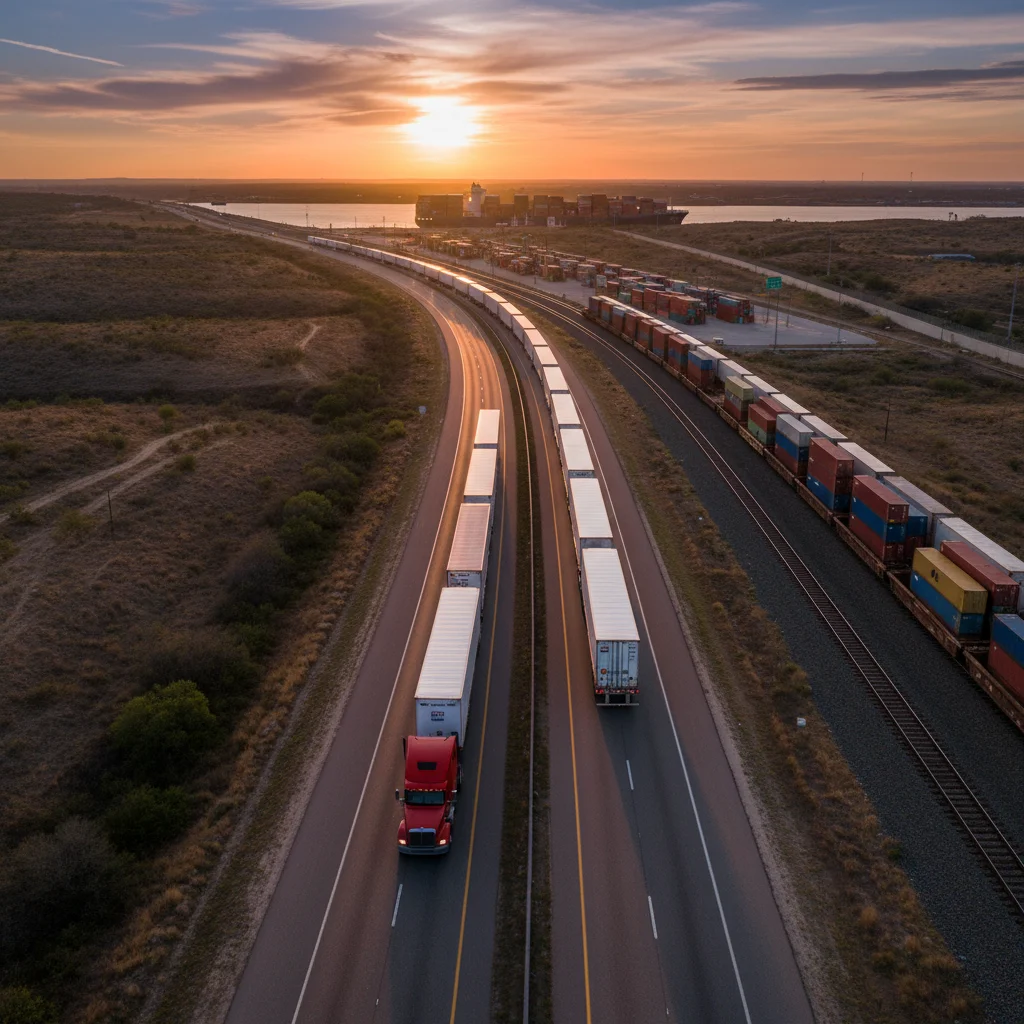
"The North American Trade Corridor, anchored by the I-35 highway, is experiencing"
The North American Trade Corridor: How Nearshoring is Reshaping Logistics on the I-35 Spine
By a Senior Technical/Financial Audit Journalist
---
Introduction: The Rebalancing of a Continent's Trade Spine
In 2023, combined U.S. trade with Canada and Mexico reached $1.57 trillion in freight flows, representing 30.8% of total U.S. international trade (Source 1: U.S. Bureau of Transportation Statistics). This figure, while nominally flat against 2022, masks a profound structural reorientation beneath the surface. The I-35 Corridor—the physical backbone connecting Winnipeg to Mexico City—is undergoing a transformation driven not by volume expansion but by supply chain re-sorting.
The critical divergence: U.S.-Mexico freight rose 2.5% to $798.8 billion, while U.S.-Canada freight declined 2.4% to $773.9 billion (Source 1: Primary Data). This asymmetry signals that nearshoring is not merely rerouting existing trade volumes; it is fundamentally altering modal preferences, inventory strategies, and infrastructure utilization patterns across the continent.
---
The Modal Shift: Why Trucking Is Winning the Nearshoring Race
Trucking dominated cross-border freight in 2023, handling 60.1% of U.S.-Canada flows and 72.2% of U.S.-Mexico flows, moving $996.4 billion in total freight value—a 5.1% year-over-year increase (Source 1: Bureau of Transportation Statistics). Rail, by contrast, stagnated at $209.2 billion, declining 0.5% despite its traditional advantage in heavy bulk commodities.
The nearshoring thesis explains this divergence. As manufacturing relocates from Asia to Mexico, supply chains are being redesigned for responsiveness rather than scale. Consumer goods, automotive components, and electronics—the core of nearshored production—require smaller batch sizes, faster transit times, and flexible routing. Trucking, with its ability to offer door-to-door service and adjust capacity hourly, matches these requirements more precisely than rail's fixed schedules and terminal-based operations.
The pandemic recovery data confirms the trucking acceleration. From April 2020 troughs to December 2023, monthly truck freight with Canada nearly doubled from $17.8 billion to $32.1 billion. With Mexico, the expansion was even sharper: from $20.8 billion to $41.1 billion (Source 1: U.S. Bureau of Transportation Statistics Monthly Data). This represents a compound monthly growth rate that significantly outpaces GDP growth, indicating a modal conversion, not merely cyclical recovery.
Rail's stagnation is structural. While rail remains cost-effective for heavy commodities like grain, minerals, and bulk chemicals, it cannot easily capture the high-value, time-sensitive manufactured goods that nearshoring generates. The corridor's freight composition is shifting toward precisely the categories where trucking holds an inherent advantage.
---
Mexico's Rise as Top Trade Partner: A Structural Shift, Not a Blip
Mexico's overtaking of China as the top U.S. trade partner represents a milestone with permanent implications for corridor dynamics. In 2023, U.S.-Mexico freight reached $798.8 billion, while U.S.-Canada trade fell to $773.9 billion—a reversal of the historical pattern where Canada held the top position (Source 1: Primary Data).
The drivers are corporate derisking strategies, not temporary tariff arbitrage. Emilio Cadena, CEO of Prodensa, has described how "derisking" is driving plant relocations closer to the U.S. border, particularly in the automotive, electronics, and medical device sectors (Source 2: Industry Expert Commentary). These are industries with long lead times and high inventory costs, making geographic proximity operationally valuable beyond labor cost differentials.
This reverses a decades-long pattern of supply chain lengthening. From the 1990s through the 2010s, U.S. manufacturers consistently sought lower-cost production further afield. The nearshoring trend represents a shortening of supply chains, not merely a lateral shift. Mexico's advantage lies in its ability to serve as a manufacturing platform within the USMCA framework while maintaining truck-accessible logistics corridors that can deliver goods to U.S. markets within 24–48 hours.
The $1.57 trillion trade flow is now bifurcated: Canadian trade is mature and commodity-driven, Mexican trade is growing and manufacturing-intensive. This compositional difference explains why modal preferences diverge between the two borders.
---
Infrastructure Under Pressure: The I-35 Corridor's 1937 Vision Meets 2024 Demand
The NAFTA Superhighway concept—now the I-35 Corridor—was first proposed in 1937 as an alternative to railroad infrastructure (Source 3: Historical Infrastructure Records). This origin is ironic given rail's current underperformance relative to trucking on the same route. Mexico completed its portion from Laredo to Mexico City first among pact countries, demonstrating early recognition of the corridor's strategic importance.
Today, that 1937 vision is being stress-tested by 21st-century demand. The corridor currently facilitates approximately $3 billion in daily cross-border trade, supporting over $1 trillion in annual freight flows (Source 1: Primary Data). This volume was unimaginable at the corridor's inception and places extraordinary pressure on border inspection facilities, highway capacity, and last-mile logistics networks.
The I-35 corridor's infrastructure challenges are threefold. First, border crossing capacity at Laredo—the busiest inland port—is nearing saturation, with inspection times extending as trade volumes compound. Second, highway segments through Texas and Oklahoma require expansion to accommodate the 72.2% of Mexico-bound freight that moves by truck. Third, the corridor's original design as a rail alternative now must serve a truck-dominated freight mix for which it was not optimized.
Robin Conklen, a senior transportation analyst, has noted that corridor infrastructure planning remains calibrated to 1990s trade patterns, creating a mismatch between current demand and systemic capacity (Source 2: Industry Expert Commentary). The infrastructure gap is most acute at the border, where physical inspection infrastructure cannot scale as quickly as trade volumes.
---
The Canada-Mexico Asymmetry: Trade Volume Shifts and Logistics Implications
The divergent performance of U.S.-Canada versus U.S.-Mexico trade reveals deeper supply chain reconfiguration. Canadian trade declined 2.4% in 2023 while Mexican trade grew 2.5%—a spread of nearly 5 percentage points (Source 1: Primary Data). This is not a one-year anomaly; it reflects a multi-year trend as manufacturers relocate production from Canada and Asia to Mexico simultaneously.
For logistics providers, this asymmetry creates capacity allocation challenges. Trucking assets dedicated to the Canada corridor face declining utilization, while Mexico-bound capacity is strained. The modal implications are equally asymmetric: Canada's trade mix—heavier in energy, minerals, and forest products—remains more rail-compatible, while Mexico's manufacturing-driven trade favors trucks.
The corridor now functions as a two-speed system. The northern segment (Canada–U.S.) is mature, stable, and rail-oriented. The southern segment (U.S.–Mexico) is dynamic, growing, and truck-dependent. This creates a logistics bifurcation where infrastructure investment priorities diverge by region.
---
Market Predictions: The Corridor's Next Five Years
Based on current trajectory, five structural predictions emerge:
First, trucking's share of cross-border freight will continue to expand, likely reaching 75% of Mexico flows and 65% of Canada flows by 2028. Rail will maintain its position in bulk commodities but will lose share in manufactured goods as nearshoring deepens.
Second, U.S.-Mexico trade will surpass $900 billion by 2026, widening the gap with U.S.-Canada trade. This will make Mexico the permanent top U.S. trade partner, fundamentally reorienting corridor planning priorities.
Third, border infrastructure investment will become a binding constraint. Without significant expansion of inspection capacity at Laredo, El Paso, and other Texas ports, truck transit times will increase, potentially eroding the time-to-market advantage that drives nearshoring.
Fourth, the 1937 I-35 corridor vision will require rethinking. The corridor's original rail-alternative logic is obsolete; the current reality demands truck-optimized infrastructure, including dedicated truck lanes, expanded rest areas, and digitized border clearance systems.
Fifth, modal competition will intensify. Rail operators may respond by offering shorter trains, faster transit, and more flexible scheduling to recapture manufactured goods traffic. The corridor will become a testing ground for intermodal innovation as trucking and rail vie for the nearshoring premium.
The North American Trade Corridor is not merely growing—it is being restructured by distance, cost, and risk tolerance. The I-35 spine, conceived in an era of rail dominance and designed for a different trade geography, now operates under a new logistics regime. The $1.57 trillion question is whether infrastructure can adapt before capacity constraints begin to constrain the nearshoring momentum itself.
Trade Metrics
Related Datasets
Q4 Cross-Border Logistics Report
PDF • 4.2 MB
Automotive Parts Supply Chain Index
CSV • 1.1 MB