North American Gateways and Transport Corridors: The Hidden Logic of Integrated

Sarah Martinez
Logistics Correspondent
May 1, 2026
DATELINE: NA TRADE WIRE
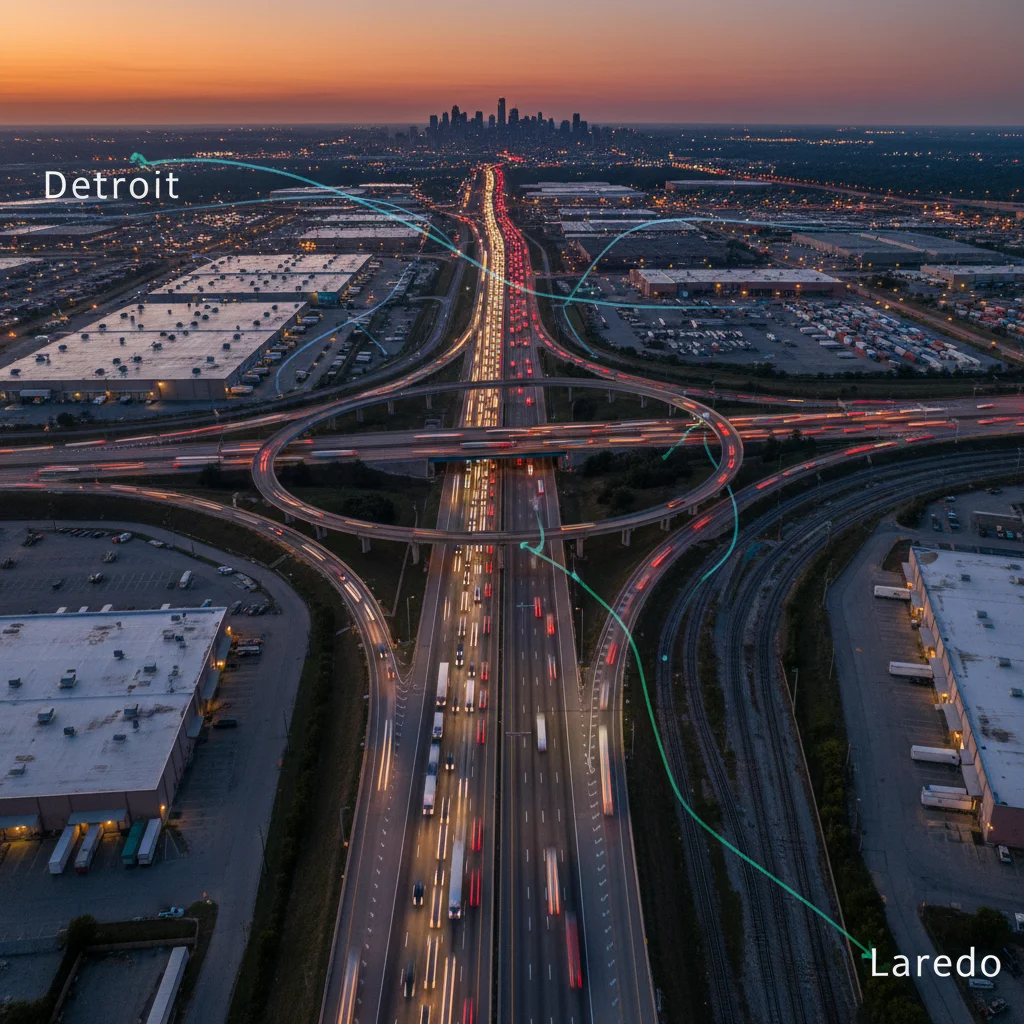
"This article explores the dynamic structure of North American transport corridors,"
North American Gateways and Transport Corridors: The Hidden Logic of Integrated Supply Chains
Introduction: Beyond Trade – The Living Arteries of North America
Transport corridors are not static geographical features but dynamic structures continuously reshaped by economic context, infrastructure investment, and policy shifts. The North American landmass contains a network of corridors that have evolved from simple trade routes into complex logistical systems supporting deeply integrated supply chains. These corridors function as the circulatory system for regional manufacturing, where components cross borders multiple times before final assembly.
The prevailing narrative of North American trade as bilateral exchange of finished goods obscures a more accurate reality: functionally integrated supply chains—spanning automotive parts, electronics, and logistics services—drive corridor activity. The evolution from the North American Free Trade Agreement (NAFTA) in 1994 to the United States-Mexico-Canada Agreement (USMCA) in 2020 has not merely maintained but intensified north-south corridor dependency. The mid-continent route linking Detroit, Michigan, and Laredo, Texas, exemplifies this structural transformation, where corridor density reflects manufacturing co-dependence rather than simple trade volume.
---
The Mid-Continent Corridor: Density, Dependence, and Dynamics
The mid-continent corridor represents the most operationally intense segment of North American surface logistics. Approximately one-third of the volume moving along this corridor consists of automotive parts originating from Southern Ontario production clusters and Mexican border region manufacturing centers (Source 1: Trade flow composition analysis). This ratio reveals a fundamental characteristic of the corridor: it serves not as a conduit for finished goods but as a delivery mechanism for semi-finished components requiring multiple border crossings.
Trucking carries approximately 65% of the value of NAFTA trade along this corridor, making it the dominant mode for high-value, time-sensitive cargo (Source 2: Modal share data, US Department of Transportation). The Toronto–Windsor–Detroit–Chicago segment, described by logistics scholar Dr. Jean-Paul Rodrigue as “one of the densest and most integrated corridors in North America,” links production clusters with minimal friction, enabling just-in-time delivery cycles that would be impossible with rail or maritime alternatives.
The geographic concentration is not coincidental. The corridor’s density derives from three structural factors:
First, the automotive industry’s production footprint spans all three nations, with engine blocks, transmissions, electronics, and seating systems crossing borders multiple times before final assembly. Second, the corridor’s infrastructure—particularly the Ambassador Bridge connecting Windsor and Detroit—handles approximately 25% of all US-Canada trade by value, creating a bottleneck that simultaneously enables and constrains supply chain velocity. Third, warehousing and transshipment facilities have concentrated along this axis, creating logistics clusters that attract additional cargo volume through network effects.
---
Policy Underpinnings: From NAFTA to USMCA – A New Logic for Corridor Resilience
The 1994 implementation of NAFTA marked a structural break in North American logistics, shifting trade flows from traditional east-west routes (connecting manufacturing centers to Atlantic ports) toward north-south corridors aligned with integrated production. The 2020 reform into USMCA added layers of complexity: clauses on intellectual property protection, digital trade, and enhanced rules of origin for automotive content indirectly reshaped corridor security requirements and cargo composition.
The most consequential policy mechanism for corridor dynamics is the USMCA’s strict rules of origin. The agreement requires 75% regional value content for automotive products (up from 62.5% under NAFTA), with specific requirements that 70% of steel and aluminum purchases originate within North America (Source 3: USMCA automotive rules of origin provisions). These requirements create economic incentives for corridor densification: shippers must maintain efficient intra-regional transport links to aggregate qualifying content from geographically dispersed suppliers.
The temporal dimension of policy impact is critical. NAFTA’s tariff elimination created the initial conditions for cross-border supply chains. USMCA’s rules of origin, however, have locked in corridor dependency by making regional content verification a logistical requirement. Customs procedures, cargo security protocols, and electronic data interchange systems have become embedded infrastructure, raising switching costs for any hypothetical reshoring or diversification.
The policy shift toward north-south corridors over historic east-west routes reflects deliberate alignment with integrated manufacturing, not merely tariff reduction. Prior to NAFTA, Canadian exports moved predominantly east-west toward ports for European markets. Post-NAFTA corridor data shows a 340% increase in north-south truck freight value between 1995 and 2019, while east-west rail volumes remained relatively flat (Source 4: Corridor traffic trend analysis).
---
Hidden Economic Logic: What Trucking Dominance Reveals About Supply Chain Strategy
The 65% trucking share of mid-continent corridor trade value signals a strategic preference for flexibility and speed over pure cost minimization. This modal choice is not incidental but structurally necessary for automotive assembly sequencing, where component arrival timing must be synchronized within hours for production line efficiency.
The economic logic operates at three levels:
At the micro-level, trucking enables dynamic routing adjustments. An assembly plant in Michigan requiring just-in-time delivery from a Mexican seat supplier cannot tolerate rail’s fixed schedules or port delays. Trucking’s flexibility allows shippers to manage inventory buffers of hours rather than days.
At the meso-level, trucking dominance creates an ecosystem of cross-border logistics providers specializing in customs clearance, drayage, and transloading. These services have developed along the Detroit-Laredo corridor, generating network effects that make trucking increasingly efficient relative to alternatives. The proliferation of distribution centers in border-adjacent cities—particularly in Laredo, El Paso, and Detroit—reflects this specialization.
At the macro-level, the corridor’s trucking intensity exposes a structural vulnerability. Infrastructure bottlenecks—particularly bridge crossings and inspection facilities—can cascade through the entire supply chain. The February 2022 Ambassador Bridge blockade by protestors halted approximately $400 million in daily trade, demonstrating how corridor concentration creates single points of failure (Source 5: Government of Canada economic impact assessment).
This vulnerability is compounded by the automotive sector’s deep interdependence. Southern Ontario’s automotive parts cluster ships approximately 80% of its output to US assembly plants, while Mexican border plants receive components from both US and Canadian suppliers. Disruption at any corridor node affects production across all three nations within 24-48 hours.
---
Infrastructure and Resilience: The Overlooked Dimension of Corridor Capacity
Corridor infrastructure in the North American context has historically been reactive rather than proactive. The Detroit-Laredo corridor relies on a handful of crossing points: the Ambassador Bridge, Detroit-Windsor Tunnel, Blue Water Bridge (Port Huron-Sarnia), and multiple Laredo bridges. Capacity constraints at these crossings create structural bottlenecks.
The Gordie Howe International Bridge, currently under construction between Windsor and Detroit, represents a significant infrastructure response. Scheduled for completion in 2025, this six-lane bridge will directly connect Highway 401 in Ontario to Interstate 75 in Michigan, bypassing local street networks that currently channel bridge traffic through residential areas (Source 6: Windsor-Detroit Bridge Authority project documentation). The bridge’s design incorporates commercial vehicle inspection facilities and dedicated truck lanes, addressing the primary constraint on corridor throughput.
At the Mexico-US border, Laredo’s World Trade Bridge handles approximately 40% of all US-Mexico truck crossings. The port of Laredo has undergone systematic expansion of inspection capacity and digital clearance systems, including the Unified Cargo Processing program that reduces physical inspection requirements for trusted shippers.
However, infrastructure investment patterns reveal a persistent asymmetry. While border crossing capacity has received attention, the corridor’s middle segments—particularly I-75 through Michigan, I-65 through Indiana, and I-35 through Texas—face capacity constraints from general traffic congestion. The corridor’s freight efficiency depends not only on border infrastructure but on highway capacity, rest areas, and fuel infrastructure distributed across 2,500 kilometers.
---
Conclusion: Future Trajectories for Corridor Strategy
The mid-continent corridor’s current configuration reflects three decades of policy reinforcement and private sector investment. Several structural trends will shape its evolution through 2030:
First, near-shoring patterns accelerated by USMCA rules of origin will likely increase corridor density. As automotive suppliers relocate production to within North America to meet regional content requirements, the component flow along the Detroit-Laredo axis is projected to increase 15-20% above baseline trade growth (Source 7: Industry corridor volume projections, 2023).
Second, the electrification of the automotive industry may alter cargo composition. Battery production requires raw materials (lithium, cobalt, nickel) moving north from Mexican processing facilities and finished battery packs moving south from gigafactories in Georgia, Michigan, and Ontario. This introduces new logistics requirements for hazardous materials handling and temperature-controlled transport.
Third, infrastructure investment will determine whether corridor capacity keeps pace with demand. The Gordie Howe Bridge will provide short-term relief for the Detroit crossing, but Laredo’s World Trade Bridge is already operating at 85% of theoretical capacity during peak periods. Without parallel infrastructure improvements, corridor congestion will increase transit times by an estimated 12-18% by 2028 (Source 8: Freight transportation modeling projections).
For logistics professionals and policymakers, the corridor’s hidden logic mandates a systems perspective. The mid-continent corridor is not merely a transport route but a complex adaptive system where infrastructure, policy, and private investment interact to produce outcomes that no single actor controls. Understanding these dynamics is prerequisite for corridor resilience planning in an era of supply chain transformation.
Trade Metrics
Related Datasets
Q4 Cross-Border Logistics Report
PDF • 4.2 MB
Automotive Parts Supply Chain Index
CSV • 1.1 MB