North American Freight and Logistics Market Forecast: Why a $2 Trillion Industry

Sarah Martinez
Logistics Correspondent
June 8, 2026
DATELINE: NA TRADE WIRE
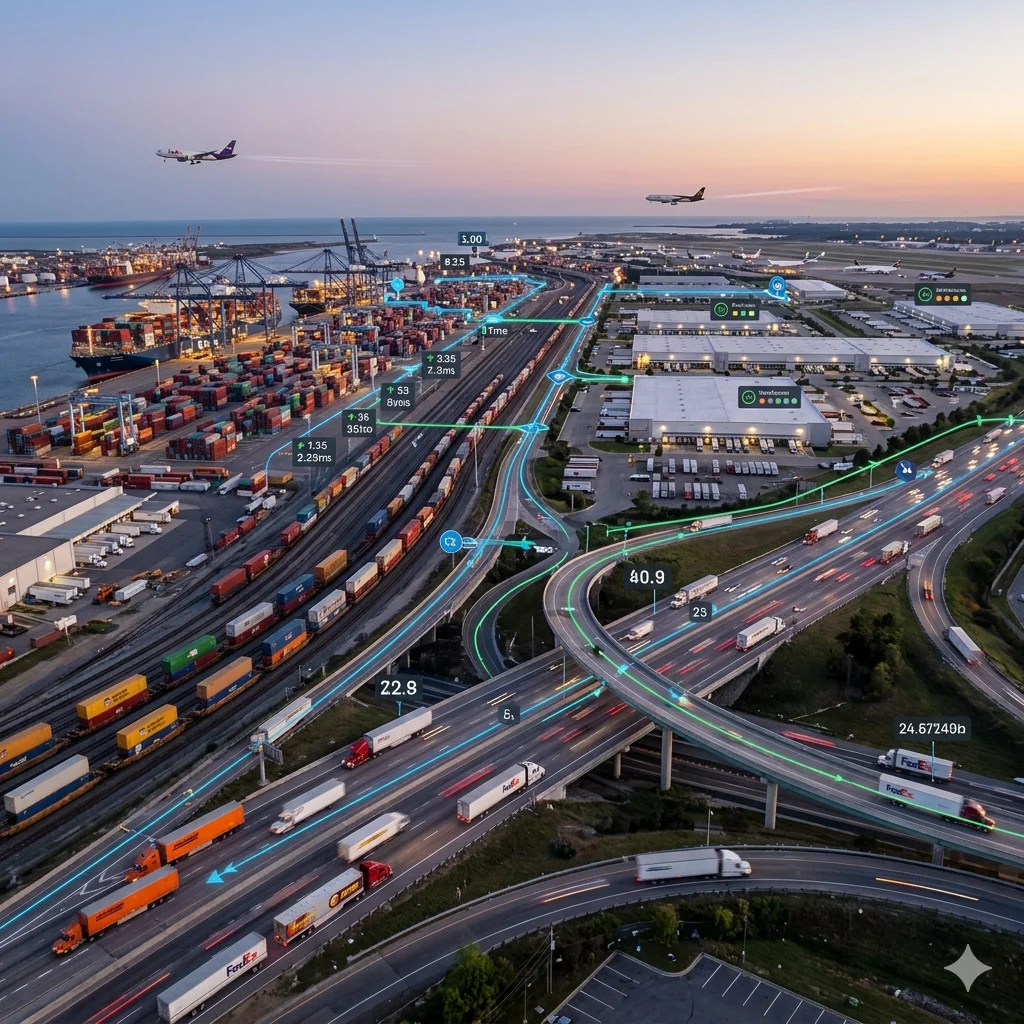
"North America’s freight and logistics market is projected to reach $2.0"
North American Freight and Logistics Market Seen Reaching $2.0 Trillion by 2031 as Trade Routes and Warehouses Shift
[IMAGE: Dashboard-style logistics map of North America with major trade corridors highlighted]
North America’s freight and logistics market is projected to reach $2.0 trillion by 2031, expanding at a 4.0% CAGR. On the surface, that forecast signals steady growth in a sector that already touches every part of the regional economy. But the more important story is structural: the market is not simply getting larger, it is being reorganized.
For shippers, carriers, warehouse operators, and infrastructure planners, the central question is not whether freight volumes will rise. It is how the operating model is changing across North America trade routes logistics networks, and which parts of the system will capture value as e-commerce, automation, infrastructure spending, and resilience planning reshape the movement of goods.
Market Snapshot: Why the $2.0 Trillion Forecast Matters
A market reaching $2.0 trillion by 2031 is significant because freight and logistics is not a standalone industry; it is a networked service layer behind retail, manufacturing, energy, agriculture, and cross-border trade. When this market grows, it often reflects broader shifts in how businesses source, store, and deliver goods.
The 4.0% CAGR suggests a relatively disciplined expansion rather than a speculative surge. That matters because it implies the market is being driven by durable changes in behavior and infrastructure, not just temporary spikes in shipping activity. The key issue is therefore not the headline number itself, but the redesign of the system that supports it: ports, rail corridors, highways, distribution hubs, and last-mile networks.
[IMAGE: Freight routes map showing ports, rail lines, highways, and distribution centers across the United States, Canada, and Mexico]
The Economic Logic Behind Growth
The growth logic behind the freight and logistics market is closely tied to e-commerce, shipment fragmentation, and the rising cost of speed. Online commerce has changed the shape of demand. Instead of a smaller number of large replenishment orders, logistics providers now manage more frequent, smaller shipments with tighter delivery windows.
That shift creates three pressures at once:
- Higher parcel volumes as more consumer and business purchases move through fulfillment networks.
- More complex routing because shipments are distributed across a larger number of delivery points.
- Greater margin pressure because fast service expectations raise labor, fuel, and handling costs.
This is where network density becomes important. In a mature logistics system, efficiency depends not just on moving freight cheaply, but on orchestrating flows across multiple modes and touchpoints. The more fragmented the shipment profile becomes, the more valuable it is to have integrated planning, cross-docking capacity, and real-time visibility.
In practical terms, the market is being pulled toward a model in which logistics performance is measured less by volume alone and more by coordination quality.
Why This Is a Slow-Analysis Story, Not Just a Forecast
This article should be read as a slow-analysis piece because the forecast period stretches from 2025 to 2031, which is long enough for structural changes to matter more than short-term cycles. Forecasts often focus on market size at the end of the period. But in logistics, the deeper question is which assets, routes, and technologies become strategically more important along the way.
That distinction matters for investors and operators. A rising market does not automatically reward every segment equally. Some assets become more valuable because they sit closer to demand centers or cross-border corridors. Others lose relative importance if they cannot support speed, visibility, or resilience.
So instead of asking only whether the market will grow, a better question is: What becomes essential infrastructure by 2031? The answer may include automated warehouses, digitally managed ports, intermodal rail hubs, and regional last-mile systems that can absorb volatility.
E-Commerce as the Demand Engine
E-commerce remains one of the strongest demand engines in North American logistics. Its effect is not limited to parcel shipping. It changes the entire distribution architecture.
Traditional retail supply chains were built around relatively centralized inventory and longer replenishment cycles. E-commerce pushes the opposite direction: more distributed inventory, more small-batch movement, and more frequent delivery commitments. This has major implications for North America trade routes logistics because fulfillment cannot rely only on a few large national nodes.
Instead, companies are building networks that place inventory closer to consumers and key metro areas. That means more regional warehouses, more urban delivery depots, and more pressure on transportation links that connect ports, inland hubs, and population centers.
E-commerce also raises the bar on service quality. Customers expect order tracking, narrow delivery windows, and reliable exceptions handling. As a result, visibility has become almost as important as physical movement. Logistics providers that can offer end-to-end transparency are better positioned than those that only move freight from point A to point B.
[IMAGE: Package sorting center with delivery vans and urban last-mile routes]
Technology Adoption Is Reshaping Cost Structure
Technology is changing logistics from a labor- and asset-heavy model into a more data-driven operating system. This does not mean automation will replace the physical network. It means the cost structure of that network is being rewritten.
Key technologies include:
- Autonomous trucking, which may improve long-haul efficiency on select routes
- Autonomous delivery vehicles, especially in controlled urban or campus environments
- Drone-based shipping, still limited but relevant for niche or hard-to-reach deliveries
- AI-powered warehouse management systems, which improve labor planning, slotting, and throughput
- Predictive analytics, which help forecast demand, reduce delays, and optimize routes
- Blockchain-based tracking, which can improve traceability and documentation across complex shipments
The practical effect of these tools is better orchestration. Warehouses can process higher volumes with fewer bottlenecks. Carriers can adjust routes faster when weather, congestion, or border delays occur. Shippers can identify exceptions earlier and reduce costly disruptions.
This is why technology is becoming a competitive moat rather than just an efficiency tool. In a market defined by tight margins and high service expectations, firms that can automate decision-making and reduce friction will have structural advantages.
Infrastructure Spending and the Rebalancing of Trade Routes
Public and private infrastructure spending is another reason the market forecast matters. North America’s logistics system is not uniform; it depends on chokepoints, corridors, and intermodal transfers that can either speed up or slow down freight movement.
Ports, rail terminals, highways, and border crossings all shape where freight accumulates and where delays occur. Over time, investment tends to favor the routes that can support higher throughput and greater reliability. That means some corridors will gain strategic importance, particularly those linking ports to inland distribution markets and cross-border manufacturing clusters.
For example, freight volumes connected to Mexico-US trade continue to influence road and rail planning, while Canadian export corridors depend on efficient access to ports and eastern and western gateways. These flows reinforce the importance of resilient intermodal networks and modernized customs processing.
In this environment, transport infrastructure is not just a public works issue. It is a competitive variable for the entire freight and logistics market.
Supply Chain Resilience Becomes a Core Operating Requirement
The last several years have made one point clear: supply chain resilience is no longer a contingency plan. It is part of the baseline operating model.
Resilience planning now includes:
- Multiple sourcing and routing options
- Larger safety stock in selected categories
- Diversified warehouse footprints
- Nearshoring and reshoring strategies
- Better scenario planning for fuel, labor, weather, and border disruptions
These changes have cost implications, but they also reduce exposure to single-point failures. For logistics providers, resilience creates demand for more flexible networks and more sophisticated coordination tools. For shippers, it shifts the emphasis from pure cost minimization to a balance between cost, speed, and continuity.
That tradeoff is one reason growth in the market is likely to concentrate in services and assets that can deliver adaptability. Fixed networks with little flexibility may struggle to compete with dynamic, data-enabled systems that can reroute freight and rebalance inventory in real time.
[IMAGE: Resilient supply chain network diagram with multiple warehouse nodes and alternate transport routes]
Sustainability Is Becoming an Operational Requirement
Sustainability is also moving from a reporting issue to an operational one. Freight transport is under pressure to reduce emissions, improve fuel efficiency, and adopt lower-carbon practices across road, rail, port, and warehouse operations.
This is not only about regulation. It is also about customer expectations and cost control. Fuel volatility makes efficiency attractive even before environmental considerations are added. At the same time, large shippers increasingly want logistics partners that can provide emissions data, route efficiency metrics, and cleaner transportation options.
Common responses include:
- Fleet modernization
- Route optimization to reduce empty miles
- Mode shifts where rail can replace some long-haul trucking
- Energy-efficient warehouse design
- Electrification in urban delivery fleets
In the context of North America trade routes logistics, sustainability is becoming part of service competitiveness. The firms that can reduce emissions while maintaining reliability will likely be better positioned in procurement decisions.
Where Growth Is Likely to Concentrate
By 2031, growth is likely to cluster in places that combine volume, connectivity, and flexibility. That includes:
- Major port gateways with strong inland links
- Intermodal rail corridors
- Cross-border freight lanes between the US, Canada, and Mexico
- Large metropolitan distribution zones
- Last-mile networks serving dense consumer markets
These are the nodes where e-commerce, manufacturing, and international trade intersect. They are also the places where automation and digital coordination can have the largest impact on throughput and cost.
This suggests that the market’s expansion will not be evenly distributed. Instead, it will likely favor hubs that can support faster fulfillment, better visibility, and stronger resilience.
Conclusion
The projected rise of the North American freight and logistics market to $2.0 trillion by 2031 is more than a growth forecast. It marks a period of structural redesign in how goods move across the continent.
E-commerce is raising shipment frequency and fragmentation. Technology is changing the cost structure. Infrastructure investment is reshaping corridors and hubs. Supply chain resilience is becoming a permanent requirement. And sustainability is becoming part of how logistics performance is measured.
For companies operating in this space, the central challenge is not simply to move more freight. It is to build networks that can move freight faster, with greater visibility, lower risk, and better adaptability. That is the real transformation behind the forecast.
Trade Metrics
Related Datasets
Q4 Cross-Border Logistics Report
PDF • 4.2 MB
Automotive Parts Supply Chain Index
CSV • 1.1 MB