The Hidden Node: How North American Freight Group Optimizes Cross-Border Logistics

Sarah Martinez
Logistics Correspondent
May 20, 2026
DATELINE: NA TRADE WIRE
"Beyond a standard freight forwarding profile, this article examines the strategic"
```markdown
The Hidden Node: How North American Freight Group Optimizes Cross-Border Logistics on Key Trade Routes
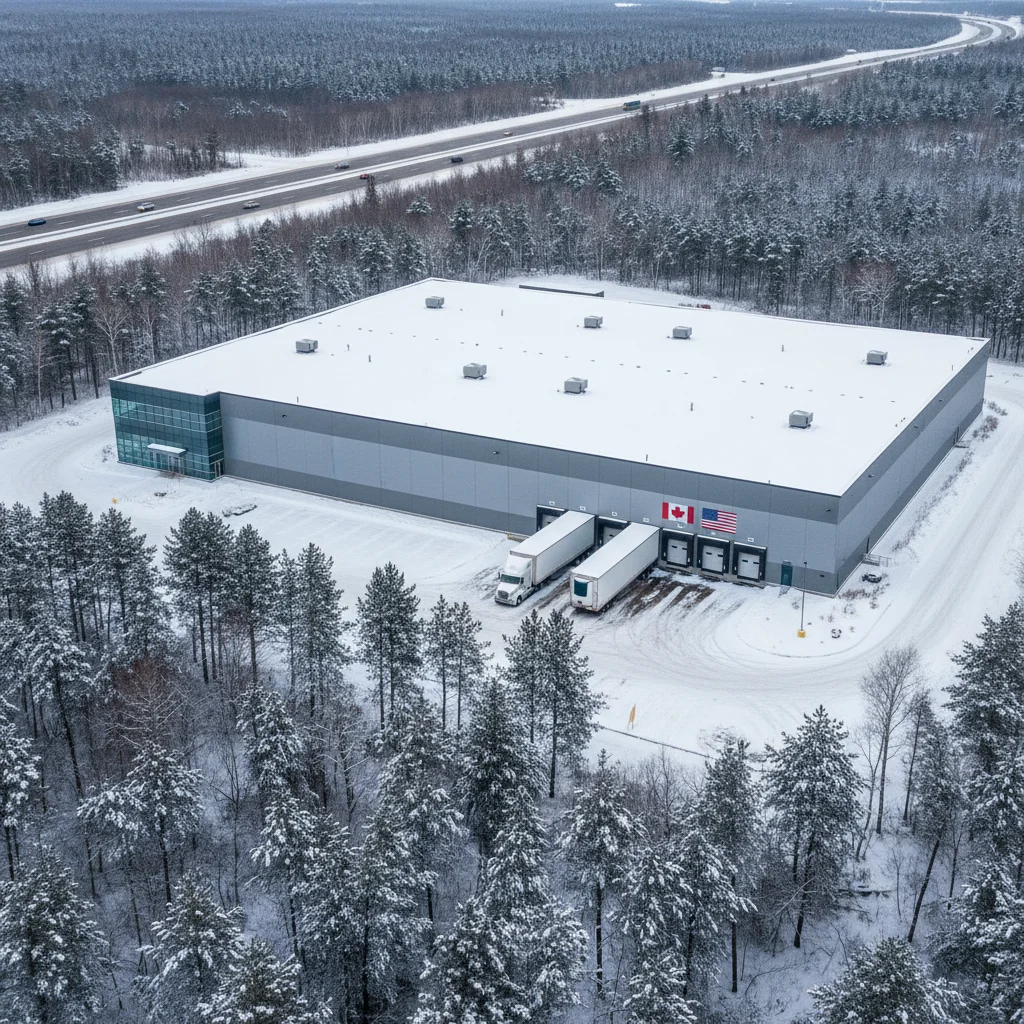
[IMAGE: A high-angle aerial view of a modern warehouse facility in Barrie, Ontario, surrounded by snow-dusted trees and a four-lane highway in the background. A semi-truck with Canadian and U.S. flags on the trailer is parked at a loading dock. The scene conveys cold-climate logistics and cross-border connectivity.]
Introduction: The Unsung Architects of North American Trade
North America’s supply chains are undergoing a quiet but profound transformation. Nearshoring trends, volatile tariff policies, and an unrelenting demand for speed have reshaped how goods move between Canada, the United States, and Mexico. While multinational logistics giants grab headlines with their global networks, the real backbone of regional trade often consists of mid-sized, specialized freight forwarders that operate in the shadows of major hubs. These firms are the silent enablers—the architects of resilient, just-in-time corridors that keep factories humming and shelves stocked.
One such player is North American Freight Group (NAFG), a Barrie, Ontario-based firm that has built a reputation for reliability by combining freight forwarding, warehousing, customs brokerage, and transport solutions under a single roof. Unlike the sprawling operations of a DHL or a Kuehne+Nagel, NAFG focuses on the granular, often-overlooked details of cross-border logistics: the customs document that saves a day at the border, the warehouse slot that aligns with a production schedule, the truck that arrives at 2 a.m. to meet a tight window.
This raises a core question: How do mid-size, regional logistics providers maintain both reliability and customization while competing with global giants? The answer lies in geographic positioning, adherence to recognized industry standards, and a service model that treats each client’s supply chain as unique. NAFG operates under the Canadian International Freight Forwarding Association (CIFFA) standard trading conditions, a framework that provides legal clarity and risk mitigation in an otherwise volatile environment. By examining NAFG as a case study, we can understand why these “hidden nodes” are becoming indispensable to North American trade.
[IMAGE: A stylized map of North America with trade route arrows connecting Canada, U.S., and Mexico, with a pin on Barrie, Ontario.]
Location as a Strategic Asset: Barrie’s Role in the Toronto-Montreal Corridor
NAFG’s headquarters at 556 Bryne Drive in Barrie, Ontario, is far from accidental. Barrie sits at the intersection of Highway 400 and Highway 11, two arterial routes that feed directly into the Greater Toronto Area (GTA)—Canada’s largest consumer and industrial market. From Barrie, a truck can reach the GTA’s major distribution zones in under an hour, and the key Canada-U.S. border crossings—Fort Erie (Buffalo), Detroit-Windsor, and Sarnia-Port Huron—within two to three hours.
This location offers a distinct operational advantage. Secondary hubs like Barrie provide lower real estate costs and significantly less congestion than downtown Toronto. Warehousing space in the GTA’s core has become prohibitively expensive and often struggles with labor shortages; smaller cities like Barrie offer a more stable workforce and room for expansion. For cross-border shipments bound for the U.S. Midwest—Michigan, Ohio, Indiana, Illinois—Barrie acts as a natural staging area. Trucks can load, clear customs at one of the proximate bridges or tunnels, and reach Detroit or Chicago within a single shift.
Barrie’s position is also part of the larger Quebec-Windsor Corridor, the most densely populated and economically active region in Canada. This corridor handles the vast majority of Canada-U.S. trade, and any logistics provider anchored here gains direct access to the busiest land border crossings in North America. NAFG’s facility therefore serves not just as a warehouse but as a command post for coordinating the movement of goods across three countries. By positioning itself away from the urban choke points, the firm can offer faster turnaround times and more predictable schedules—a critical factor for clients operating on just-in-time principles.
[IMAGE: A detailed regional road map showing Barrie’s proximity to Toronto, the 400 series highways, and key Canada-U.S. border crossings.]
CIFFA Standard Trading Conditions: A Trust Anchor in an Unstable Market
In a logistics landscape marked by disrupted ocean schedules, unpredictable air freight rates, and sudden border closures, standard terms of trade are not a bureaucratic luxury—they are a necessity. NAFG provides freight forwarding services in accordance with the CIFFA standard trading conditions, a widely recognized legal framework that governs the relationship between forwarders and shippers.
CIFFA (Canadian International Freight Forwarding Association) standard trading conditions cover liability limits, documentation requirements, force majeure events, and dispute resolution procedures. For a shipper, this means knowing exactly what happens if a container is delayed due to a port strike, if a customs broker makes an error, or if cargo is damaged in transit. Without such standardized terms, every shipment becomes a potential legal gray area, especially when crossing multiple jurisdictions.
For a mid-sized freight forwarder like NAFG, adhering to CIFFA conditions signals professionalism and accountability. It differentiates the firm from “fly-by-night” operators that may offer lower rates but lack the risk management infrastructure to handle complex cross-border shipments. In volatile trade environments—where U.S. tariffs on Canadian goods can change overnight, or Mexican customs can tighten inspections without warning—having a trusted contractual anchor reduces friction for both parties. The CIFFA conditions also align with the broader trend of supply chain resilience: they encourage forwarders to maintain transparent documentation and standardized processes, which in turn build trust over repeated transactions.
NAFG’s commitment to CIFFA is not just a marketing point; it is embedded in the company’s operating philosophy. As one company representative noted, “We treat every shipment as if it were our own. The CIFFA framework gives our clients peace of mind, because they know exactly where they stand legally and operationally.” This client-first approach, combined with a strict adherence to industry standards, helps explain why regional logistics providers can compete effectively even against far larger rivals.
[IMAGE: A close-up of a CIFFA certification document or a stylized icon of a contract with a Canadian maple leaf and a scales of justice.]
Integrated Services: The Warehouse-to-Customs Pipeline
NAFG’s service stack is designed to cover every link in the cross-border supply chain—from origin to destination—without requiring the shipper to coordinate multiple vendors. The company offers freight forwarding (air, ocean, and ground), warehousing and distribution, customs brokerage, and dedicated transport solutions. The synergy of these services under one roof reduces handoff points, cuts delays, and provides end-to-end visibility.
Freight Forwarding: NAFG handles both international and domestic shipments. For air freight, it books space on major carriers out of Toronto Pearson and Montreal Trudeau, while ocean freight moves through ports such as Montreal, Vancouver, and Prince Rupert. Ground transportation is the core of its cross-border business: the company runs dedicated LTL and FTL services to the U.S. Midwest, Northeast, and increasingly to Mexico via Laredo and other southern gateways.
Warehousing & Distribution: The Barrie facility offers over 50,000 square feet of temperature-controlled and dry storage, equipped with racking systems and cross-docking capabilities. This warehousing capacity is particularly valuable for clients engaged in nearshoring—moving production from Asia back to Mexico or the U.S.—because it allows for inventory buffering near the border. A manufacturer with a plant in Monterrey, for example, can ship components to NAFG’s Barrie warehouse, where they are held until called off by a customer in Toronto, avoiding the need for the manufacturer to maintain its own distribution center in Canada.
Customs Brokerage: NAFG employs licensed customs brokers who handle all documentation for Canada Border Services Agency (CBSA) and U.S. Customs and Border Protection (CBP). With the rise of U.S.-Mexico-Canada Agreement (USMCA) certification requirements and country-of-origin rules, having in-house customs expertise is a competitive advantage. The brokerage team also advises clients on tariff classification, duty deferral programs, and free trade agreement eligibility—services that large multinationals often charge extra for or outsource to separate firms.
Transport Solutions: The company’s owned and contracted fleet of trucks ensures that cargo moves on schedule. Unlike pure brokerage models that rely entirely on third-party carriers, NAFG maintains direct control over a portion of its fleet, allowing it to guarantee capacity during peak seasons or when spot rates spike. This is especially important for just-in-time logistics, where a missed pickup can shut down a production line.
The integration of warehousing, customs, and transport means that a single shipment can be received at the Barrie dock, cleared by customs, cross-docked onto a waiting truck, and dispatched to a U.S. destination within hours—all managed under one roof. For shippers, this eliminates the frustration of calling multiple phone numbers to trace a delayed load. It also allows NAFG to offer flexible solutions tailored to specific industry needs, such as automotive parts, machinery, or consumer goods, which large freight forwarders often treat as commodity business.
[IMAGE: A warehouse interior showing stacked pallets with Canadian and U.S. labeling, a forklift moving boxes, and a customs broker’s office visible in the background.]
Nearshoring and the Rise of Regional Logistics Providers
The broader context that makes NAFG’s model relevant is the accelerating trend of nearshoring. Companies that once relied on Asian manufacturing are now relocating production to Mexico and, to a lesser extent, the United States and Canada. This shift is driven by supply chain resilience concerns, rising labor costs in China, and geopolitical tensions. For Canadian importers and exporters, this means more trade flowing north-south rather than east-west.
Large multinational logistics firms tend to focus on high-volume, standardized corridors—the trans-Pacific or trans-Atlantic lanes. Regional providers like NAFG, however, are better positioned to handle the complexity of intra-North American movements. A shipment from a plant in Guadalajara to a distribution center in Barrie, for example, requires coordination across Mexican customs, U.S. in-bond procedures, and Canadian clearance. The customs classification and regulatory compliance vary significantly between countries. NAFG’s team, with deep knowledge of each country’s rules, can navigate these complexities more efficiently than a global generalist.
Moreover, nearshoring often increases the need for warehousing near the final consumer. As companies reduce their reliance on distant inventories, they seek buffer stock closer to demand. Regional logistics providers with facilities near key border crossings or secondary hubs become natural partners. NAFG’s Barrie location, combined with its relationships with U.S. and Mexican partners, makes it a viable node in this new supply chain architecture.
Conclusion: Why the Hidden Node Matters
North American Freight Group exemplifies the role that mid-sized, regionally focused freight forwarders play in modern cross-border logistics. By leveraging a strategically located facility in Barrie, Ontario; adhering to CIFFA standard trading conditions; and offering an integrated suite of services from warehousing to customs brokerage, the company provides a level of customization and reliability that shippers often cannot find from larger competitors.
In an era of supply chain volatility, where speed and trust are paramount, these “hidden nodes” are becoming critical infrastructure. They enable just-in-time delivery, support nearshoring trends, and act as a safety net when global disruptions occur. While they may not command the brand recognition of a multinational, their impact on the day-to-day flow of goods across North America is undeniable. For any company involved in cross-border trade between Canada, the U.S., and Mexico, understanding the value of a regional logistics provider like NAFG—and the standards it upholds—is more than a competitive advantage; it is a necessity.
[IMAGE: A photo of a NAFG-branded semi-truck driving on a highway, with a snowy landscape and a border crossing sign in the distance. No text.]
Trade Metrics
Related Datasets
Q4 Cross-Border Logistics Report
PDF • 4.2 MB
Automotive Parts Supply Chain Index
CSV • 1.1 MB