The New Industrial Policy Arms Race: How China, EU, and US Are Reshaping Global

Sarah Martinez
Logistics Correspondent
June 28, 2026
DATELINE: NA TRADE WIRE
"A deep analysis of industrial policy evolution across China, the EU, and"
The New Industrial Policy Arms Race: How China, EU, and US Are Reshaping Global Trade and Supply Chains (2009–2024)
Data from the New Industrial Policy Observatory reveals a fundamental shift from episodic crisis management to persistent, rival-directed market-shaping competition.
Introduction: The Transformation of Industrial Policy
"Industrial policy has returned, but in a form that differs markedly from earlier episodes of state intervention." This observation, drawn from systematic analysis of government actions across the world's three largest economic blocs, captures a truth that policymakers, supply chain managers, and global investors can no longer afford to ignore.
The period from 2009 to 2024 marks a watershed. What began as emergency responses to the Global Financial Crisis has evolved into something far more strategic and durable. The old model—where governments stepped in with temporary subsidies or tariff relief to correct market failures, then stepped back—has been replaced by a persistent, proactive, and geopolitically charged competition to shape market structures.
Drawing on the New Industrial Policy Observatory (NIPO) dataset, which tracks over 2,500 industrial policy actions across China, the European Union, and the United States over fifteen years, this analysis uncovers ten stylised facts that define the new era. These facts paint a picture of an escalating arms race: a sharp post-2019 expansion of selective actions, growing concentration in strategic and dual-use sectors, rapid diffusion of subsidies followed by import restrictions, and structurally durable export controls.
The core thesis is straightforward: modern industrial policy is no longer domestic or sector-neutral. It is rival-directed. It strategically targets chokepoints in global value chains—semiconductor fabrication, rare earth processing, battery manufacturing, quantum computing—and in doing so, is fragmenting global trade routes, creating new vulnerabilities, and forcing businesses to navigate an increasingly geopolitical landscape.
[IMAGE: A timeline graphic showing the number of industrial policy actions per year from 2009 to 2024, with a clear inflection point around 2019. China, EU, and US data shown as separate coloured lines.]
From Crisis Response to Market Shaping: The Post-2019 Inflection
The data tells a clear story of two eras. Between 2009 and 2018, industrial policy actions followed a cyclical pattern. The post-crisis years (2009–2012) saw a spike in support measures—mostly broad-based subsidies and counter-cyclical spending intended to stabilise demand. Then, from 2013 to 2018, activity plateaued as economies recovered and governments retreated from intervention.
But from 2019 onward, the curve breaks sharply upward. The annual number of selective industrial actions—policies targeting specific sectors, technologies, or firms—more than doubled in each of the three regions. Crucially, the nature of these actions also changed.
Before 2019, the stated policy motives were largely domestic: correcting market failures, supporting R&D, smoothing adjustment for declining industries. After 2019, resilience, security, and geopolitical advantage became the dominant rationales. As the NIPO analysis notes: "Governments are no longer primarily focused on correcting isolated market failures or smoothing cyclical adjustment. Instead, they are actively reshaping market structure."
This shift is not accidental. It reflects a recognition that certain industries—semiconductors, batteries, rare earths, artificial intelligence, quantum computing—are not just economically valuable but strategically essential. Dependence on rival powers for these technologies is now seen as an unacceptable vulnerability. The result is a self-reinforcing cycle: one bloc's industrial policy triggers a response from rivals, which in turn provokes further action.
[IMAGE: Bar chart comparing the average annual number of selective industrial actions for China, EU, and US in two periods: 2009-2018 (pre-inflection) and 2019-2024 (post-inflection). Each region shows a clear step-change increase.]
Strategic Sectors and Chokepoints: Where Policy Concentrates
The concentration of industrial policy in a narrow set of sectors is perhaps the most striking feature of the post-2019 landscape. While earlier interventions were spread across agriculture, automobiles, steel, and renewable energy, the new wave is tightly focused on a handful of strategic and dual-use sectors—technologies that have both commercial and military applications.
Semiconductors: The Epicentre of Rivalry
The semiconductor industry alone accounts for nearly 30% of all selective industrial policy actions taken by the US and EU since 2020. The US CHIPS and Science Act (2022) committed $52 billion in subsidies and tax credits for domestic chip manufacturing, accompanied by stringent "guardrails" that prevent recipients from expanding advanced manufacturing in China. The EU Chips Act (2023) followed with €43 billion in public investment, aiming to double Europe's share of global semiconductor production to 20% by 2030. China, meanwhile, has poured hundreds of billions of yuan into its domestic chip ecosystem through a combination of state-led investment funds, procurement preferences, and talent repatriation programs.
The result is a tri-polar subsidy race where each bloc tries to outspend the others. But subsidies are only one instrument. Import restrictions and export controls form the other blade of the scissors.
Dual-Use Technology and Export Controls
The Biden administration's October 2022 export controls on advanced semiconductors and semiconductor manufacturing equipment marked a watershed in the use of trade policy as a weapon. Unlike traditional trade barriers that target specific goods or countries, these controls are structurally durable: they are embedded in licensing requirements, end-use monitoring, and technology-transfer restrictions that cannot be easily reversed by a change in administration.
The EU has followed suit, introducing tighter controls on dual-use items including advanced materials, quantum computing components, and surveillance technologies. China has responded by restricting exports of gallium, germanium, and antimony—critical inputs for semiconductor production and defence applications—along with stricter approvals for foreign investment in key technology sectors.
This pattern—subsidies to build domestic capacity, import restrictions to close the home market, and export controls to deny rivals critical inputs—creates what trade economists call a "layered chokepoint" strategy. Control over a single bottleneck in the global value chain (e.g., Dutch lithography machines, Chinese rare earth processing, American chip design software) gives a government disproportionate leverage over the entire system.
[IMAGE: A heat map of the world showing the density of industrial policy actions in key sectors (semiconductors, batteries, rare earths, AI, quantum) across China, EU, and US. The densest hotspots are in East Asia (Taiwan, South Korea, China), the US West Coast, and Western Europe.]
Batteries and Critical Minerals: The New Resource Wars
The race to secure battery supply chains for electric vehicles and energy storage has triggered a parallel wave of industrial policy. The US Inflation Reduction Act (2022) ties consumer EV tax credits to domestic content requirements, effectively excluding Chinese-made batteries. The EU's Critical Raw Materials Act (2023) sets targets for domestic mining and processing of essential minerals, while China dominates 70% of global battery cell production and 90% of rare earth processing.
Subsidies flow freely: European governments are pouring billions into battery gigafactories; China provides cheap land, electricity, and tax holidays for its battery champions; the US Department of Energy has allocated $7 billion for regional battery materials processing hubs. Yet these subsidies are increasingly paired with trade barriers: anti-dumping duties on Chinese lithium-ion batteries in the EU, Section 301 tariffs on Chinese EVs and batteries in the US, and restrictive localisation requirements in China's own government procurement.
The consequence is a fragmentation of supply chains that once crossed borders efficiently. A battery made in China can no longer easily access American or European markets. A mining project in Chile must now be certified as meeting US domestic content rules to qualify for tax credits. Companies that once optimised for cost and speed must now optimise for geopolitical alignment.
The Mechanics of Fragmentation: How Trade Routes Are Being Redrawn
The cumulative effect of these policies is visible in trade data. Global trade in semiconductor production equipment, for instance, has bifurcated: exports from the US and Netherlands to China have plummeted since 2022, while intra-allied trade (US to Japan, EU to US) has surged. Rare earth trade shows a similar pattern—China's exports of processed rare earths to the US have fallen, while imports from Australia and the US itself have risen as new processing capacity comes online outside China.
This fragmentation creates new chokepoints even as it attempts to resolve old ones. The US push to build advanced semiconductor fabs in Arizona and Ohio, for example, relies on Japanese and Dutch equipment, German chemicals, and Taiwanese engineering talent—each a potential vulnerability. The EU's battery ambitions depend on Chinese cathode materials and Australian lithium, both subject to geopolitical risk.
For businesses, the implications are profound. Supply chain resilience is no longer a question of redundant sourcing or safety stock; it demands active scenario planning for export controls, subsidy races, and sudden tariff changes. Global investors must reprice assets based on exposure to "strategic sectors" that attract both generous subsidies and capricious restrictions.
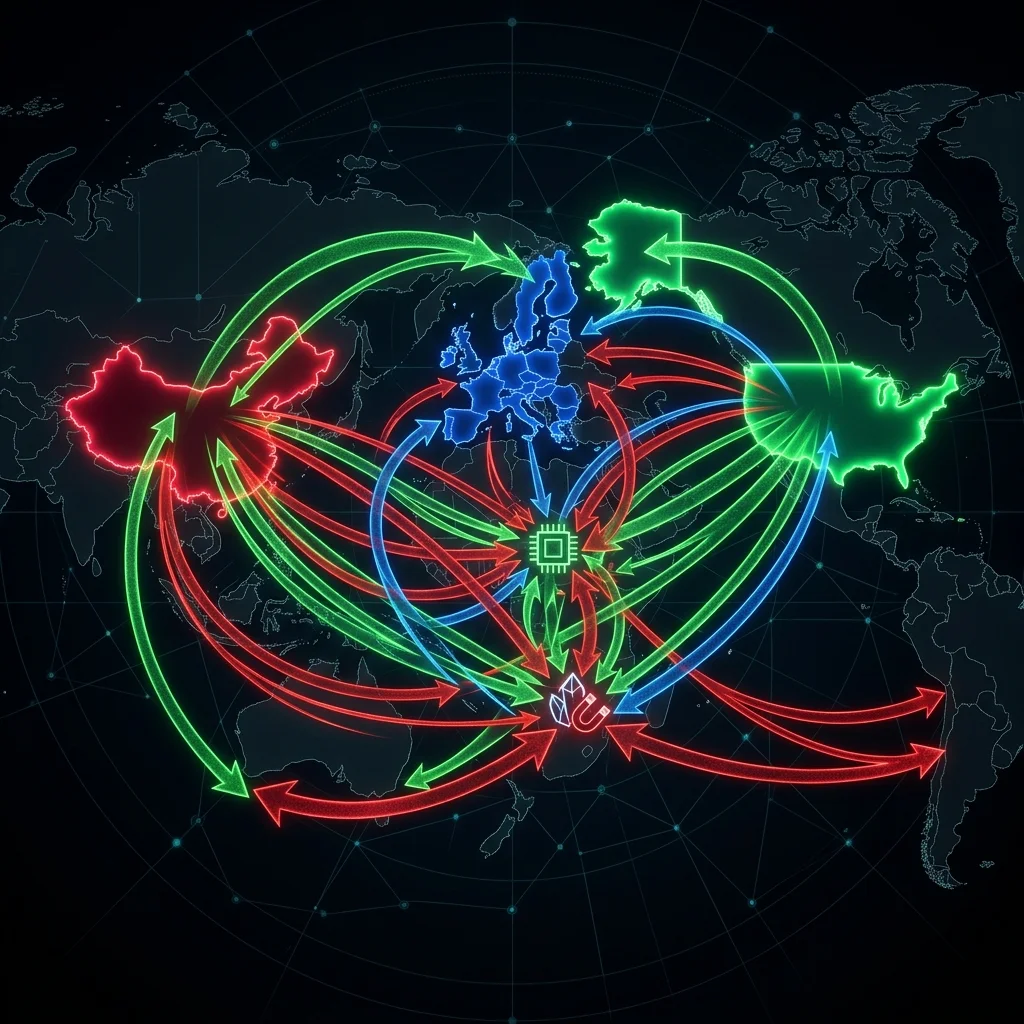
[IMAGE: A world map with three glowing regions (China, European Union, United States) connected by thick, overlapping arrows: green for subsidies, red for import restrictions, blue for export controls. The arrows form a tangled web converging on key chokepoints: semiconductor fabrication nodes in Taiwan, rare earth mines in Inner Mongolia, data centres in Virginia, and battery gigafactories in Hungary.]
Ten Stylised Facts That Define the New Era
Drawing from the NIPO dataset, the following ten regularities characterise modern industrial policy:
- Post-2019 inflection: The frequency of selective actions rose sharply after 2019, with no sign of returning to pre-crisis levels.
- Rival-directed logic: Policies increasingly target specific competitor countries, especially China (by the US and EU) and the US (by China).
- Concentration in strategic sectors: Over 60% of actions target semiconductors, batteries, critical minerals, AI, quantum, or advanced manufacturing equipment.
- Dual-use identity: The same technologies are simultaneously subsidised for commercial growth and restricted for national security.
- Subsidy-tariff pairing: Domestic subsidies are almost invariably accompanied by import restrictions or localisation requirements.
- Structural export controls: Unlike earlier episodic controls (e.g., US on Huawei in 2019), current export barriers are embedded in licensing and end-use frameworks.
- Accelerating race: Each major policy action (e.g., CHIPS Act, IRA) triggers rapid responses from rivals, compressing decision timelines.
- Geopolitical alignment: Supply chains are reorienting along alliance lines (US-Japan-South Korea-Taiwan; EU-Mercosur; China-Russia-Southeast Asia).
- Domestic political durability: Unlike past industrial policies that faded with electoral cycles, today's measures enjoy bipartisan support in the US and cross-party consensus in the EU.
- Uncertain macroeconomic impact: While individual subsidies boost specific sectors, the aggregate effect is rising costs, reduced trade, and slower productivity growth.
Conclusion: Navigating an Era of Permanent Competition
The industrial policy arms race between China, the EU, and the US is not a temporary aberration. It is the new normal. Governments have internalised the lesson that controlling strategic chokepoints offers an asymmetric advantage in geopolitical rivalry. They have also learned that subsidies alone are insufficient—they must be paired with trade barriers to capture value domestically and deny it to rivals.
For global trade and supply chains, the consequences are profound. The era of comparative advantage and frictionless cross-border flows—always an ideal rather than a reality—is giving way to a world of managed trade, "friend-shoring," and strategic autonomy. Companies that once operated in an apolitical global market must now develop geopolitical literacy. Investors must factor policy risk into every decision involving semiconductors, batteries, rare earths, or AI.
The ten stylised facts outlined here are not predictions; they are observations of how policy has already transformed the landscape. But they offer a framework for anticipating what comes next. As the arms race intensifies, the winners will be those who can navigate complexity, hedge against fragmentation, and adapt to a world where industrial policy is not a temporary intervention but a permanent feature of the economic geography.
[IMAGE: A futuristic, high-contrast geopolitical aesthetic with a dark background and subtle grid lines. Three glowing regions (China, EU, US) are connected by thick, overlapping arrows (green, red, blue) forming a tangled web around key chokepoints. No text, no watermarks.]
---
Data source: New Industrial Policy Observatory (NIPO), a global database tracking industrial policy actions across 42 economies. All statistics cited reflect the dataset period 2009–2024.
Trade Metrics
Related Datasets
Q4 Cross-Border Logistics Report
PDF • 4.2 MB
Automotive Parts Supply Chain Index
CSV • 1.1 MB