Beyond Speed: How Logistics Became the Strategic Backbone of North American

Sarah Martinez
Logistics Correspondent
April 28, 2026
DATELINE: NA TRADE WIRE
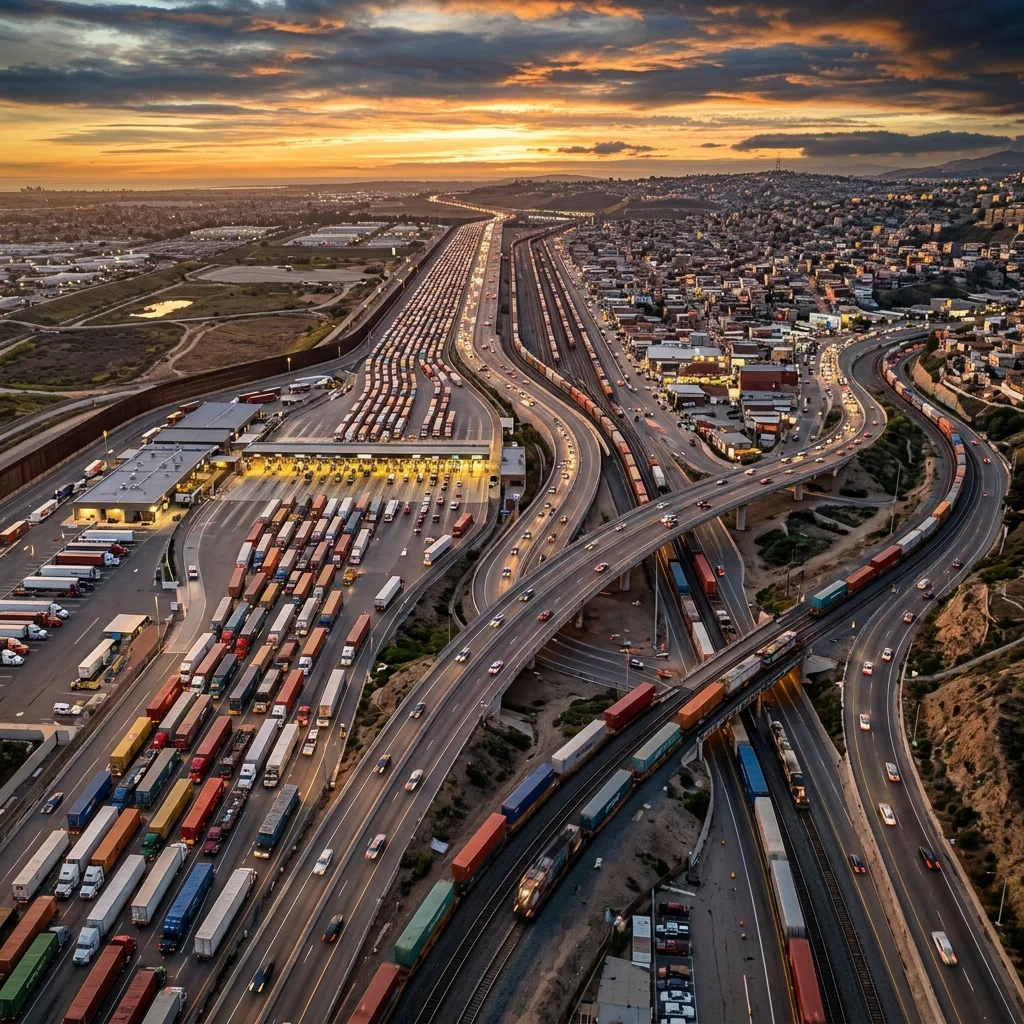
"Logistics has evolved from a cost center to a strategic competitive advantage"
Beyond Speed: How Logistics Became the Strategic Backbone of North American Trade Under USMCA
Published: March 26, 2026
Introduction: The Quiet Revolution in Logistics Strategy
Logistics has undergone a structural transformation from an operational cost center to a boardroom-level strategic lever, fundamentally altering how North American supply chains function under the United States–Mexico–Canada Agreement (USMCA). This shift is not theoretical—it is measurable in the reallocation of capital, the redesign of distribution networks, and the recalibration of inventory strategies across the continent.
North America accounts for nearly 30% of global GDP through deeply interconnected supply chains. The US and Canada alone maintain annual trade exchanges approaching US$1 trillion (Source: USMCA trade data). Any sustained slowdown in logistics infrastructure risks cascading economic effects across all three economies, making logistical fluency a competitive differentiator rather than a back-office expense.
The era of prioritizing pure speed and lowest unit cost has given way to a new operational doctrine: flexibility has become the new stability. Trade policy volatility, periodic tariff threats, and customs enforcement variability have rendered rigid, optimized-for-cost supply chains obsolete. The strategic question for corporate leadership is no longer "How fast can we move goods?" but "How resilient is our network when a single border crossing slows to a crawl?"
The 2025 Trade Shift: Mexico's Rise as America's Top Partner
In 2025, Mexico exported over US$399.5 billion to the United States, surpassing all other nations to become America's primary trading partner (Source: US Department of Commerce Census Bureau). This milestone was not an anomaly but the culmination of a multi-year trend driven by nearshoring, USMCA rule-of-origin requirements, and logistics infrastructure evolution.
During the first 10 months of 2025 alone, Mexican exports to the US reached nearly US$448 billion, while US shipments to Mexico exceeded US$283 billion in the same period (Source: US Department of Commerce Census Bureau). This bidirectional flow demonstrates that the relationship is not a one-way dependency but a deeply integrated manufacturing corridor. The physical composition of this trade is instructive: vehicles, engine parts, auto components, appliances, avocados, beer, electronic components, and heavy machinery cross the border daily in volumes that require orchestration at industrial scale.
The Bank of Mexico and the Ministry of Economy (Mexico) have consistently reported that nearshoring inflows accelerated after 2020, as multinational corporations reassessed single-source dependencies on Asian supply chains. USMCA's stricter rules of origin for automotive and electronic sectors effectively incentivized regional production, creating a self-reinforcing cycle: more regional content requirements led to more regional investment, which increased cross-border logistics demand, which required more sophisticated logistics infrastructure.
Canada: The Underutilized Stability Anchor for Mexican Exporters
Despite the dominance of the US-Mexico corridor, Canada represents a structurally underappreciated market that offers distinct advantages: stable demand, consistent regulatory frameworks, and less exposure to the periodic political friction that characterizes US-Mexico trade relations.
In 2022, Mexico sent more than US$22 billion worth of goods to Canada (Source: USMCA trade statistics). While this figure is modest compared to the US-Mexico flow, it represents a growth vector with lower marginal friction. The infrastructure connecting Mexico's industrial heartland to Canadian entry points—particularly the Windsor-Detroit corridor and the Vancouver gateway—remains less developed than the US-Mexico corridor, presenting a strategic optimization opportunity for logistics operators.
Diversifying into the Canadian market reduces structural over-reliance on a single border zone. As trade policy volatility persists—periodic tariff announcements, customs delays, and regulatory divergence between administrations—Mexican exporters and their logistics partners benefit from maintaining a multi-corridor strategy. The Canadian route provides what Francisco Ricaurte, a senior logistics executive at UPS Latin America, describes as "portfolio diversification for supply chains"—an insurance policy against single-point-of-failure risk at the US southern border.
Choke Points and Critical Corridors: The Physical Reality of Continental Logistics
The strategic importance of logistics becomes visible at the physical choke points where theoretical trade policy meets concrete infrastructure constraints. Border crossings at Laredo, Ciudad Juárez, and Tijuana handle the vast majority of US-Mexico trade volume. Any disruption at these nodes—whether due to customs processing delays, infrastructure maintenance, or security-related inspections—can slow economic activity across the entire continent.
Highway 57, the backbone route from central Mexico's industrial zones to the northern border, carries an outsized share of manufactured goods and automotive components. This single corridor is the circulatory system for Mexico's export economy. When trucks slow on Highway 57, assembly plants in Detroit and warehouses in Chicago feel the delay within 48 hours.
The quotes from industry executives are blunt assessments of physical realities: "If that logistical engine slows down, the economies on both sides slow down." This is not hyperbole—it is a structural description of an integrated production system where just-in-time manufacturing depends on predictable border transit times.
The concentration of trade through a limited number of ports of entry creates systemic vulnerability. U.S. Customs and Border Protection data consistently shows that Laredo alone handles over 15,000 commercial truck crossings daily. A single day of reduced throughput at this crossing can strand hundreds of millions of dollars in goods. The strategic implication is clear: companies that have developed multi-route contingency plans—alternative crossings, rail diversification, or inventory pre-positioning—gain a structural advantage over competitors relying on single-corridor optimization.
Flexibility as the New Stability: Redesigning Networks for Volatility
The logistics industry's response to trade policy volatility has been a fundamental redesign of network architecture. Traditional models optimized for lowest total landed cost assumed stable tariffs and predictable border clearance times. These assumptions no longer hold.
"Flexibility is today's stability"—this operational principle reflects a structural shift. Companies now build networks with redundancy built in: multiple routing options, buffer inventory at strategic nodes, and contract structures that allow rapid reallocation of capacity. The cost of this flexibility is measurable, but the cost of inflexibility in a volatile environment is demonstrably higher.
Companies like Mexecution, a logistics consultancy specializing in Mexico-US cross-border operations, have documented a shift toward "hybrid distribution models" where companies maintain both centralized distribution centers in Mexico's industrial north and decentralized cross-dock facilities near US consumption centers. This dual-node strategy allows rapid switching between direct-to-customer and warehouse-to-customer models depending on border conditions and demand variability.
The automotive sector provides the clearest illustration of this transformation. Auto parts—the single largest category of cross-border trade—require precise timing for just-in-sequence manufacturing. A 24-hour delay at the border can halt an assembly line. In response, automotive logistics providers have invested in "near-border warehousing" on both sides of the frontier, creating buffer zones that decouple long-haul transportation from final-mile delivery. This adds cost per unit but provides schedule reliability that justifies the premium.
Market Predictions: The Next Five Years
Looking forward, several structural trends will define logistics strategy in North American trade under USMCA.
First, infrastructure investment will become a competitive differentiator at the national and corporate levels. Corridors with modernized ports of entry, digitized customs processing, and multimodal connectivity will attract disproportionate trade volume. The current concentration of traffic through Laredo will likely persist, but secondary crossings—such as Otay Mesa near Tijuana and the Pharr-Reynosa bridge—will see increased investment and throughput.
Second, the Canadian corridor will attract greater attention from Mexican exporters and their logistics partners. As US trade policy remains subject to political cycles, the stability of Canada's regulatory environment becomes a measurable asset. Expect increased investment in Mexico-Canada direct routes, including rail connections that bypass US processing entirely for certain cargo categories.
Third, technology adoption—particularly real-time tracking, predictive analytics, and automated customs documentation—will separate leading logistics operators from followers. The companies that can predict border delays, reroute shipments proactively, and maintain visibility across the entire continental network will capture margin that less sophisticated competitors cannot access.
Fourth, nearshoring will continue but will evolve from the initial wave of "low-complexity assembly" toward more sophisticated manufacturing. This evolution will demand higher-value logistics services: temperature-controlled transport for electronics, specialized handling for advanced automotive components, and integrated supply chain finance solutions.
The fundamental logic is clear: North America's integrated economy generates nearly one-third of global GDP, and that output depends on physical movement across borders. Logistics is no longer the cost of doing business—it is the strategic capability that determines which companies, and which economies, capture the value of continental integration under USMCA. The battleground is no longer speed or cost alone; it is resilience, flexibility, and the capacity to absorb volatility without breaking.
Trade Metrics
Related Datasets
Q4 Cross-Border Logistics Report
PDF • 4.2 MB
Automotive Parts Supply Chain Index
CSV • 1.1 MB