The Great Unwinding: How Global Trade Is Shifting from Integration to Strategic

Sarah Martinez
Logistics Correspondent
June 27, 2026
DATELINE: NA TRADE WIRE
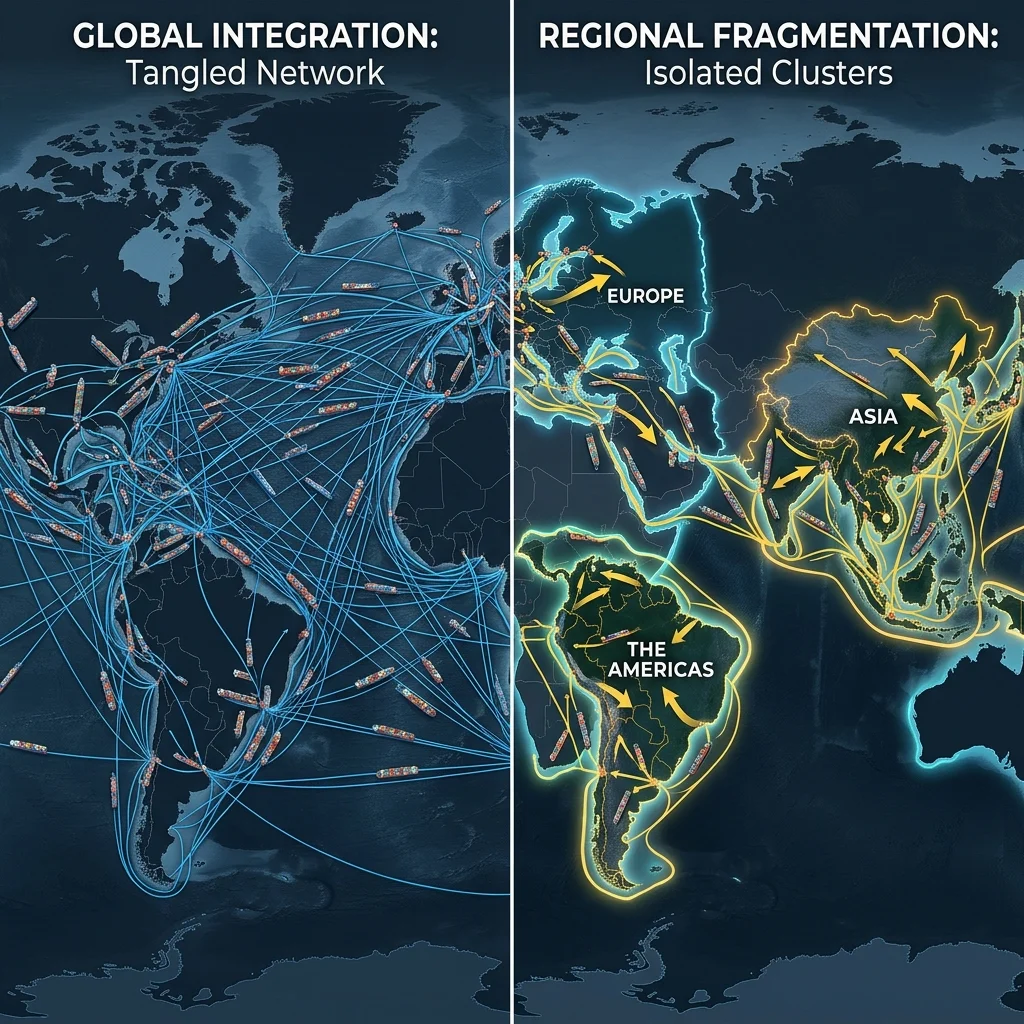
"The global trade system is undergoing a profound transformation. Decades"
The Great Unwinding: How Global Trade Is Shifting from Integration to Strategic Fragmentation
Introduction: The End of Hyperglobalization
For three decades following the Cold War, the global trade system operated on a singular logic: deeper integration. Tariffs fell, borders softened, and supply chains stretched across continents in pursuit of the lowest production costs. The World Trade Organization (WTO) facilitated rounds of liberalization, China joined the global trading system, and multinational corporations built intricate global value chains that connected factories in Shenzhen to warehouses in Ohio.
That era has ended. Not with a single dramatic event, but through a series of shocks that exposed the fragility of hyperconnected commerce. The US-China trade war, the COVID-19 pandemic, the Suez Canal blockage, and Russia's invasion of Ukraine collectively shattered the assumption that open trade was both inevitable and desirable.
[IMAGE: Historical timeline of global trade openness indicators (1990-2025) showing plateau or decline. Key data points: world trade-to-GDP ratio peaking around 2008, then plateauing; number of new trade restrictive measures rising sharply after 2018; global value chain participation index flattening post-2020.]
Today, policymakers and corporate strategists are not simply reversing globalization. They are reorganizing it into overlapping regional and strategic blocs. This is not deglobalization in the crude sense of nations retreating behind walls. It is something more complex: strategic fragmentation, where trade flows are increasingly shaped by geopolitical alignment, security concerns, and resilience requirements rather than pure economic efficiency.
The Hidden Logic: From Efficiency to Resilience and Security
The underlying rationale for the old trade system was elegant in its simplicity. Companies sourced materials and components from wherever offered the lowest cost, optimized inventory through just-in-time delivery, and concentrated production in specialized hubs. Labor cost differentials drove decisions, and global supply chains were engineered for maximum efficiency.
That calculus has fundamentally changed. The pandemic revealed that a single factory shutdown in Southeast Asia could halt automotive production in Germany. The war in Ukraine demonstrated that energy dependence on a single supplier is a strategic vulnerability. Trade is no longer just an economic activity—it is an extension of national security policy.
[IMAGE: Diagram comparing traditional linear supply chain vs. multi-regional resilient network. Left side shows a straight line from raw materials to consumer. Right side shows a web of nodes with redundant connections, regional hubs, and multiple sourcing arrows.]
This shift has produced new corporate and government priorities. "Just-in-case" is replacing "just-in-time." Companies are investing in inventory buffers, dual sourcing, and regional warehousing. Governments are promoting "friend-shoring"—moving supply chains to allied nations—and "near-shoring" to neighboring countries. The economic logic has shifted from pure cost optimization to risk-adjusted cost optimization.
Technology is accelerating this transformation. Digital trade platforms allow for more distributed manufacturing. 3D printing reduces the need for long supply chains by enabling local production of complex parts. Automation is diminishing the labor cost advantages that originally drove offshoring. A factory in Alabama with robots can now compete with a factory in Guangdong, especially when shipping costs and geopolitical risks are factored in.
Embedded evidence supports this structural shift. WTO data shows world merchandise trade volume growth slowing from an average of 5.6% annually between 1990 and 2008 to roughly 2.5% since 2012. The IMF's April 2024 World Economic Outlook notes rising geoeconomic fragmentation, estimating that severe decoupling could reduce global GDP by up to 7% in the long term. Trade policy uncertainty indices have spiked to levels not seen since the 1930s.
Emerging Trade Routes and Blocs: The Polycentric World
As the old system fragments, new structures are emerging. The world is not becoming less connected—it is becoming connected in different ways, around different poles.
Regional trade agreements are proliferating. The Regional Comprehensive Economic Partnership (RCEP) binds 15 Asia-Pacific economies into the world's largest trade bloc. The Comprehensive and Progressive Agreement for Trans-Pacific Partnership (CPTPP) links Pacific Rim nations with high-standard rules. The African Continental Free Trade Area (AfCFTA) aims to create a single continental market. The United States-Mexico-Canada Agreement (USMCA) has updated North American integration with stronger regional content requirements.
[IMAGE: World map highlighting major new trade corridors and regional bloc boundaries with flow arrows. Show RCEP region with internal arrows, USMCA region with dense cross-border arrows, EU with expanded Eastern flows, and new corridors: IMEC from India to Europe via Middle East, Arctic shipping routes, Trans-Caspian route connecting Central Asia to Caucasus.]
New trade corridors are being forged outside the traditional sea lanes. The India-Middle East-Europe Economic Corridor (IMEC), announced at the 2023 G20 summit, aims to connect South Asia to Europe via rail and sea links through the Gulf and the Levant. The Polar Silk Road is opening Arctic shipping routes as ice melts. The Trans-Caspian International Transport Route is linking China and Central Asia to Europe via the Caucasus, bypassing Russia.
China's Belt and Road Initiative (BRI), initially conceived as a grand narrative of connectivity, is adapting to this new reality. While Western countries scale back engagement, Beijing is focusing on "small yet smart" projects and deepening ties with the Global South. BRI lending has shifted from grand infrastructure to digital connectivity and green energy.
Industry-specific developments highlight the depth of this transformation. Semiconductor manufacturing is being reshored to the United States and Europe through massive subsidy programs. Battery supply chains are being built in Latin America—Chile and Argentina for lithium, Mexico for assembly. Europe is investing in domestic rare earth processing. These are not marginal adjustments; they represent a fundamental reordering of industrial geography.
Market dynamics reflect these shifts. Energy flows are being redirected as Europe replaces Russian gas with LNG from the United States and Qatar. Critical mineral supply chains are being diversified away from dominant producers. Trade in services, particularly digital services, is growing faster than goods trade, partly because services are less constrained by physical border frictions.
Policy Updates and Geopolitical Undercurrents
The structural shifts in trade are not happening organically—they are being driven by aggressive government intervention. Industrial policy has returned as a primary instrument of trade strategy.
The United States has led this resurgence. The CHIPS and Science Act commits $52.7 billion to domestic semiconductor manufacturing. The Inflation Reduction Act ties electric vehicle tax credits to battery supply chains that exclude China. The US-Mexico-Canada Agreement requires 75% of automotive content to be made in North America. Europe has responded with its own Critical Raw Materials Act and the European Chips Act, aiming to secure supply chains for technologies deemed strategic.
[IMAGE: Graph showing growth in trade policy interventions (tariff and non-tariff measures) by year, sourced from Global Trade Alert. Show sharp upward trend from 2018 onwards, with a breakdown between liberalizing and restrictive measures. Highlight the surge in export controls and investment screening.]
Sanctions and export controls have become sharper tools. The United States has imposed increasingly stringent controls on semiconductor equipment and advanced AI chips destined for China. These controls are bilateral in theory but global in impact, as companies worldwide must comply or risk losing access to American technology. Japan and the Netherlands have joined these restrictions, creating a de facto technology alliance.
The WTO's dispute resolution system is effectively paralyzed, with the Appellate Body nonfunctional since 2019 due to US blocking of appointments. In response, countries are pursuing plurilateral agreements through Joint Statement Initiatives on e-commerce, investment facilitation, and services domestic regulation. These "coalitions of the willing" allow progress among like-minded nations even as the multilateral system stalls.
For global businesses, these policies create significant compliance burdens. Dual-use goods restrictions require extensive due diligence. Re-routing of trade through third countries to avoid tariffs or sanctions—known as "trade deflection"—is rising. Companies must maintain compliance teams that track sanctions regimes, export control lists, and local content requirements across dozens of jurisdictions.
The winners and losers of this reordering are becoming clear. Vietnam has emerged as a major beneficiary of nearshoring, attracting electronics and textile manufacturing relocating from China. Mexico has become the top US trading partner, benefiting from USMCA and the broader trend of North American regionalization. India is positioning itself as an alternative manufacturing hub, particularly in electronics and pharmaceuticals.
For smaller economies, the picture is more complex. Countries without strong regional ties or strategic resources risk being marginalized. Landlocked developing nations face higher trade costs as supply chains regionalize. Small island states dependent on global tourism and remittances are exposed to fragmentation in services trade.
Innovation Patterns and the Future of Trade Architecture
The fragmentation of global trade is not solely a story of policy and geopolitics. Technology is both driving and enabling this transformation, and innovation patterns are reshaping the architecture of commerce.
Digitalization is making distributed production more feasible. Cloud-based supply chain management allows firms to coordinate multiple regional hubs with near-real-time data. Blockchain is being piloted for trade finance and customs documentation, reducing friction at borders. The rise of digital trade rules in agreements like the Digital Economy Partnership Agreement (DEPA) is creating frameworks for cross-border data flows even as physical goods trade faces new barriers.
[IMAGE: Infographic showing how digital technologies enable distributed manufacturing. Depict a central design hub connected to multiple regional 3D printing facilities, with data flows replacing physical goods flows. Show reduction in shipping distance and lead time metrics.]
Automation and robotics are reducing the labor cost advantage that drove offshoring. The cost of industrial robots has fallen by more than 50% over the past decade. A growing number of firms are finding that automated production in high-cost countries is competitive with manual assembly in low-wage economies, especially when shipping, inventory, and risk costs are included. This "reshoring" trend is strongest in electronics, automotive, and precision manufacturing.
The energy transition is creating new trade patterns. Critical minerals—lithium, cobalt, rare earths—are becoming the new oil, and countries with these resources are gaining strategic importance. The diversification of renewable energy supply chains is driving investment in solar manufacturing in India, wind turbine production in Europe, and battery gigafactories across North America. Trade in green hydrogen is expected to become a major new global commodity flow.
The European Union's Carbon Border Adjustment Mechanism (CBAM), set to take full effect in 2026, introduces a new dimension to trade: carbon accounting. Importers will need to purchase certificates corresponding to the carbon price that would have been paid if goods were produced under EU emissions rules. This creates a new form of trade friction but also incentivizes cleaner production globally.
Looking ahead, experts anticipate the emergence of a "fractal" global trade system. Rather than a single integrated network or isolated blocs, the future will likely consist of overlapping, multi-speed arrangements. Some sectors—commodities, basic manufacturing—may see continued global integration. Others—semiconductors, AI, defense-related technologies—will be deeply fragmented. Services and digital trade may remain relatively open even as goods trade erects new barriers.
Conclusion: Navigating the New Trade Landscape
The great unwinding of global trade is not a return to protectionism of the 1930s, but it is not business as usual either. The world is moving toward a polycentric system where trade flows are shaped by strategic alignment, security considerations, and regional resilience rather than pure efficiency.
For businesses, the implications are profound. Supply chains must be redesigned for redundancy, not just cost. Geopolitical risk analysis must be integrated into sourcing decisions, as routine as currency hedging. Multi-regional footprints are becoming essential, with separate supply chains for the Americas, Europe, and Asia-Pacific.
The winners in this new landscape will be those that adapt fastest. Countries that invest in infrastructure that connects regional blocs—ports, railways, digital corridors—will capture trade flows. Companies that build flexible, resilient supply chains with diversified sourcing will weather disruptions better than those still optimized for the old model.
The global trade system is not dying. It is transforming. Understanding the logic of strategic fragmentation, the emergence of new corridors and blocs, and the policy forces driving this shift is essential for navigating the next era of global commerce. The age of hyperglobalization is over. The age of strategic trade has begun.
Trade Metrics
Related Datasets
Q4 Cross-Border Logistics Report
PDF • 4.2 MB
Automotive Parts Supply Chain Index
CSV • 1.1 MB