Beyond the Driver''s Seat: How Divergent Market Entry Models Are Shaping the

Sarah Martinez
Logistics Correspondent
April 15, 2026
DATELINE: NA TRADE WIRE
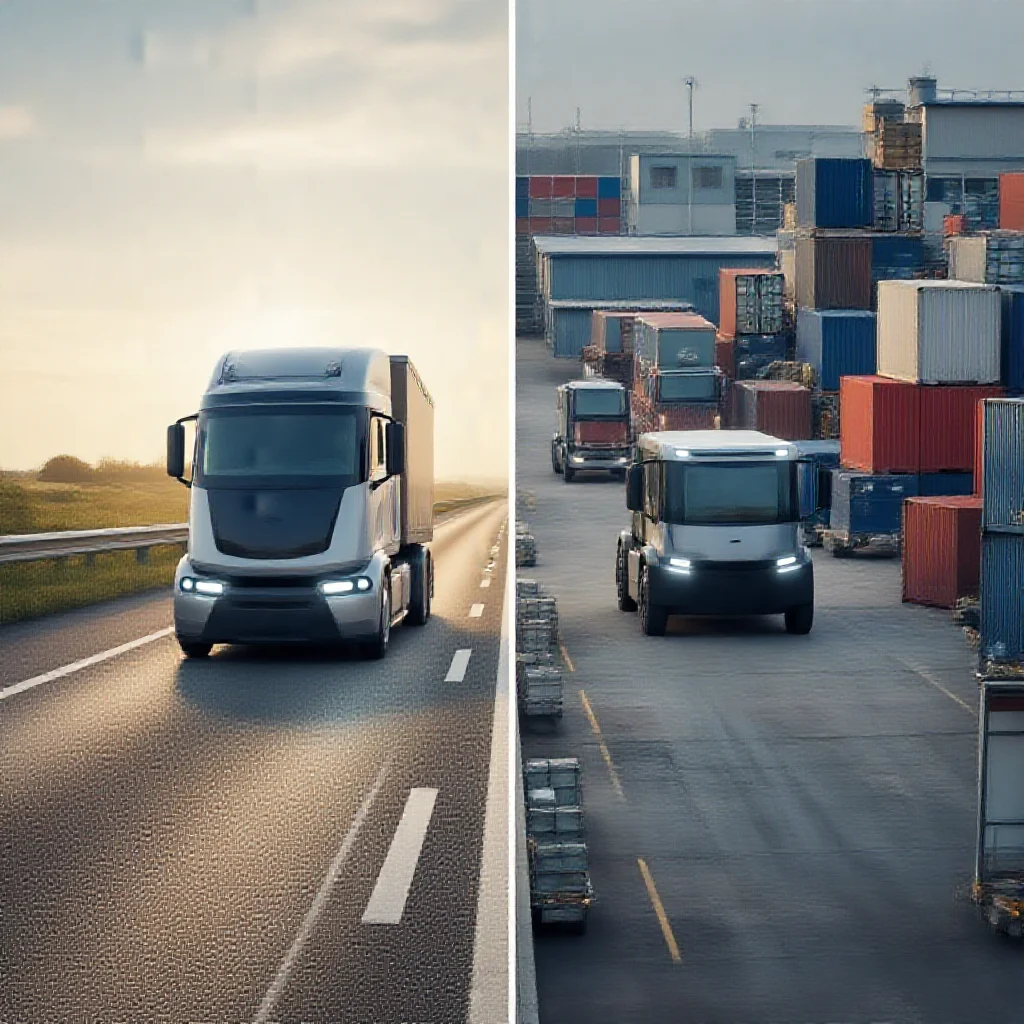
"The autonomous trucking industry is no longer pursuing a monolithic path"
Beyond the Driver's Seat: How Divergent Market Entry Models Are Shaping the Future of Autonomous Trucking
Introduction: The End of the One-Size-Fits-All Dream
The initial vision of a universally capable self-driving truck, navigating any road in any condition, is receding. In its place, a landscape of strategic specialization is emerging. This fragmentation into distinct commercialization models represents a critical maturation phase for the autonomous trucking industry, signaling a pragmatic confrontation with real-world operational and economic complexity. The industry is moving beyond a single approach to commercialization (Source 1: [Industry Analysis]). The chosen market entry model is no longer merely a technical roadmap; it is a fundamental strategic bet on which segment of the logistics value chain will be most disrupted and, consequently, which will yield the most durable profitability in a post-driver ecosystem.
Deconstructing the Core Axes of Divergence
The divergence in market entry strategies can be mapped across three core axes, each representing a critical strategic fork in the road.
* Axis 1: Operational Design Domain (ODD) – The ‘Where’. The primary split lies between highway-only and terminal-capable systems. Highway-first models restrict operations to controlled-access highways with clear markings and predictable traffic flow. Terminal-capable models aim to handle the significantly more complex navigation required in freight yards, docking bays, and urban industrial areas.
* Axis 2: Deployment Strategy – The ‘How’. Approaches vary from a phased, human-supervised rollout—using remote operators or safety drivers to manage exceptions and complex scenarios—to a direct pursuit of full, unsupervised driverless operations from the outset. This axis balances speed-to-market against operational risk and regulatory scrutiny.
* Axis 3: Business Philosophy – The ‘Who’. The underlying economic model separates asset-light technology licensors, who aim to sell or license autonomous driving stacks to existing truck manufacturers and fleets, from full-stack freight service providers, who intend to own and operate a fleet of autonomous trucks, selling freight capacity directly to shippers.
These models are emerging based on factors like operational design domain and deployment strategy (Source 2: [Market Strategy Reports]). The combination of choices across these axes defines a company’s initial market beachhead and its long-term strategic posture.
The Hidden Economic Logic: A Bet on the Pain Point
The divergence in technical ODD is fundamentally a divergence in economic targeting. Each model represents a calculated bet on which logistical bottleneck, when removed, creates the highest margin and most defensible business moat.
The ‘Highway-First’ Model targets the long-haul driver shortage and the associated wage cost, which can constitute over 40% of total operating expenses for a traditional fleet. This model optimizes for maximum asset utilization on the most predictable and monotonous leg of a journey. Its economic logic is one of substitution and efficiency gain on a known, high-cost line item.
Conversely, the ‘Terminal-Capable’ Model bets on solving a more complex, expensive, and time-consuming bottleneck: the “first and last mile” within freight hubs. This includes the significant labor, fuel, and time costs associated with yard maneuvering, docking, and trailer transfers. By aiming to control the entire trip from dock to dock, this model seeks to unlock value not just from driver replacement, but from streamlining the entire transfer hub operation, a major source of delay and cost in contemporary supply chains.
These are not merely technical preferences but financial strategies. The fragmentation indicates a maturing market with varied paths to market entry, each with its own risk-reward profile and target customer (Source 3: [Commercialization Studies]).
Slow Analysis: The Long-Term Ripple on Supply Chain Architecture
The implications of these competing models extend far beyond transportation costs. They will passively dictate the future physical and strategic architecture of global supply chains over decades.
A proliferation of highway-only autonomy could reinforce and accelerate the existing trend toward centralized ‘hub-and-spoke’ networks. If autonomous trucks are most efficient on long, uninterrupted highway hauls between major nodes, the economic incentive grows to build larger, more automated mega-distribution centers at those hubs. This model favors scale and consolidation in warehouse infrastructure.
In counterpoint, the successful deployment of dock-to-dock autonomous systems could enable more decentralized, responsive ‘point-to-point’ networks. By reducing the cost and complexity of freight handling at terminals, it becomes economically viable to move goods directly between more numerous, smaller facilities. This architecture could reduce aggregate inventory levels across the supply chain, increase responsiveness to demand shifts, and alter the optimal location of manufacturing and fulfillment centers.
The ultimate impact is that the dominant autonomous entry model will exert a passive but powerful influence on future warehouse real estate, corporate inventory strategies, and even retail business models that rely on just-in-time delivery. The competition is not only to build a better truck but to shape the landscape in which it will operate.
Neutral Market/Industry Predictions
The autonomous trucking market is unlikely to converge on a single winner-takes-all model in the foreseeable future. Instead, a period of coexistence and specialization is predicted. Highway-first models are likely to achieve scaled commercial deployment earlier, given the reduced technical complexity, and will initially capture value on specific, dense freight corridors. Terminal-capable models face a longer technical development path but, if successful, will compete for a different and potentially more lucrative segment of the logistics value chain.
The long-term industry structure may see a stratification similar to the broader technology sector: with some companies succeeding as specialized technology providers (the “Intel inside” model for trucks) and others evolving into large-scale, technologically-driven logistics service providers (the “Amazon Web Services” model for freight). Regulatory frameworks, insurance models, and public acceptance will evolve asymmetrically in response to these different operational paradigms, further cementing the fragmented, multi-model future of autonomous freight.
Trade Metrics
Related Datasets
Q4 Cross-Border Logistics Report
PDF • 4.2 MB
Automotive Parts Supply Chain Index
CSV • 1.1 MB