How AI Is Reshaping Trade Intelligence: Insights from ITA’s Industry Sectors
Sarah Martinez
Logistics Correspondent
June 21, 2026
DATELINE: NA TRADE WIRE
"The International Trade Administration (ITA) supports 22 industry sectors"
How AI Is Reshaping Trade Intelligence: Insights from ITA’s Industry Sectors and Beta Chatbot
When the U.S. International Trade Administration (ITA) quietly launched a beta AI chatbot called the Global Business Navigator earlier this year, few outside trade policy circles noticed. Yet the tool, built on Microsoft Azure AI and trained on ITA’s Export Solutions web pages, represents a significant experiment: Can artificial intelligence democratize the labyrinthine world of export regulations, tariff classifications, and market entry requirements—information that small and medium-sized enterprises (SMEs) often struggle to access?
This article unpacks the ITA’s 22-industry portfolio, the chatbot’s capabilities and limitations, and the broader economic logic behind pairing human expertise with artificial intelligence. While the promise of faster trade intelligence is real, the beta status reveals a gap between hype and practical support that policymakers and businesses must navigate carefully.
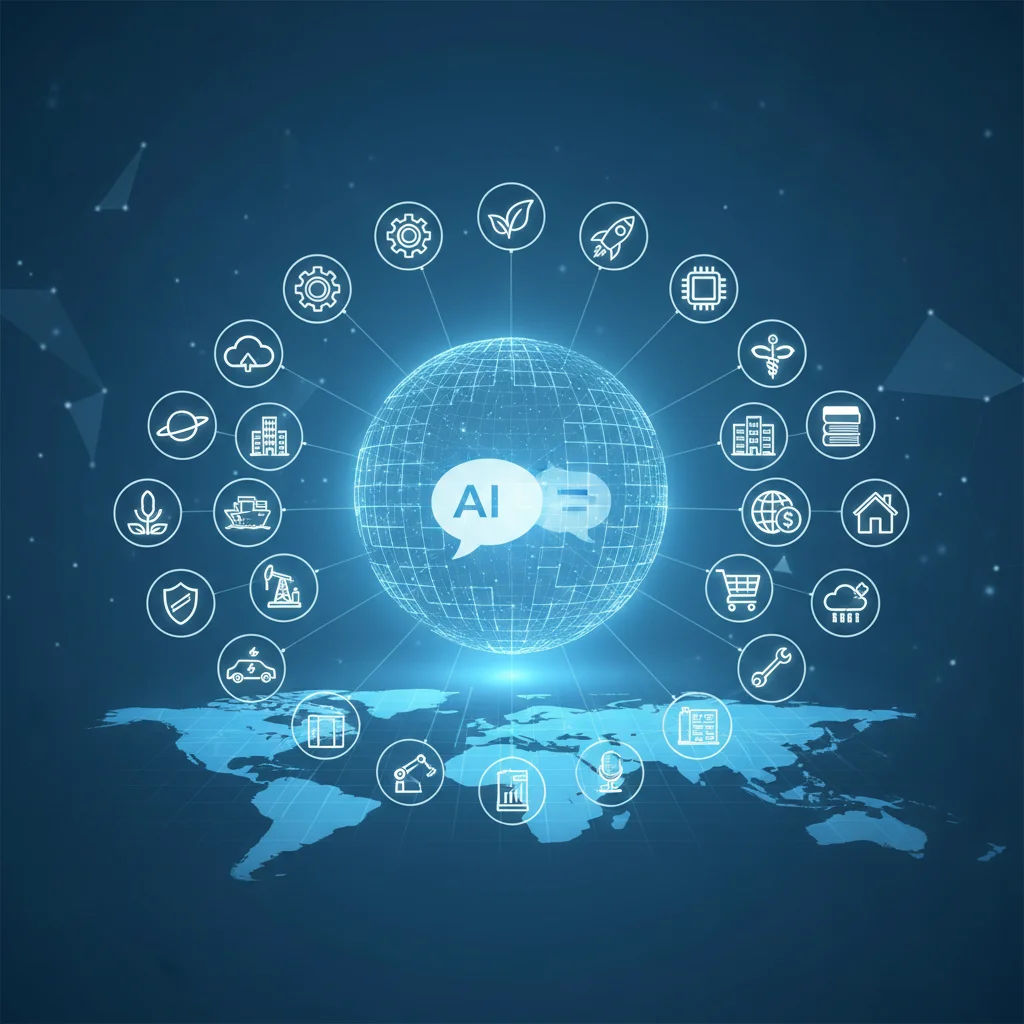
[IMAGE: A futuristic, minimalistic image showing a glowing AI chatbot interface floating above a world map, with icons representing 22 industry sectors arranged around it. No text, no watermark. Style: clean, professional, blue and white color palette with subtle grid lines suggesting international trade routes.]
---
The ITA’s 22-Industry Ecosystem: A Lens on Global Trade Priorities
The ITA’s industry coverage spans 22 distinct sectors, from Advanced Manufacturing to Travel & Tourism. This list is not arbitrary—it reflects the sectors the U.S. government deems critical for export growth and global competitiveness. The full roster includes:
| Aerospace & Defense | Automotive | Chemical | Consumer Goods |
|---------------------|------------|----------|----------------|
| Digital Economy | Energy & Environmental Tech | Financial Services | Food & Beverage |
| Health & Medical | Industrial Machinery | Information & Communication Tech | Metals & Mining |
| Pharmaceuticals | Professional Services | Retail & E-commerce | Supply Chain & Logistics |
| Textiles & Apparel | Transportation & Infrastructure | Travel & Tourism | Wood & Paper |
Several patterns emerge. The inclusion of Digital Economy and Environmental Tech signals a strategic pivot toward high-value, sustainability-driven trade—areas where the U.S. seeks to maintain a competitive edge amid global decarbonization efforts. The Supply Chain & Logistics sector, added after pandemic-era disruptions, reflects a newfound urgency to strengthen trade resilience. Meanwhile, traditional heavyweights like Aerospace and Automotive remain, but their sub-sectors now increasingly incorporate electric vehicles, advanced materials, and digital twins.
“Our industry teams are dedicated to helping your business expand market access,” the ITA states on its website. This mission applies equally to the agency’s 200+ industry specialists—seasoned experts who provide tailored guidance—and to the nascent AI chatbot. Yet the chatbot represents a fundamentally different approach: scalable, self-service, and always available, but limited by the static nature of its training data.
[IMAGE: Infographic showing the 22 industry icons arranged in a circle with the ITA logo in the center.]
The hidden economic logic here is that the ITA’s industry teams already generate an enormous volume of structured knowledge: market reports, tariff schedules, export guides, and compliance checklists. Much of this information is publicly available but scattered across thousands of web pages. The chatbot aims to aggregate and surface it more efficiently.
---
Global Business Navigator: A Beta AI Chatbot for Trade
The Global Business Navigator is currently in beta—a status that the ITA is transparent about. Developed on Microsoft Azure AI, the chatbot is trained exclusively on the content of Trade.gov Export Solutions pages, which cover topics from export documentation to foreign country-specific requirements.
Key capabilities include:
- Answering natural language questions about export procedures, e.g., “What are the labeling requirements for medical devices in Japan?”
- Providing links to official ITA resources for further reading.
- Maintaining conversation context within a single session, though it cannot recall past interactions across visits.
Notable design choices:
- No user data collection. The ITA states explicitly that the chatbot does not store personal information or conversation logs for anything beyond internal quality reviews. This privacy-first approach addresses common concerns about government AI tools.
- Conversations reviewed for improvement only. Human reviewers periodically sample anonymized interactions to refine the model’s accuracy—but no data is used for marketing or third-party sharing.
However, limitations are equally explicit. The chatbot’s own disclaimer warns: “This tool may produce inaccurate information and does not provide company-specific or market-specific advice.” It cannot analyze a business’s unique circumstances—such as a firm’s existing contracts, supply chain dependencies, or credit risks—nor can it offer customized market-entry strategies. Its knowledge is confined to the content of Export Solutions pages, which are updated periodically but not in real time.
[IMAGE: Screenshot mockup of a chatbot interface with a user asking “How do I export medical devices to Japan?” and a partial AI response showing a list of regulatory steps.]
For example, if a user asks about the latest tariff changes under a new trade agreement, the chatbot might reference outdated information if the relevant Export Solutions page hasn’t been revised. This limitation is critical because trade policies—tariff rates, licensing requirements, sanctions lists—can shift weekly.
---
The Hidden Economic Logic: Why AI + Industry Teams Matter
The ITA’s dual approach—maintaining both human industry experts and an AI chatbot—addresses a well-documented market gap: SMEs lack the resources to navigate complex trade regulations and routes. According to the U.S. Census Bureau, firms with fewer than 500 employees account for over 97% of all exporters but represent only about one-third of total export value. Many SMEs never attempt to export, citing regulatory complexity as the primary barrier.
The Global Business Navigator reduces friction in information retrieval. Instead of scouring dozens of government pages, a business owner can type a question and receive a concise answer with links. For simple inquiries—such as “What is the Harmonized Tariff Schedule code for ceramic tiles?”—the chatbot can save hours.
Yet its beta status reveals a cautious rollout. Accuracy and completeness are non-negotiable for trade decisions; a wrong tariff code can result in fines or shipment delays. The ITA appears to be balancing innovation with risk management, releasing the chatbot in a limited capacity while collecting feedback.
[IMAGE: Diagram showing a funnel: broad industry data → AI chatbot → filtered insights for SMEs, with a ‘beta’ label on the AI stage.]
The unseen impact lies in the potential for deeper integration. If the chatbot could eventually cross-reference industry data (e.g., export volumes by sector) with trade policies (e.g., preferential tariff rates under the USMCA), it might help identify optimal supply chain routes or emerging market opportunities. For instance, a textile exporter could learn which Southeast Asian markets offer tariff-free access for organic cotton—information that currently requires manual research across multiple databases.
But the current scope is limited to static web pages. The chatbot cannot access real-time customs data, trade dispute filings, or foreign government regulatory updates. This constraint means that while AI can accelerate the information search stage, it cannot yet replace human judgment on nuanced questions like “Is Country X likely to impose new sanitary standards on soy imports next quarter?”
---
Challenges and Realities: AI Limitations in Trade Intelligence
Despite the promise, the Global Business Navigator’s beta status underscores several fundamental challenges for AI in trade intelligence.
First, knowledge freshness. The chatbot’s training data is a snapshot of Export Solutions content at the time of model updates. Trade policy changes—new sanctions, updated certificate-of-origin rules, shifting tariff rates—require manual content updates before the chatbot can reflect them. During the transition, the tool risks providing outdated or even harmful advice.
Second, contextual understanding. The chatbot excels at retrieving facts but struggles with ambiguous questions. A query like “What paperwork do I need to sell to Europe?” could refer to the EU, the broader European Economic Area, or a single country like Germany. The answers differ substantially. Without clarifying follow-up questions, the chatbot may default to a generic response that misleads users.
Third, liability concerns. The ITA’s disclaimer that the chatbot “may produce inaccurate information” effectively shields the agency from legal responsibility. For a business that relies on the tool’s advice and suffers losses due to errors, there is no recourse. This liability gap limits how deeply SMEs can trust the tool for high-stakes decisions.
Fourth, language and cultural barriers. The chatbot is English-only, which excludes many non-native-speaking exporters who might need trade guidance. Moreover, it cannot interpret culturally specific business practices—such as gift-giving norms in East Asian markets—that seasoned human advisors would know.
[IMAGE: Split image showing left side: a complex flowchart of trade regulations; right side: a simple chatbot question box with a warning icon reading “Beta – May Produce Inaccurate Information”.]
These limitations do not negate the value of the experiment. Rather, they highlight the need for a hybrid model where AI handles routine, fact-based queries while human experts tackle complex, judgment-intensive cases. The ITA’s industry teams remain the backbone of trade support; the chatbot is a front-end efficiency tool.
---
Implications for SMEs and Global Supply Chains
For SMEs, the Global Business Navigator offers a low-cost entry point into trade intelligence. A small manufacturer exploring exports for the first time can quickly learn the basics: required documents, common pitfalls, and helpful government resources. This alone could reduce the time-to-export for many businesses.
However, SMEs must treat the chatbot as a starting point, not a final authority. The ITA itself advises users to “verify all information with official sources or a trade specialist.” For high-value decisions—entering a new market, choosing a freight forwarder, or restructuring supply chains—human expertise remains indispensable.
The broader implication for global supply chains is that AI tools like this could gradually lower barriers to entry for smaller players, potentially diversifying the exporter base. If more SMEs successfully export, supply chains become less dependent on a handful of large multinationals, enhancing resilience. But this outcome hinges on the chatbot’s accuracy and scope improving over time.
[IMAGE: World map with highlighted trade routes connecting major ports, with small icons representing SMEs at origin nodes and a blue glow indicating AI-assisted decision points.]
---
Conclusion: A Measured Step Forward
The ITA’s Global Business Navigator is a pragmatic experiment in applying AI to trade intelligence. It does not—and does not claim to—revolutionize export assistance overnight. Rather, it addresses a specific pain point: the difficulty of finding structured information across a vast government website.
By limiting the chatbot’s scope to static content, avoiding user data collection, and being transparent about its beta status, the ITA has taken a responsible approach. Future iterations could incorporate real-time policy feeds, multilingual support, and integration with customs databases. But for now, the tool serves as a useful supplement to the work of the ITA’s 22 industry sector teams.
The real lesson is that AI in trade is not about replacing human expertise—it is about amplifying it. The International Trade Administration’s commitment to both human advisors and an AI chatbot reflects a nuanced understanding that successful export support requires speed and accuracy, scale and customization. As the beta evolves, trade professionals will be watching closely to see whether the promise of AI-assisted trade intelligence outweighs the perils of incomplete or inaccurate answers.
For now, the answer is cautious optimism—with a beta label attached.
---
Keywords: International Trade Administration, Global Business Navigator, AI in trade, export assistance, industry sectors, beta chatbot, trade intelligence, SME export support
Trade Metrics
Related Datasets
Q4 Cross-Border Logistics Report
PDF • 4.2 MB
Automotive Parts Supply Chain Index
CSV • 1.1 MB