From Digital to Physical: How AI is Reshaping the Tangible Core of Supply

Sarah Martinez
Logistics Correspondent
March 28, 2026
DATELINE: NA TRADE WIRE
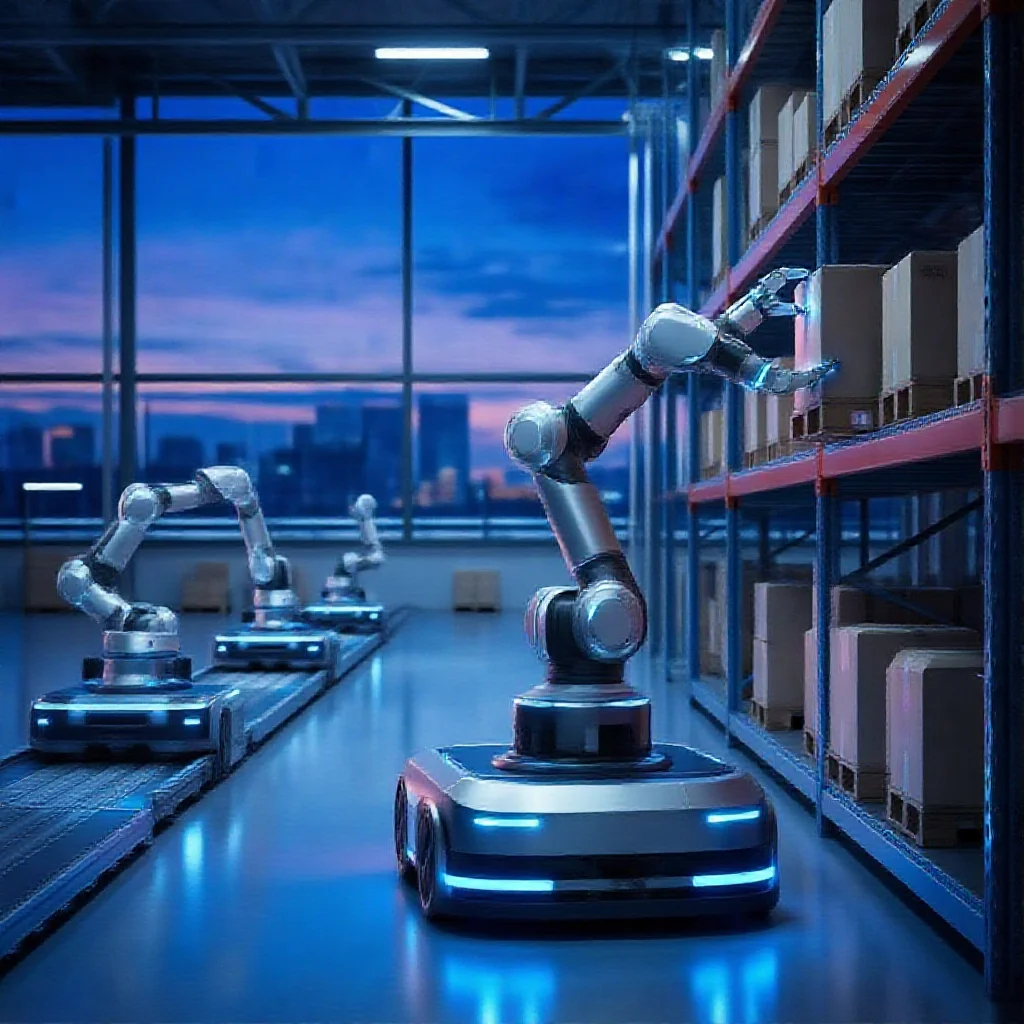
"By 2026, the application of artificial intelligence is undergoing a critical"
From Digital to Physical: How AI is Reshaping the Tangible Core of Supply Chains
Summary: By 2026, the application of artificial intelligence is undergoing a critical shift from digital planning to direct physical execution within supply chains. This article explores the profound implications of this transition, moving beyond predictive analytics to examine how AI-driven robotics, autonomous vehicles, and smart warehousing are fundamentally altering labor dynamics, infrastructure investment, and real-time operational resilience. We analyze the strategic areas leaders must monitor to navigate this new era where intelligence is embedded not just in software, but in the very movement and manipulation of goods.
The Pivot Point: AI's Leap from the Server Room to the Warehouse Floor
The dominant narrative of AI in supply chains for the past decade has centered on predictive analytics, digital twins, and planning optimization. These are cognitive functions performed within software, advising human decision-makers. The period leading to 2026 marks a definitive pivot, where artificial intelligence transitions from an advisory role to one of direct physical actuation. This shift represents the maturation of a "Physical Intelligence Layer," where AI algorithms do not merely suggest an action but execute it through robotic appendages, autonomous guided vehicles, and intelligent material handling systems.
This transition from digital simulation to physical execution is now reaching mainstream strategic awareness, as noted in contemporary industry analysis (Source 1: logisticsviewpoints.com, March 24, 2026). The core differentiator is the closure of the control loop. Where digital AI predicts a stock-out, physical AI directs a robot to relocate inventory; where it forecasts a delay, it autonomously reroutes a forklift or a delivery drone. The locus of intelligence is migrating from centralized servers to distributed nodes at the edge of operations.
Beyond Efficiency: The Hidden Economic Logic of Physical AI Integration
The initial justification for physical AI integration often focuses on labor cost reduction and operational efficiency. The deeper economic logic, however, is capability-building. Physical AI enables service models that are otherwise untenable. Micro-fulfillment centers in dense urban areas, economically unviable with human labor alone, become feasible with dense, high-throughput robotic systems. "Lights-out" or fully autonomous warehouses can operate continuously, decoupling throughput from human shift patterns and geographical labor pools.
This shift has significant implications for capital allocation. Investment is transitioning from purely human-centric infrastructure to cyber-physical systems, altering the traditional balance between capital expenditure (CAPEX) and operational expenditure (OPEX). A higher upfront CAPEX in robotics and sensor networks aims to lock in lower, more predictable long-term OPEX and enable revenue from new services. Furthermore, it facilitates a reconsideration of global footprints. When physical operations are less dependent on local labor cost and availability, the calculus for near-shoring or reconfiguring network nodes changes fundamentally. The underlying market pattern suggests a move toward "supply chain as a self-optimizing system," where human intervention is reserved for exception handling and strategic oversight, not routine execution.
Strategic Imperatives: Four Key Areas for Leadership Monitoring
- Interoperability and System Fragmentation: The current landscape features proprietary robotic ecosystems from major vendors. The strategic risk is the creation of new physical silos, where mobile robots from one manufacturer cannot interface with storage systems or packaging lines from another. Leadership must monitor the development of open standards and middleware that ensure different physical AI agents can collaborate within a unified operational environment.
- Workforce Transformation and Hybrid Teams: The model is evolving from pure automation-for-replacement to structured human-AI collaboration. The emerging imperative is managing hybrid teams where humans supervise, maintain, and work alongside autonomous systems. This requires new skill sets focused on robot oversight, data interpretation, and system troubleshooting, necessitating significant investment in workforce retraining and organizational redesign.
- Resilience of Autonomous Systems: Physical AI introduces novel failure modes and vulnerabilities. A cyber-attack could now cause direct physical damage or gridlock, not just data theft. The resilience of an AI-driven warehouse depends on the system's ability to gracefully degrade, have fallback protocols, and defend against cyber-physical threats. Traditional business continuity planning must expand to include the failure scenarios of intelligent equipment.
- Data Infrastructure for the Physical World: The performance of physical AI is contingent on the quality and latency of sensor data. Computer vision, LiDAR, and force feedback sensors generate vast, real-time data streams. The infrastructure must support this flow to train, validate, and provide real-time feedback for AI actions. Inadequate data infrastructure will lead to "brittle" physical AI that fails under unmodeled or dynamic real-world conditions.
The Deep Audit: Unseen Consequences on the Underlying Supply Chain
The integration of a Physical Intelligence Layer will have second- and third-order effects on supply chain fundamentals. An "Infrastructure Inversion" hypothesis posits that AI-driven logistics may favor different asset types. For example, autonomous trucking may reduce the need for certain intermediary hubs but increase demand for specialized charging/ servicing depots. Ports may be redesigned around continuous, AI-coordinated flow rather than batch handling.
Inventory theory may also be revisited. Pervasive physical AI could enable a hyper-granular "just-in-time" model, with robots performing constant, micro-replenishment within a facility. Conversely, the same technology could make the holding of strategic buffer stocks more efficient and dynamically managed by AI, potentially reviving their strategic use in certain lanes.
An environmental footprint paradox emerges. The direct energy consumption of compute-intensive AI and a fleet of robots is substantial. The net environmental impact will be determined by whether the gains in overall network optimization, reduced waste from errors, and more efficient transportation routing outweigh this increased direct energy draw. A full lifecycle analysis is required.
Navigating the Transition: A Framework for Action
The transition to physical AI operations is not a singular technology adoption but a systemic transformation. A structured framework for action is necessary.
First, pilot programs must be prioritized for closed-loop, high-impact processes where the physical AI can be clearly measured against a baseline. Second, investment must be allocated not only to the robots themselves but to the enabling data and connectivity infrastructure that forms their central nervous system. Third, governance models require updating to encompass ethics of automation, safety protocols for human-robot interaction, and new key performance indicators that measure system resilience and capability enhancement, not just efficiency gains.
The logical end-state is a supply chain where the boundary between digital planning and physical execution is blurred. Intelligence will be ambient, embedded in the very infrastructure that moves, stores, and assembles goods. The organizations that will navigate this transition successfully are those auditing their operations not just for digital readiness, but for physical adaptability. The competitive frontier has moved from the cloud to the warehouse floor, the loading dock, and the delivery vehicle. The era of cognitive physical operations has begun.
Trade Metrics
Related Datasets
Q4 Cross-Border Logistics Report
PDF • 4.2 MB
Automotive Parts Supply Chain Index
CSV • 1.1 MB