Beyond the $70M Grant: How LA''s Port Infrastructure Investment Reshapes Global

Lisa Park
Supply Chain Editor
April 12, 2026
DATELINE: NA TRADE WIRE
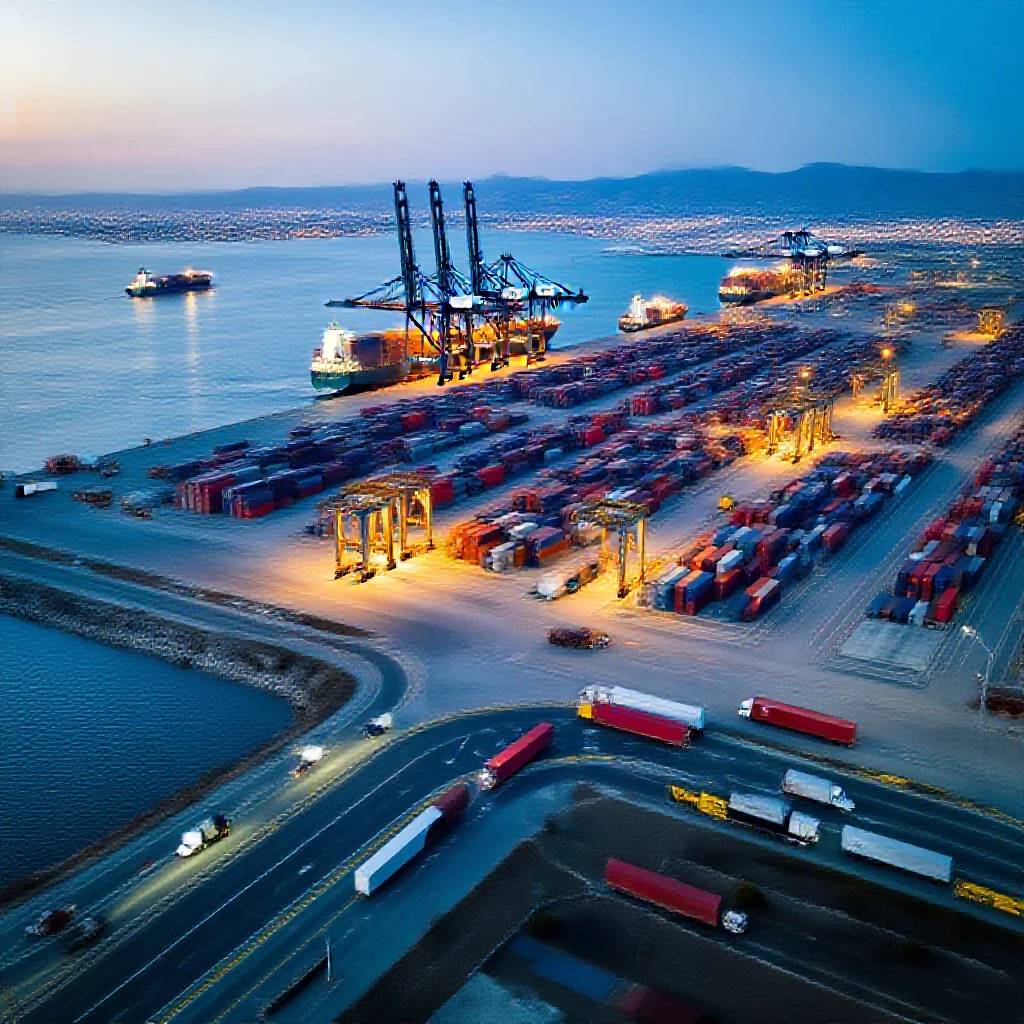
"The Port of Los Angeles''s recent $70.6 million federal grant is more than"
Beyond the $70M Grant: How LA's Port Infrastructure Investment Reshapes Global Supply Chain Resilience
The Port of Los Angeles has been awarded $70,630,625 in federal funding from the U.S. Department of Transportation's Maritime Administration (Source 1: [Primary Data]). This allocation, sourced from the Port Infrastructure Development Program (PIDP), will be directed toward three specific infrastructure initiatives: the West Harbor Transportation Improvement Project, the Terminal Island Water Quality Improvement Project, and the Backland Improvements for Sustainable Expansion Project (Source 1: [Primary Data]). On the surface, this constitutes a significant capital injection for port modernization. A deeper analysis, however, reveals a strategic pivot in post-pandemic port economics, shifting investment focus from pure volumetric capacity to systemic resilience and operational fluidity.
The $70.6M Blueprint: Decoding the Three-Pronged Strategic Investment
The PIDP itself is a legislative response to the systemic failures exposed during the 2021-2022 global supply chain crisis. The allocation to the Port of Los Angeles, the nation's premier container gateway, is not for speculative expansion but for targeted remediation of chronic, known failure points. The three funded projects function as interconnected components of a coordinated resilience strategy.
The West Harbor Transportation Improvement Project will reconstruct a roadway and add a dedicated truck lane. The Terminal Island Water Quality Improvement Project involves constructing a stormwater treatment facility. The Backland Improvements for Sustainable Expansion Project will prepare a site for future development of a container storage and chassis facility (Source 1: [Primary Data]). Individually, these are municipal engineering upgrades. Collectively, they address the triad of congestion, environmental risk, and spatial rigidity that crippled port operations during peak demand.
From Throughput to Throughput Velocity: The Hidden Economic Logic
The economic logic of the West Harbor project transcends pavement quality. It directly targets the "drayage" bottleneck—the short-distance truck movement of containers from ship to rail or warehouse. This leg is often the most expensive and unpredictable segment of containerized freight. Chronic truck congestion at terminal gates increases turn times, reducing asset utilization for trucking firms and imposing demurrage and detention costs on shippers.
Investing in dedicated truck lanes and roadway reconstruction is an investment in velocity. Studies on port congestion, such as those cited by the National Academies of Sciences, Engineering, and Medicine, quantify the multi-billion-dollar economic drag of port inefficiency. The return on investment for fluidity is measured in reduced per-container logistics costs and enhanced reliability for import-dependent industries. This grant signals a recognition that the value of a port is increasingly defined not by how many containers it can store, but by how quickly and predictably it can move them through the system.
Future-Proofing Against the Next Crisis: Environmental and Spatial Resilience
The remaining two projects address latent risks that threaten future operations. The Terminal Island Water Quality Project is a pre-emptive risk mitigation investment. It moves beyond basic regulatory compliance to future-proof the port against inevitable stricter Environmental Protection Agency regulations on stormwater discharge and climate-change-induced storm surges. Non-compliance presents a direct operational and financial risk, potentially leading to fines or work stoppages.
The Backland Improvements Project represents the creation of a strategic "option." By preparing land for container and chassis storage, the port is building a critical buffer zone. The scarcity of such "flex space" was a primary accelerant of the 2021-2022 gridlock, as containers with nowhere to go clogged terminal yards, halting operations. This investment facilitates a shift from "just-in-time" to "just-in-case" logistics at the foundational infrastructure level, providing the spatial elasticity needed to absorb demand shocks without systemic failure.
The Ripple Effect: Implications for National Competitiveness and Consumer Markets
The strategic recalibration at the Port of Los Angeles has implications extending far beyond its terminals. As the primary U.S. gateway for transpacific trade, its operational efficiency is a direct input into national economic competitiveness and domestic price stability. Improved port fluidity can dampen logistics cost pressures on a vast array of imported goods, from consumer electronics to automotive parts, contributing to moderated inflationary pressures.
Furthermore, enhanced reliability makes U.S. import channels more attractive versus alternatives, strengthening the nation's position within global trade networks. For manufacturers and retailers, predictable lead times reduce the need for excessive safety stock, lowering inventory carrying costs. This federal investment, therefore, is not merely a subsidy for local infrastructure but a strategic expenditure on the resilience of the national supply web, aiming to convert a critical point of vulnerability into a source of durable competitive advantage.
Trade Metrics
Related Datasets
Q4 Cross-Border Logistics Report
PDF • 4.2 MB
Automotive Parts Supply Chain Index
CSV • 1.1 MB