North America Transportation & Logistics Market Forecast: Key Trends and Growth

Lisa Park
Supply Chain Editor
May 14, 2026
DATELINE: NA TRADE WIRE
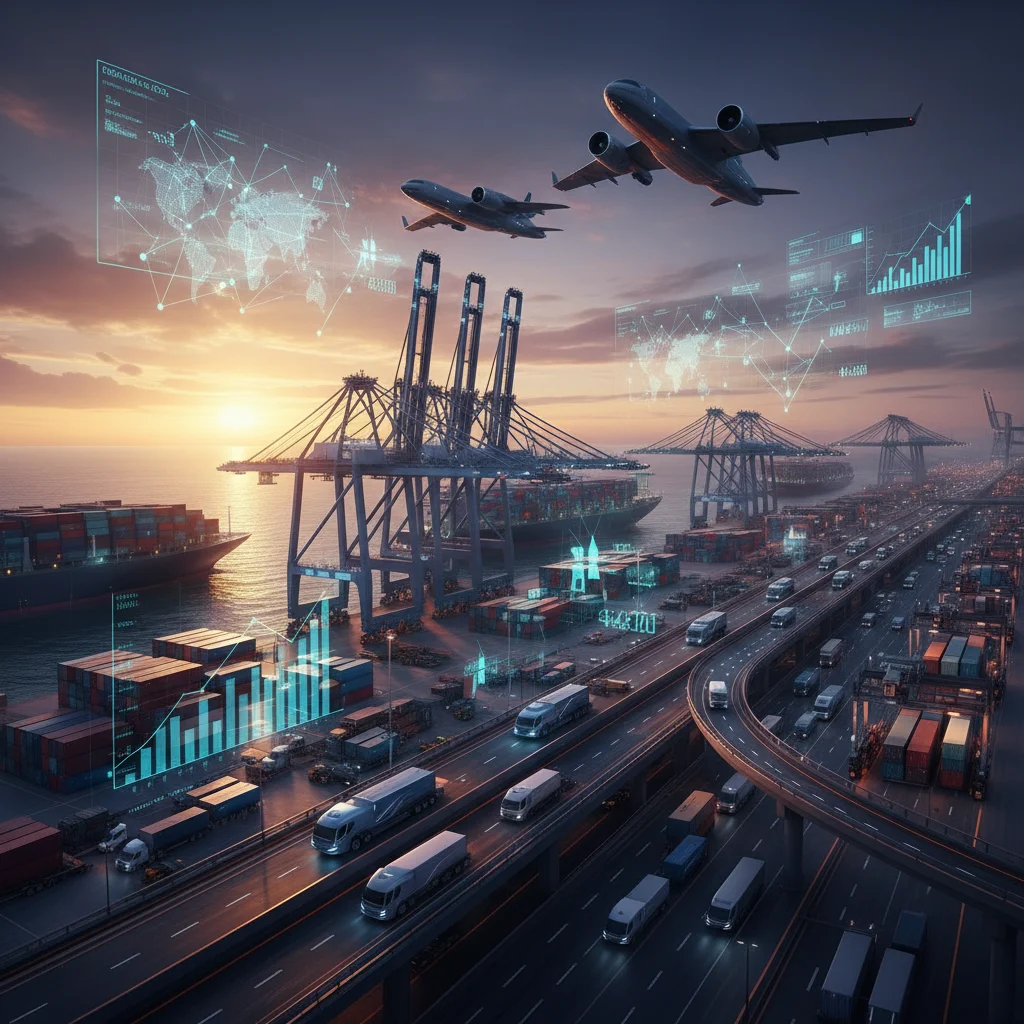
"The North American transportation and logistics market is poised for significant"
North America Transportation & Logistics Market Forecast: Key Trends and Growth Drivers for Supply Chain Resilience
Introduction: The New Geography of North American Logistics
The North American transportation and logistics market is entering a transformative phase. Industry estimates suggest total logistics costs across the region are projected to surpass $1.8 trillion by 2027, representing a compound annual growth rate (CAGR) of approximately 4.5% from 2023 levels. Container port traffic, the vital artery of continental trade, is forecast to exceed 270 million twenty-foot equivalent units (TEUs) annually within the same timeframe. These masked figures are not merely statistical projections—they signal a fundamental recalibration of how goods move across the continent.
[IMAGE: A map of North America with shipping lanes, rail lines, and major logistics hubs highlighted in glowing blue]
For decades, the dominant logic in supply chain management was cost minimization: squeeze inventory, optimize routes, and reduce labor expenses. That paradigm has shifted. The post-pandemic era has exposed the fragility of just-in-time models, and the North America supply chain trends now point toward a new imperative: resilience over efficiency. This article decodes the hidden economic logic and technology trends behind the forecast data, offering stakeholders a forward-looking perspective on the region's evolving logistics landscape.
Market Size and Growth: Investment Imperatives Behind the Numbers
The projected growth in logistics costs—from approximately $1.5 trillion in 2023 to over $1.8 trillion by 2027—reflects more than inflation. It signals the scale of capital investment required to modernize aging infrastructure, address persistent labor shortages, and accelerate technology adoption across the transportation logistics market.
Breaking down the CAGR drivers reveals three interconnected dynamics:
First, e-commerce penetration continues to climb, now accounting for over 22% of retail sales in the United States and Canada combined. This shift demands last-mile delivery networks that are denser, faster, and more flexible than traditional parcel systems.
Second, nearshoring and supply chain diversification are redirecting trade flows. Mexico surpassed China as the largest trading partner of the United States in 2023, a trend that reshapes trucking corridors, rail routes, and border crossing infrastructure from Laredo to Nogales.
Third, labor constraints remain acute. The American Trucking Associations estimates a shortage of 80,000 drivers, a figure that could double by 2030. Automation and autonomous vehicle technology are no longer theoretical solutions—they are operational necessities.
[IMAGE: A line graph showing year-over-year logistics cost growth with annotations for key drivers like e-commerce and reshoring]
Compared to the Asia-Pacific region, where manufacturing-centric supply chains dominate, North America's growth is uniquely characterized by consumption-driven demand. The implication is clear: investment must prioritize distribution and fulfillment infrastructure over production logistics.
Container Port Traffic: The Pulse of Trade
Container port traffic across North America is forecast to climb from approximately 210 million TEUs in 2023 to over 270 million TEUs by 2027. This growth is tightly correlated with GDP expansion, but the relationship is not linear. Each additional TEU generates disproportionate demands on inland infrastructure—trucks, rail cars, warehouse space, and cross-dock facilities.
Port congestion, a painful memory of 2021-2022, has not been eliminated. Rather, the system has learned to manage volatility through digitalization. Terminal operating systems now use AI to optimize crane scheduling and container placement. The Port of Los Angeles, for instance, has invested $500 million in a digital platform that integrates data from ocean carriers, rail operators, and trucking companies to predict congestion and allocate resources dynamically.
[IMAGE: Aerial view of a busy container terminal with automated cranes and stack yards]
The ripple effects of port capacity extend far beyond waterfront terminals. Consider the chassis shortage during peak seasons—a single bottleneck at Los Angeles-Long Beach can idle trucks across the Midwest. Similarly, rail dwell times on the West Coast directly impact warehouse utilization rates in Dallas, Chicago, and Atlanta. The container port traffic North America data is therefore a leading indicator for the entire logistics ecosystem.
Sub-market Deep Dive: 3PL, Postal, and Freight Forwarding
Third-Party Logistics (3PL): The E-commerce Enabler
The 3PL market in North America is projected to grow from $275 billion to $350 billion by 2028, driven primarily by retailers outsourcing warehousing and fulfillment operations. The logic is simple: building owned distribution networks is capital-intensive and inflexible. Third-party providers offer scalability, geographic reach, and specialized capabilities in inventory management, order fulfillment, and reverse logistics.
Leading players like DHL, FedEx, and UPS are expanding their 3PL arms aggressively. DHL Supply Chain has added over 15 million square feet of warehousing space across the United States since 2021, much of it equipped with autonomous mobile robots and automated sorting systems. The 3PL growth story is not just about capacity—it is about technology integration that allows real-time visibility and dynamic inventory allocation.
[IMAGE: Diagram of the North American supply chain showing the three sub-markets as interconnected layers, with icons for trucks, ships, planes, and warehouses]
Postal Services: Reinvention Under Pressure
The United States Postal Service (USPS) and Canada Post are undergoing existential transformations. Traditional mail volumes continue to decline, while e-commerce parcel delivery now accounts for over 60% of USPS revenue. The agency's 10-year reform plan, "Delivering for America," includes $40 billion in modernization investments—new processing equipment, electric delivery vehicles, and a redesigned transportation network.
Private carriers like FedEx and UPS maintain competitive advantages in speed and reliability, but USPS leverages statutory obligations for universal service and lower pricing on last-mile delivery. The tension between public service mandates and commercial viability defines this sub-market's trajectory. DHL, while primarily focused on international express, also competes in cross-border e-commerce parcel delivery from Canada and Mexico.
Freight Forwarding: Modal Shifts and Regional Dynamics
The freight forwarding segment encompasses road, rail, pipeline, waterborne, and air transport. Current freight forwarding trends indicate a clear shift toward intermodal solutions—combining rail for long-haul efficiency with trucking for last-mile flexibility. Rail carriers like Union Pacific and BNSF are investing in transload facilities that allow seamless container-to-trailer transfers.
Air freight, traditionally reserved for high-value perishables and emergency shipments, is gaining share due to e-commerce time-sensitivity and nearshoring urgency. The air express segment, dominated by FedEx and UPS, now handles over 40 million packages daily across North America. Pipeline transport, critical for energy logistics, remains stable but faces regulatory headwinds.
Supply Chain Resilience: The New Strategic Imperative
The supply chain resilience agenda reshapes every decision in the North America supply chain trends landscape. Companies are moving from single-source to multi-source procurement. Inventory strategies are shifting from just-in-time to just-in-case, with safety stock levels rising by 20-30% across many sectors.
This has direct implications for the transportation logistics market: longer holding periods mean higher warehousing demand, more complex inventory management, and greater need for real-time tracking. Resilience also drives investment in digital twins, supply chain control towers, and AI-powered demand forecasting.
[IMAGE: Infographic showing a supply chain control tower dashboard with real-time data on shipments, inventory levels, and risk alerts]
The hidden cost of resilience is higher logistics cost ratios. Where previously companies targeted logistics costs at 8-9% of revenue, many now accept 10-12% as the price of reliability. This structural shift underpins the projected growth in total logistics expenditures.
Technology Trends: Automation, AI, and Digital Twins
Three technology themes dominate the forecast period:
Automation in warehousing is accelerating beyond pilot programs. Major operators are deploying goods-to-person systems, autonomous forklifts, and robotic palletizers. The payback period has shortened to 2-3 years due to rising labor costs and improved technology reliability.
Artificial intelligence is transforming route optimization, demand forecasting, and inventory placement. Machine learning models can now predict regional demand patterns with 85% accuracy, enabling proactive repositioning of inventory before peak seasons.
Digital twins create virtual replicas of entire supply chains, allowing companies to simulate disruptions—a port closure in Vancouver, a hurricane on the Gulf Coast, a rail strike in Chicago—and test mitigation strategies without real-world consequences.
DHL, FedEx, and UPS are investing heavily in these technologies. UPS's "Network of the Future" initiative, for example, uses AI to dynamically reroute packages through its sorting hubs based on real-time capacity and transit time constraints.
Conclusion: Preparing for the Next Disruption
The North American transportation and logistics market is not simply growing—it is restructuring. The masked forecast data points to a future where logistics costs rise as a share of GDP, container port traffic strains existing infrastructure, and sub-markets like 3PL and freight forwarding bifurcate between commodity providers and technology-enabled specialists.
For industry stakeholders, the actionable insights are clear:
- Invest in visibility across multi-modal networks, not just within owned assets.
- Plan for capacity constraints in port, rail, and warehouse infrastructure through 2028.
- Partner strategically with 3PL providers that offer technology integration rather than just square footage.
- Monitor nearshoring corridors from Mexico and Canada for emerging trucking and rail demand patterns.
The next disruption will not be a pandemic—it will be structural. Resilience, not efficiency, will define the winners in North America's evolving logistics landscape. The data is clear; the route forward requires decisive action.
Trade Metrics
Related Datasets
Q4 Cross-Border Logistics Report
PDF • 4.2 MB
Automotive Parts Supply Chain Index
CSV • 1.1 MB