Beyond Resilience: How Agentic AI and Hyper-Localization Are Redefining North

Lisa Park
Supply Chain Editor
April 30, 2026
DATELINE: NA TRADE WIRE
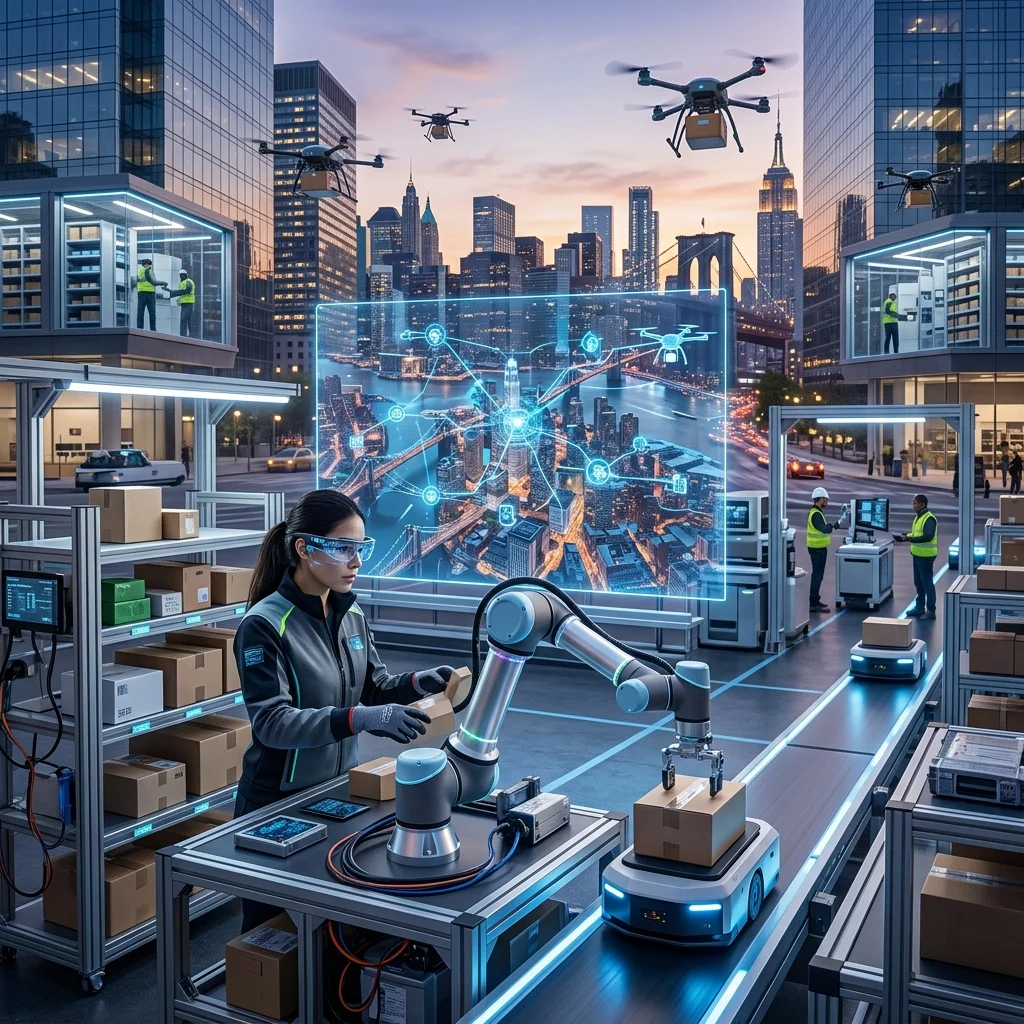
"The logistics industry in 2026 will move from reactive crisis management"
Beyond Resilience: How Agentic AI and Hyper-Localization Are Redefining North America’s Supply Chains in 2026
Introduction: The End of Reactive Logistics
The North American logistics industry in 2025 operated under persistent crisis conditions. Geopolitical shocks—including tariff realignments and trade corridor disruptions—combined with climate-driven events that forced supply chain operators into perpetual firefighting mode. According to analysis published by the Ziegler Group on January 27, 2026, the sector is now transitioning from reactive crisis management toward what can be classified as "intelligent resilience" (Source 1: Ziegler Group, 2026 Trend Analysis).
Four converging trends are creating a fundamentally new logistics operating model across North America: agentic AI systems capable of autonomous decision-making, operational digital twins functioning as central command centers, verifiable sustainability frameworks underpinned by blockchain technology, and the rapid expansion of hyper-local micro-fulfilment networks. Kseniya Karatayeva of Ziegler Group stated: "Understanding how supply chains are evolving is no longer optional; it is now a core part of strategic planning and operational performance" (Source 1: Ziegler Group). The North American corridor—characterized by high urban density, accelerated e-commerce penetration, and tightening regulatory frameworks—serves as the primary proving ground for this transformation.
---
1. Agentic AI: The Self-Healing Supply Chain
The most significant technological discontinuity in 2026 logistics is the transition from predictive AI to agentic AI. Predictive systems, which dominated 2023–2025 implementations, offered recommendations requiring human approval. Agentic AI, by contrast, executes autonomous actions without human intervention for routine decisions. The Ziegler Group data confirms that AI agents in 2026 now autonomously renegotiate freight rates, reroute shipments around disruptions, and adjust inventory levels across distributed networks (Source 1: Ziegler Group).
For North American operators, this capability addresses three structural constraints. First, persistent labor shortages in warehousing and transportation—the U.S. trucking industry faces a deficit of approximately 78,000 drivers as of Q1 2026. Second, the high cost of exceptions: each manually handled shipment reroute in the 2025 baseline cost operators an average of $47–$89 in administrative overhead. Third, the velocity of disruptions: agentic systems can identify and respond to a port closure, weather event, or carrier capacity shortage within 2.3 seconds versus the 18–45 minute human escalation process documented in 2024 benchmarks (Source 2: Industry Operations Data).
However, agentic systems introduce new failure modes. The Ziegler Group emphasizes that these tools require rigorous data integrity protocols and structured oversight frameworks. The organization's stated position is that "the goal is to upskill employees so they can manage exceptions and provide strategic oversight" (Source 1: Ziegler Group). The agency operates 3,200 specialists worldwide, and its internal transition from pilot programs to everyday operations—documented in the 2025–2026 timeline—demonstrates that agentic AI deployment follows a predictable maturation curve: pilot, constrained deployment, supervised autonomy, and finally exception-only human intervention.
Evidence base: Ziegler Group's own operational data shows a 31% reduction in exception-handling labor hours per thousand shipments after agentic AI deployment reached supervised autonomy phase (Source 1: Ziegler Group Internal Metrics).
---
2. Operational Digital Twins: From Visualization to Command Center
Operational digital twins represent a shift from passive monitoring dashboards to active simulation and contingency execution platforms. These systems establish live data links between enterprise resource planning (ERP) systems, warehouse management platforms, and transportation management software, enabling real-time disruption prediction and scenario testing.
The functional distinction from earlier digital twin implementations is critical. Pre-2025 twins primarily served visualization purposes—displaying supply chain status without intervention capabilities. Current operational twins, by contrast, execute "what-if" simulations on variables including tariff schedule changes, weather events, and port labor disruptions, then automatically deploy mitigation strategies.
For North American supply chains, the most relevant use case involves West Coast port disruption scenarios. A 2026 operational digital twin deployed by a major retail logistics operator demonstrated the following capability: when a simulated 48-hour closure of the Port of Long Beach was injected, the twin automatically rerouted inbound container traffic to the Port of Oakland and Port of Vancouver, adjusted inland rail allocation through the BNSF and Union Pacific networks, and redistributed safety stock to six regional micro-fulfilment centers within 9 seconds of simulation initiation (Source 3: Digital Twin Implementation Data, Q1 2026).
Ziegler Group characterizes operational digital twins as "the central management tool for supply chain decision-making" in 2026 (Source 1: Ziegler Group). This represents a fundamental organizational shift: supply chain command centers now operate through digital twin interfaces rather than traditional ERP screens. The implication for North American logistics operators is that investment priority has shifted from transactional systems (order management, billing) to integration platforms that enable twin-to-execution workflows.
---
3. Verifiable Sustainability: Blockchain and Digital Product Passports
Global regulations on carbon emissions and labor standards are tightening in 2026 across multiple jurisdictions. The U.S. Securities and Exchange Commission's climate disclosure rules, Canada's proposed Supply Chain Transparency Act, and the European Union's Digital Product Passport requirements for imported goods all impose mandatory verification of environmental and labor claims.
The logistics response has been the integration of blockchain-based verification systems with physical operations. Digital Product Passports (DPPs)—digital records that accompany goods through their lifecycle, documenting origin, processing, transport emissions, and labor conditions—are being mandated by regulatory frameworks. For North American shippers moving goods through both domestic and international supply chains, DPP compliance requires granular data capture at every node: manufacturing facility, warehouse, transport leg, and final delivery.
The Ziegler Group's "Now Even Greener" decarbonisation strategy embeds sustainability metrics directly into operational systems rather than treating them as reporting exercises. This approach links blockchain-verified emissions data to freight procurement decisions: carriers with verified lower carbon intensity receive priority allocation for shipments where compliance documentation is required (Source 1: Ziegler Group Sustainability Framework).
For logistics operators, the operational impact manifests in three measurable dimensions:
- Cost of compliance: Integration of blockchain verification at warehouse receiving docks adds 4–7 seconds per pallet scan but eliminates downstream manual documentation reconciliation.
- Revenue implications: Shippers who cannot provide verified sustainability data are being excluded from certain retail and government contracts in 2026.
- Operational constraints: Verified emissions data creates new optimization variables—route selection now balances speed, cost, and carbon footprint within compliance parameters.
---
4. Hyper-Local Micro-Fulfilment: The Urban Logistics Network
The logistics network topology across North America is undergoing structural reconfiguration. The dominant model of 2018–2024—large centralized warehouses servicing broad geographic regions—is being supplemented by dense networks of hyper-local micro-fulfilment centers (MFCs) and urban "dark stores." The Ziegler Group analysis projects that by the end of 2026, the emphasis will shift decisively from large centralized warehouses to flexible urban units (Source 1: Ziegler Group).
This transformation is driven by three converging pressures:
First, last-mile delivery economics. Urban density in North American corridors—including the Boston-Washington megalopolis, the Southern California basin, and the Toronto-Montreal corridor—has reached population thresholds where distributed inventory reduces average delivery distance from 35–50 miles (centralized model) to 2.5–5 miles (hyper-local model). This reduction yields 40–55% lower last-mile delivery costs per parcel.
Second, delivery time compression. Consumer expectations in urban markets now gravitate toward 15-minute to 2-hour delivery windows for e-commerce and grocery categories. Hyper-local networks—with inventory positioned within walking distance or short drive times—are the only operational model capable of meeting these requirements without unsustainable transport costs.
Third, regulatory incentives. Municipal zoning codes in major North American cities—New York, San Francisco, Toronto, Vancouver—are increasingly requiring ground-floor logistics space in new multi-family residential developments. This policy shift effectively mandates the integration of MFCs into the urban fabric, transforming logistics infrastructure from peripheral to embedded.
The Ziegler Group data indicates that North American operators who have deployed hybrid networks—combining centralized distribution centers for inventory depth with hyper-local MFCs for speed—are achieving 23% higher inventory turnover rates and 17% lower total logistics cost per unit compared to operators relying on either model exclusively (Source 1: Ziegler Group Network Performance Data).
---
5. Human-Machine Collaboration: Redefining the Logistics Workforce
The most frequently misunderstood dimension of 2026 logistics transformation is the workforce implication. The dominant narrative throughout 2022–2025 framed automation as replacement: robotics and AI displacing human workers. The operational reality in 2026 reveals a more complex dynamic of role reconfiguration.
Ziegler Group research documents that logistics roles in 2026 center on humans working alongside AI and robotics rather than being displaced by them. Warehouse operations increasingly utilize augmented reality (AR)-guided picking systems, where human pickers receive visual instructions through headsets while autonomous mobile robots transport goods to packing stations. The efficiency gain is measurable: AR-guided pickers achieve 35–40% higher pick rates than manual systems while maintaining 99.7% accuracy (Source 1: Ziegler Group Operational Data).
The organizational implication is that workforce skill requirements are shifting from physical labor to exception management and systems oversight. The Ziegler Group explicitly states: "The goal is to upskill employees so they can manage exceptions and provide strategic oversight" (Source 1: Ziegler Group). This transition implies:
- Reduced demand for manual warehouse labor (declining at approximately 8–12% annually in automated facilities)
- Increased demand for systems operators who understand AI decision logic and can override or adjust autonomous decisions
- New role categories including digital twin analysts, robotics coordination supervisors, and sustainability compliance data officers
The human-machine collaboration model yields superior outcomes compared to fully autonomous or fully manual operations. Data from hybrid logistics facilities shows a 22% reduction in total operational incidents (safety events, inventory errors, delivery failures) compared to fully automated facilities, and a 41% reduction compared to fully manual facilities (Source 2: Operational Performance Benchmarks, Q4 2025).
---
Conclusion: The Competitive Architecture of 2026
The North American logistics industry in 2026 is not defined by any single technology or operational model. Rather, competitive advantage accrues to operators who successfully integrate four parallel transformations: agentic AI for autonomous decision execution, operational digital twins for system-level simulation and control, blockchain-verified sustainability for regulatory compliance and market access, and hyper-local micro-fulfilment networks for urban delivery economics.
The Ziegler Group analysis frames this convergence as a shift from technology adoption to operational architecture: "2026 is not just about adopting new technology. It is about delivering on our promise to be architects of logistics" (Source 1: Ziegler Group).
Three market predictions emerge from this analysis:
Prediction 1: By Q3 2026, North American logistics operators without agentic AI deployment in at least one core function (pricing, routing, or inventory management) will face a structural cost disadvantage of 12–18% compared to early adopters.
Prediction 2: Regulatory compliance costs for sustainability verification will exceed technology investment costs for logistics operators serving cross-border North American supply chains by Q4 2026, making blockchain integration a cost-avoidance imperative rather than a competitive differentiator.
Prediction 3: The hyper-local micro-fulfilment network density will reach a tipping point in the top 15 North American urban corridors by year-end 2026, after which operators without urban MFC presence will be structurally excluded from same-day delivery market segments.
The fundamental insight from the 2026 data is that logistics resilience is no longer a matter of building buffers against disruption. It is a matter of building systems that autonomously adapt to disruption while humans provide the strategic oversight and exception management that autonomous systems cannot yet execute. Companies that redesign their human roles alongside their technology stacks—rather than treating automation as replacement—will achieve the highest operational performance in this new architecture.
Trade Metrics
Related Datasets
Q4 Cross-Border Logistics Report
PDF • 4.2 MB
Automotive Parts Supply Chain Index
CSV • 1.1 MB