Beyond the Surcharge: How Maersk''s 2026 Hormuz Crisis Response Reveals a

Lisa Park
Supply Chain Editor
March 27, 2026
DATELINE: NA TRADE WIRE
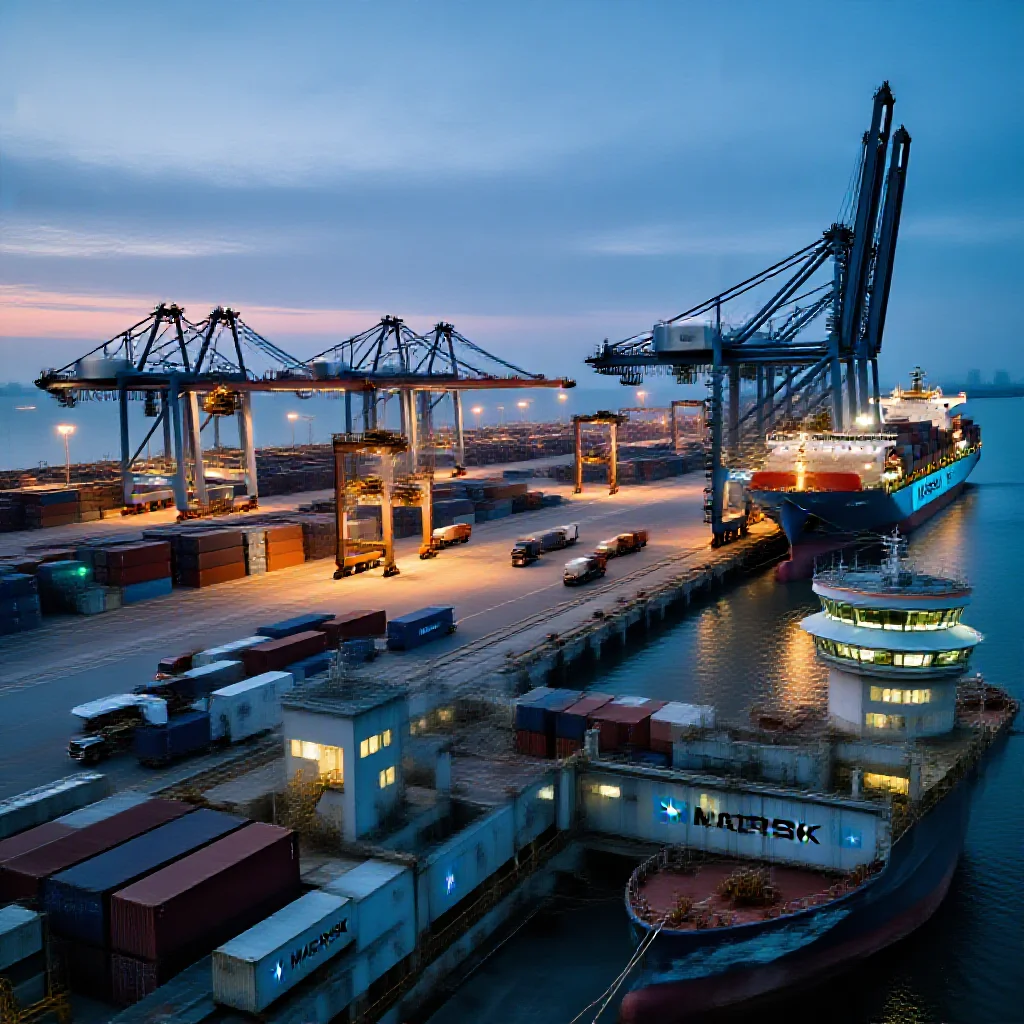
"Maersk's March 2026 advisory on the prolonged Strait of Hormuz closure is"
Beyond the Surcharge: How Maersk's 2026 Hormuz Crisis Response Reveals a Fragile New Era for Global Logistics
The Advisory as a Tipping Point: From Acute Crisis to Chronic Contingency
On March 24, 2026, A.P. Moller–Maersk issued a customer advisory that formally transitioned the Strait of Hormuz crisis from an acute shipping disruption to a chronic operational contingency (Source 1: [Primary Data]). The advisory described the situation as "highly volatile," with the chokepoint likely to remain closed to commercial traffic and disruptions expected to persist into the second quarter of 2026 (Source 1: [Primary Data], [Primary Data]). This timeline distinguishes the event from past regional conflicts; it is not a temporary blockage but a prolonged systemic failure of a critical maritime node.
The strategic significance lies in Maersk's explicit declaration of operating in "contingency mode" (Source 1: [Primary Data]). This is not a temporary adjustment but a formal acknowledgment of a new, unstable baseline. The core thesis emerging from the advisory is that global logistics architecture must now be redesigned to account for the permanent vulnerability of singular, high-capacity chokepoints. The response moves beyond reactive rerouting to a fundamental acceptance of prolonged failure, forcing a structural shift from "just-in-time" efficiency to "just-in-case" resilience.
Decoding the Operational Pivot: The Hidden Logic of Selective Shutdowns and Gateways
Maersk's operational directives reveal a calculated, triage-based strategy for a fragmented trading environment. The suspension of bookings for Upper Gulf markets—including the UAE, Qatar, Bahrain, Kuwait, Iraq, and eastern Saudi Arabia—is not a full regional retreat (Source 1: [Primary Data]). It is a deliberate funneling of trade flows toward more secure alternative gateways that remain open, such as Jeddah, Salalah, and Aqaba (Source 1: [Primary Data]). This action effectively re-maps regional trade geography, elevating secondary ports to primary hub status and forcing a rapid, unplanned regionalization of logistics networks.
The exception for "essential goods" like food and medical supplies functions as a risk-calibrated triage system (Source 1: [Primary Data]). This policy prioritizes high-value, time-sensitive, and socially critical cargo, simultaneously exposing the non-essential nature of a significant portion of containerized trade under extreme duress. Concurrently, the expansion of landbridge solutions and increased reliance on air freight represents a capital-intensive bet on multimodal resilience (Source 1: [Primary Data]). This shift signals a long-term reallocation of resources away from assets optimized purely for maritime cost efficiency toward flexible, intermodal capabilities designed for redundancy.
The Fuel Factor: Bunker Constraints as the Silent Amplifier of Global Ripple Effects
A critical, underreported dimension of the crisis is the parallel breakdown in bunker fuel logistics. Refinery outages and export limitations linked to the Hormuz shutdown have tightened global bunker availability, creating a secondary crisis that amplifies the primary disruption (Source 1: [Primary Data]). This fuel constraint is a systemic vulnerability often overlooked in analyses focused on container movements.
The implementation of a global Emergency Bunker Surcharge, effective March 25, 2026, directly addresses this (Source 1: [Primary Data]). It reflects the economic reality of vessels being forced into "fuel foraging"—diverting to alternative ports to secure bunkers at higher prices, which in turn degrades schedule reliability globally (Source 1: [Primary Data]). This creates a powerful feedback loop: security-driven rerouting exacerbates fuel shortages, which then force further operational deviations, spreading cost and delay far beyond the Middle East. This fuel dynamic is a primary technical reason why ripple effects will persist deep into 2026, irrespective of geopolitical developments at the chokepoint itself.
Neutral Market and Industry Predictions
The Maersk advisory of March 2026 serves as a leading indicator for broader, irreversible shifts in global logistics. The forced regionalization of supply chains, evidenced by the selective gateway strategy, will accelerate investment in near-shoring and redundant manufacturing footprints. Logistics contracts will increasingly incorporate force majeure clauses with broader triggers and shift from purely cost-based metrics to hybrid models valuing guaranteed capacity and rerouting options.
The bunker fuel crisis will spur accelerated investment in fuel diversification, including LNG bunkering infrastructure and methanol-capable vessels, to reduce dependence on any single refining region. Furthermore, the premium on visibility and flexibility will catalyze the adoption of predictive logistics platforms that can model cascading failures across multimodal networks. The era where the lowest per-unit shipping cost dictated trade flows is concluding. It is being replaced by an era where the cost of resilience and the premium for assured delivery become fundamental, internalized components of global trade economics.
Trade Metrics
Related Datasets
Q4 Cross-Border Logistics Report
PDF • 4.2 MB
Automotive Parts Supply Chain Index
CSV • 1.1 MB