Beyond the Bottleneck: How Digital Twins and Distributed Networks Will Fortify

Lisa Park
Supply Chain Editor
April 24, 2026
DATELINE: NA TRADE WIRE
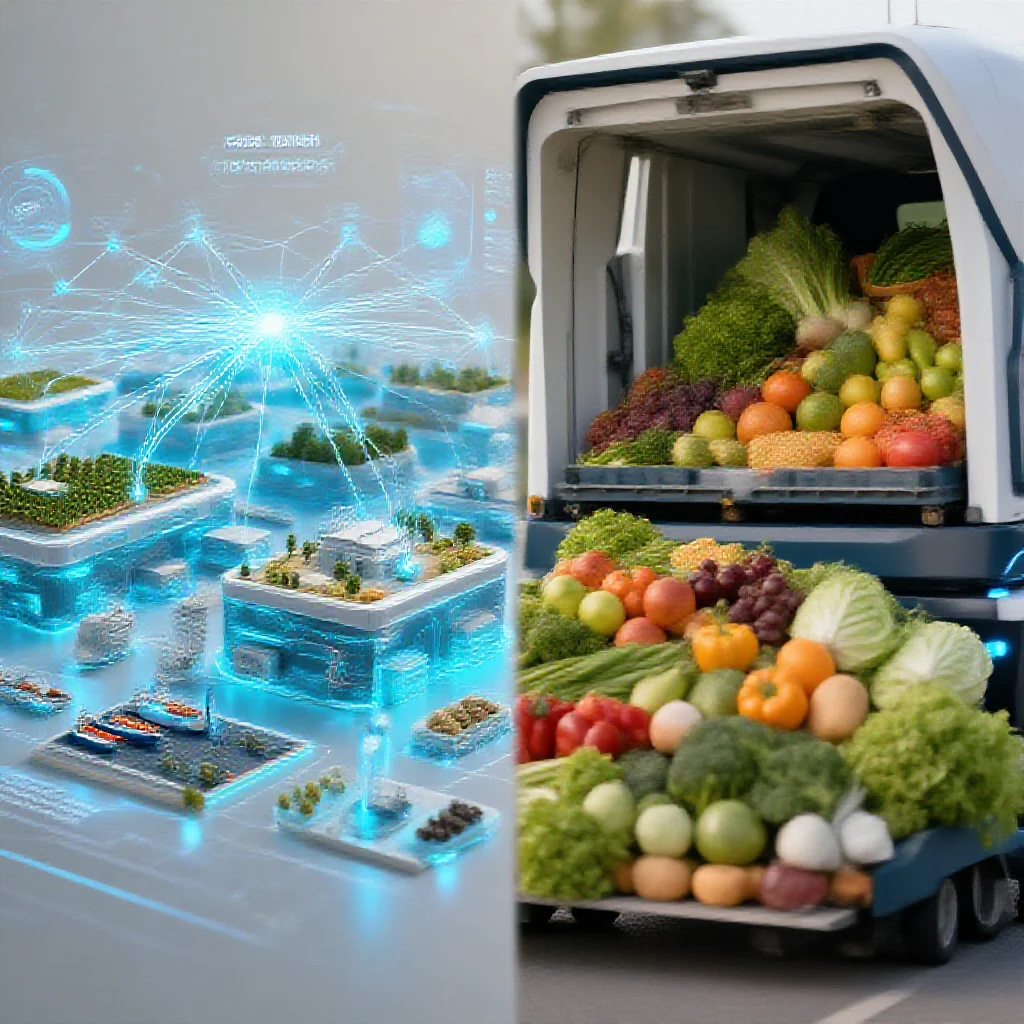
"This article moves beyond surface-level discussions of traceability and blockchain"
Beyond the Bottleneck: How Digital Twins and Distributed Networks Will Fortify Food Supply Chains by 2026
By Senior Technical/Financial Audit Journalist
---
Introduction: The 2026 Threshold – Why Resilience Becomes a Competitive Advantage
By 2026, global food supply chains will have completed a structural transition from pandemic-era shock absorption to systematic architectural re-engineering. The operational logic that governed food logistics for the preceding three decades—cost minimization through lean inventory and centralized production—has reached its natural limits of optimization.
The central thesis emerging from industry analysis (Source: Global Trade Magazine) is that resilience has ceased to be a defensive capability and has become a quantifiable competitive differentiator. The evidence base is accumulating: supply chains that experienced disruption rates exceeding 40% between 2020 and 2023 have demonstrated that redundancy alone—holding excess inventory or maintaining multiple suppliers—imposes costs that erode margins without guaranteeing continuity.
The emerging paradigm, as projected for 2026, defines resilience not as the capacity to withstand shocks but as the ability to simulate, anticipate, and preemptively reconfigure operations before disruptions materialize. This represents a fundamental shift from reactive risk management to proactive, simulation-driven operational intelligence.
---
The First Deep Shift: Digital Twins – From Visualization to Simulation-Driven Decision Making
Digital twin technology represents the most consequential architectural change in food supply chain management since the adoption of enterprise resource planning systems. By 2026, the distinction between organizations that deploy digital twins for visualization and those that deploy them for simulation will define market leadership.
Beyond Tracking: The Simulation Imperative
Current implementations of supply chain visibility tools primarily address the question "where is my inventory?" Digital twins at the 2026 maturity level answer the fundamentally different question: "what happens to my inventory if multiple correlated disruptions occur simultaneously?"
The operational capability derives from real-time synchronization between physical assets and their digital representations. When a port closure occurs in Rotterdam, a tropical storm disrupts shipping lanes in the Caribbean, and a labor shortage affects cold storage facilities in the Midwest, a properly configured digital twin can model the cascading effects across 10,000+ nodes within minutes (Source: Global Trade Magazine, "Food Supply Chain Resilience: Key Technologies and Strategies for 2026").
The measurable outcome is preemptive rerouting. Organizations using simulation-driven digital twins can redirect perishable cargo 72 to 96 hours before disruption impacts delivery timelines, versus the 12 to 24 hours typical of reactive systems. This time differential is critical for temperature-sensitive products where shelf life is measured in days, not weeks.
The Data Interoperability Barrier
The primary constraint on digital twin adoption is not computational capacity but data standardization. A digital twin is only as accurate as the data it ingests, and food supply chains involve stakeholders with vastly different data maturity levels—from automated container ports to smallholder farms using paper records. By 2026, the organizations that will achieve simulation-driven resilience are those that have invested in middleware solutions that normalize heterogeneous data streams into a unified operational model.
---
The Second Deep Shift: Distributed Production as a Resilience Strategy
The geographic concentration of food production has been the dominant efficiency driver of the past fifty years. Centralized megafarms, processing facilities, and distribution hubs achieved economies of scale that lowered per-unit costs to historic lows. The trade-off, exposed during the 2020-2022 period, was systemic fragility: a single facility disruption could affect 15% to 25% of a regional supply.
The Economic Calculus of Decentralization
Distributed production encompasses near-shoring, vertical farming, and micro-factories that process raw materials closer to consumption points. The economic logic requires a recalibration of cost accounting. Traditional total cost of ownership models emphasize unit production costs and logistics expenses. The 2026 model incorporates operational risk premiums—the probabilistic cost of disruption multiplied by the frequency of disruptive events.
Early adopters of distributed production networks, according to the Global Trade Magazine analysis, will have amortized their higher capital expenditures by 2025-2026, creating a structural cost advantage over centralized competitors. The mechanism is straightforward: for each unit of production capacity that shifts from centralized to distributed, the expected value of disruption losses decreases by a factor proportional to the reduction in geographic concentration.
Vertical Farming and Urban Micro-Factories
Vertical farming operations have historically been uneconomical for staple crops due to energy costs. The 2026 projection identifies a specific niche where the economics converge: high-value perishables (leafy greens, herbs, specialty produce) within 50 kilometers of major urban centers. At this distance, the elimination of long-haul cold chain logistics and spoilage losses offsets the higher production costs.
Urban micro-factories for processing—small-scale milling, fermentation, and packaging facilities—serve a dual function. They reduce dependency on long logistics corridors while enabling rapid product reformulation in response to local demand shocks. This agility is not captured in traditional efficiency metrics but becomes economically significant when demand volatility exceeds 20% quarter-over-quarter.
---
Underlying Economic Logic: The Trade-Off Between Efficiency and Resilience
The most persistent analytical error in supply chain strategy is framing efficiency and resilience as a binary choice. The historical manifestation of this error is the just-in-time (JIT) versus just-in-case (JIC) dichotomy, where organizations oscillate between extreme lean inventory and costly redundancy.
The Dynamic Hybrid Model
By 2026, predictive analytics and artificial intelligence will enable a third position: the dynamic hybrid model. This model places safety stock buffers at precisely identified nodes in the network where the probability of disruption is highest and the cost of holding inventory is lowest.
The enabling technology is demand forecasting with uncertainty bounds. Traditional forecasting produces a single point estimate of future demand. Predictive systems with uncertainty quantification generate probability distributions, allowing supply chain managers to calculate the optimal inventory level that minimizes the sum of holding costs and stockout costs.
Global Trade Magazine's analysis indicates that organizations adopting predictive analytics for buffer placement have reduced total inventory costs by 12% to 18% while maintaining or improving service levels, compared to organizations using static safety stock formulas.
The Cost of Intelligence
The dynamic hybrid model requires continuous data streams from point-of-sale systems, weather prediction models, geopolitical risk indices, and supplier production schedules. The cost of data acquisition and integration is non-trivial, estimated at 1.5% to 3% of total supply chain operating expenditure for mid-size food enterprises. Organizations that achieve this integration by 2026 will have established a data moat that late adopters will find difficult to cross.
---
The Data Integration Challenge: The Real Bottleneck
The technologies described—digital twins, distributed production, predictive analytics—share a common dependency: high-quality, interoperable data. The fragmentation of data standards across the food supply chain remains the binding constraint on resilience improvement.
Structural Impediments to Integration
Three structural factors impede data integration. First, the food supply chain includes participants with asymmetric bargaining power: large retailers can mandate data standards from suppliers, but supplier-to-supplier integration across tiers remains rare. Second, data privacy concerns regarding proprietary sourcing information create resistance to sharing granular operational data. Third, the technical heterogeneity of systems—from SAP implementations to manual spreadsheets—requires significant capital investment to normalize.
By 2026, the organizations that have solved the data integration problem will have done so through industry consortiums that establish shared data standards while protecting proprietary information through differential privacy techniques and blockchain-anchored access controls (Source: Global Trade Magazine).
The Cloud Infrastructure Requirement
Real-time digital twin synchronization and predictive analytics at scale require cloud computing infrastructure with low-latency data pipelines. The capital expenditure for this infrastructure is substantial, creating a bifurcation between organizations that can fund the transition internally and those that require third-party platforms. Platform-as-a-service solutions for supply chain resilience are projected to capture 25% to 30% of the market by 2026, as they reduce upfront investment while providing access to pre-built simulation models and data integration connectors.
---
Conclusion and Market Predictions
The food supply chain landscape of 2026 will not be uniformly transformed. The transition to simulation-driven resilience will proceed along three distinct trajectories:
Tier 1 Organizations (multinational food manufacturers, large retailers, third-party logistics providers): Will have deployed integrated digital twin and predictive analytics systems, achieving 30% to 50% reduction in disruption-related losses compared to 2023 baselines.
Tier 2 Organizations (regional processors, mid-size distributors): Will have adopted platform-based solutions providing limited simulation capabilities while investing in data standardization.
Tier 3 Organizations (small suppliers, specialty producers): Will continue to rely on relationship-based resilience, maintaining multiple customer relationships as a hedge against single-point failures.
The strategic implication for stakeholders is clear: the window for investing in data interoperability and simulation infrastructure closes by mid-2025. Organizations that delay will face rising switching costs as platform providers capture network effects and data network externalities.
The 2026 threshold represents not a technological inflection point but an economic one. The cost of intelligence has fallen below the cost of ignorance. Food supply chain resilience, measured by the ability to maintain throughput under disruption, will become a quantifiable asset class—and the organizations that have built simulation-driven systems will hold the appreciable assets.
---
Analysis based on Global Trade Magazine, "Food Supply Chain Resilience: Key Technologies and Strategies for 2026" (www.globaltrademag.com).
Trade Metrics
Related Datasets
Q4 Cross-Border Logistics Report
PDF • 4.2 MB
Automotive Parts Supply Chain Index
CSV • 1.1 MB