Beyond the Chokepoint: How CMA CGM''s Multimodal Strategy Redefines Global

Lisa Park
Supply Chain Editor
March 22, 2026
DATELINE: NA TRADE WIRE
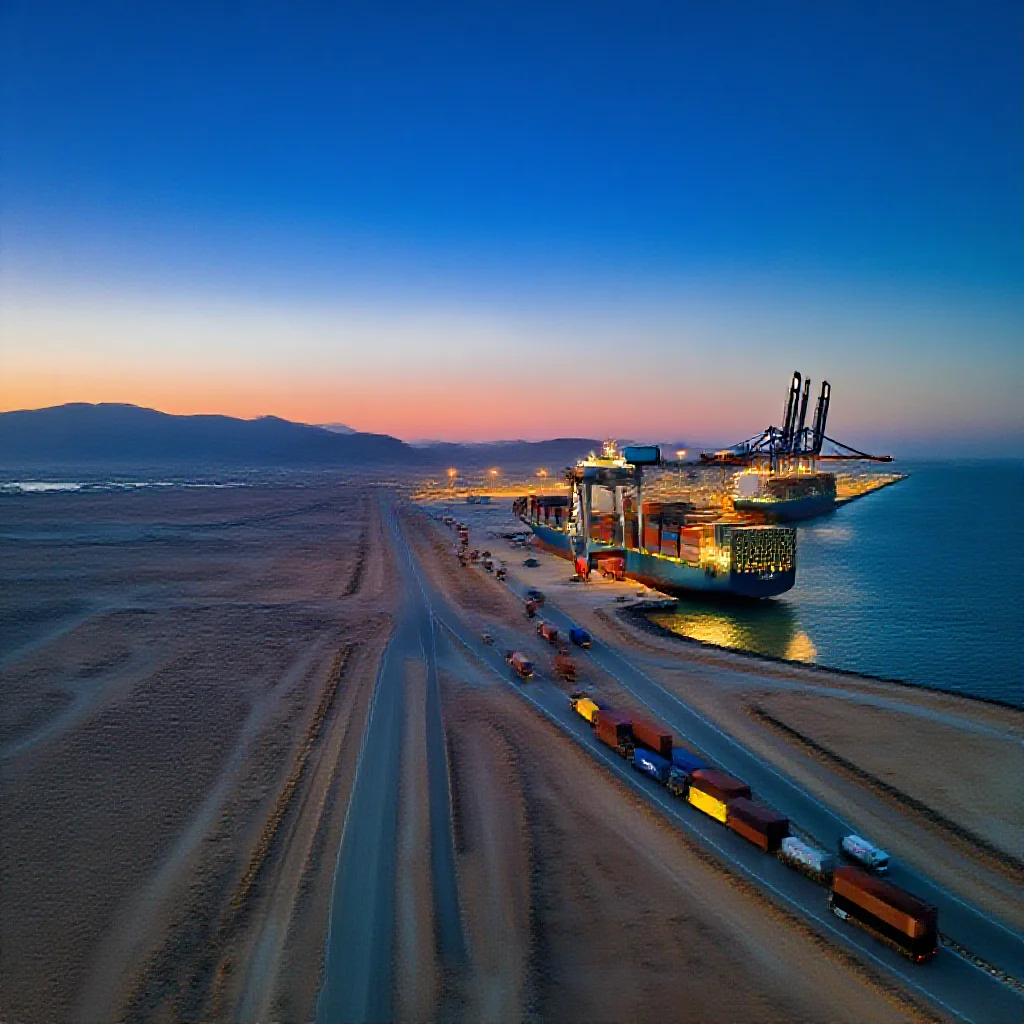
"In response to escalating regional tensions, French shipping giant CMA CGM"
Beyond the Chokepoint: How CMA CGM's Multimodal Strategy Redefines Global Supply Chain Resilience
The Strait Dilemma: Why a Shipping Giant is Forging a New Path
The Strait of Hormuz, a narrow maritime passage between the Gulf of Oman and the Arabian Gulf, functions as one of the world's most critical trade chokepoints. Approximately one-fifth of global oil consumption and a significant volume of containerized goods transit this waterway. Its geopolitical sensitivity has long been a calculated risk embedded in global logistics networks. Recent escalations in regional tensions have shifted this calculation, prompting proactive mitigation strategies that extend beyond traditional contingency planning.
In direct response, French shipping conglomerate CMA CGM has launched two new multimodal transport corridors. The primary route connects Jebel Ali in the United Arab Emirates to Jeddah, Saudi Arabia, by sea. Containers are then transported overland to the Mediterranean port of Sokhna, Egypt, before resuming their sea journey to Northern Europe. A secondary route initiates from Shuwaikh, Kuwait, to Jebel Ali, then follows the same land bridge to Sokhna. These corridors represent a strategic engineering of supply chain pathways to circumvent the Strait entirely. (Source 1: [Primary Data])
Decoding the Multimodal Calculus: Cost vs. Certainty
The economic rationale for such a pivot is not rooted in efficiency, but in risk mitigation. A direct comparison reveals a higher direct cost structure for the multimodal option. Expenses accrue from additional transshipment operations, land freight—whether by truck or potentially rail—and heightened administrative coordination. These are measured against the latent and volatile costs associated with Strait of Hormuz transit: soaring war risk insurance premiums, unpredictable delays from heightened naval activity or security incidents, and the potential for catastrophic disruption.
The operational viability of these land bridges hinges on a complex partnership ecosystem. Seamless handoffs between maritime carriers, port operators, customs authorities, and land-based freight providers are essential. This introduces new points of potential friction but distributes operational risk across a broader network. The economic premium for this certainty is likely borne through a shared model. Carriers may absorb a portion to secure client loyalty, while shippers of high-value, time-sensitive, or mission-critical cargo are the most probable adopters, potentially passing some cost to end consumers. The calculus signifies a shift where reliability begins to outweigh pure cost minimization in strategic logistics planning.
The Ripple Effect: Reshuffling Regional Logistics Hubs
CMA CGM's strategic re-routing will have tangible long-term effects on regional port competitiveness. Jebel Ali's position is reinforced, transforming from a terminus into a pivotal transshipment nexus for east-west land corridors. Similarly, Sokhna on the Red Sea gains strategic depth as a Mediterranean gateway for goods originating in the Arabian Gulf, potentially diverting volume from ports reliant solely on Suez Canal transit.
This aligns with broader regional economic ambitions. Saudi Arabia's Vision 2030 explicitly targets transforming the nation into a global logistics hub. The activation of the Jeddah-Sokhna land corridor leverages the Kingdom's geographic mass, providing tangible infrastructure utility for its goals. The model may incentivize accelerated investment in overland transport infrastructure, including rail networks, across the Arabian Peninsula, altering the region's economic geography.
Beyond a Single Bypass: A Blueprint for Supply Chain De-risking?
The move by CMA CGM is analytically significant not as an isolated workaround, but as a symptomatic adaptation to a new era of persistent systemic risk. It reflects a broader, nascent trend in global logistics: the deliberate pivot from hyper-lean, efficiency-optimized supply chains toward more resilient, redundant networks. This paradigm, often termed "de-risking," accepts higher baseline costs in exchange for reduced vulnerability to single points of failure, whether geopolitical, climatic, or pandemic-related.
The strategic implication is a potential re-architecting of global trade flows. If replicated by other carriers or for different chokepoints, it could accelerate the regionalization of supply chains and the proliferation of multimodal corridors. Logistics strategy is increasingly defined by optionality—the possession of multiple validated pathways for cargo. CMA CGM's new routes provide a concrete blueprint for how major players can engineer that optionality, signaling that in today's volatile trading environment, the most valuable route may no longer be the shortest, but the most assured.
Trade Metrics
Related Datasets
Q4 Cross-Border Logistics Report
PDF • 4.2 MB
Automotive Parts Supply Chain Index
CSV • 1.1 MB