Beyond Route Optimization: How AI Agents Are Rewiring the Economic Logic of
Lisa Park
Supply Chain Editor
April 12, 2026
DATELINE: NA TRADE WIRE

"While AI agents are celebrated for optimizing delivery routes and warehouse"
Beyond Route Optimization: How AI Agents Are Rewiring the Economic Logic of Global Logistics
Summary: While AI agents are celebrated for optimizing delivery routes and warehouse operations, their deeper impact lies in fundamentally altering the economic calculus of global supply chains. This analysis moves beyond efficiency gains to explore how AI-driven, real-time decision-making is shifting logistics from a cost-centric, fixed-asset model to a dynamic, resilience-focused system. We examine the emerging 'predictive capacity' market, where AI's ability to forecast and adapt creates new forms of value and competitive advantage, ultimately challenging traditional logistics business models and redefining what it means to be resilient in an unpredictable world.
---
The Surface Layer: AI's Operational Playbook in Logistics
The deployment of artificial intelligence agents within logistics networks is operationally demonstrable. These systems process real-time data streams from traffic monitors, weather feeds, and IoT sensors to execute dynamic route planning, avoiding delays and recalculating paths instantaneously. Within warehouse environments, AI agents coordinate fleets of autonomous mobile robots, optimizing picking, packing, and sorting sequences. A parallel application involves predictive maintenance, where AI analyzes vehicle sensor data to forecast mechanical failures before they occur. The commercial validation of these applications is reflected in sector investment, with the global AI in logistics market valued at approximately $5.5 billion in 2023 (Source 1: Market Valuation Data). The return on investment is quantified through direct metrics: reduced fuel consumption, lower labor costs per unit handled, and decreased asset downtime. The operational narrative is one of data-driven efficiency, where the real-time substrate provided by pervasive sensing enables a shift from scheduled, static operations to adaptive, responsive ones.
The Hidden Economic Shift: From Cost Minimization to Resilience Capitalization
The traditional economic model of logistics competes on the minimization of variable costs—fuel, labor, leasing—within a framework of fixed, physical assets. Trucks, ships, and warehouses are capital-intensive items utilized to maximize load factors and minimize idle time. AI agents introduce a fundamental alteration to this calculus. The primary value proposition evolves from pure cost reduction to the capitalization of resilience. This is achieved through the creation of "predictive capacity"—the ability to monetize foresight and operational flexibility. Avoiding a port delay through predictive rerouting is not merely a fuel savings exercise; it is an action that protects service-level agreements, preserves customer trust, and prevents cascading contractual penalties. Consequently, AI transforms static assets into "adaptive assets." A truck is no longer just a vehicle with a scheduled route; it becomes a dynamically reconfigurable resource, its utilization and maintenance dictated by predictive load planning and health analytics. The economic priority inverts: resilience and adaptability form the new foundation of the business model, upon which cost efficiency is subsequently optimized.
The Deep Entry Point: AI Agents and the Fragmentation of Supply Chain Sovereignty
A more complex, systemic consequence emerges as AI agents proliferate across nodes. As these agents make autonomous, micro-decisions across disparate entities—a carrier's fleet, a third-party warehouse, a port authority's traffic system—the locus of strategic control becomes fragmented. This creates a new layer of power centered on the control of chain intelligence. The risk extends beyond traditional vendor lock-in for software to a state of "logic lock-in," where a corporation's operational flexibility becomes inherently dependent on the decision-making paradigms, algorithms, and data biases embedded within its chosen AI platform. A long-term analytical question concerns systemic alignment. Decentralized AI agents, each acting to optimize the performance of their immediate node, may achieve a form of global system efficiency that paradoxically conflicts with the strategic objectives of individual corporations within the chain. The sovereignty of the end-to-end supply chain strategy is challenged by the distributed intelligence governing its components.
Evidence and Market Trajectory: The Consolidation of Intelligence
The trajectory of this technological integration points toward the consolidation of intelligence as a core competitive moat. The market valuation (Source 1: Market Valuation Data) signifies initial investment in operational tools, but the subsequent phase involves investment in proprietary data ecosystems and algorithmic advantage. The entities that control the most robust, real-time data feeds and the most sophisticated simulation environments for stress-testing supply chain scenarios will wield significant influence. This will likely accelerate vertical integration, as logistics providers and large retailers seek to internalize AI development to maintain strategic autonomy. Alternatively, it may give rise to dominant, neutral AI-platform operators who become essential arbiters of global logistics flows. The economic logic of the industry will increasingly reward predictive accuracy and adaptive speed over sheer scale of physical assets, redefining market leadership for the coming decade.
---
Image Prompt References:
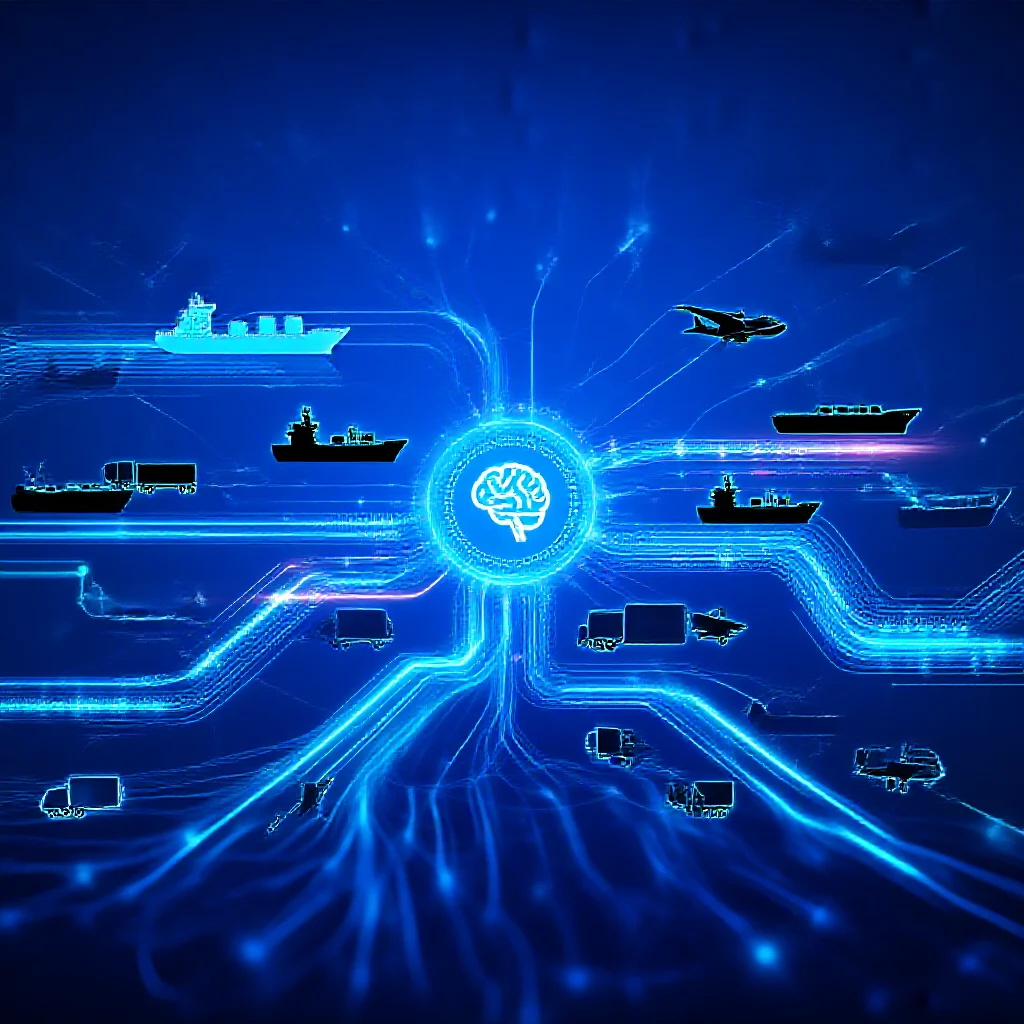
Cover: A futuristic, abstract visualization of global supply chain networks. Silhouettes of trucks, ships, and planes are interconnected by glowing, data-stream lines on a dark blue background.
Section 1: An infographic showing a map with multiple delivery routes, one static (red, congested) and one dynamic AI-optimized (green, flowing).
Section 2: A conceptual diagram contrasting two pyramids: 'Old Model' with Cost at the base, and 'New Model' with Resilience & Adaptability at the base.
Section 3: A network diagram showing multiple company logos each with their own AI agent 'brain,' with conflicting signal arrows.
Trade Metrics
Related Datasets
Q4 Cross-Border Logistics Report
PDF • 4.2 MB
Automotive Parts Supply Chain Index
CSV • 1.1 MB