2026 Supply Chain Trends: From Soft Markets to Strategic Tightening and Automation

Lisa Park
Supply Chain Editor
May 16, 2026
DATELINE: NA TRADE WIRE
"After a soft 2025 marked by near-record low truckload spot rates and capacity"
2026 Supply Chain Trends: From Soft Markets to Strategic Tightening and Automation
The North American supply chain enters 2026 standing on the shoulders of a paradox. After a 2025 freight market defined by near-record low truckload spot rates and lingering capacity oversupply, the sector is now bracing for a selective but definitive tightening. But this is not simply a cyclical rebound. Beneath the surface, structural forces — AI-driven automation, infrastructure megaprojects, and a fundamental reshaping of warehousing and 3PL relationships — are rewriting the rules of competitiveness.
For shippers and carriers alike, the coming year will separate those who merely survive from those who build durable advantage. This article offers a deep audit of the forces that will define the North American supply chain in 2026, drawing on data from Ryder, DAT, McKinsey, and industry intelligence.
The 2025 Hangover: Understanding the Softness That Sets the Stage for 2026
To understand where the market is going, we must first reckon with where it has been. The 2025 freight market was, by most measures, a year of endurance. Truckload spot rates plunged to multi-year lows in early 2025, driven by a sustained imbalance between abundant carrier capacity and tepid demand. According to DAT Freight & Analytics, national average dry van spot rates bottomed out at roughly $1.70 per mile in Q1 2025, a level not seen since the post-pandemic normalization of 2023. Contract rates followed downward, though with the usual lag, as shippers leveraged spot market weakness to renegotiate annual agreements.
[IMAGE: A line chart comparing spot rates vs. contract rates over 2024–2025, with annotations for Q3 tightening and late-2025 normalization]
Yet the narrative softened as the year progressed. By Q3 2025, pockets of tightening emerged. Inventories, which had been bloated through much of 2024 and early 2025, began to balance as retailers and manufacturers finally aligned stock levels with consumer spending patterns. The Southeast, Texas, and the Mountain West — regions buoyed by population growth and manufacturing investment — saw earlier signs of firming. In these lanes, spot rates crept up 5–8% from their Q1 nadir, signaling that the capacity rebalancing had begun.
Ryder’s Monthly State of Transportation Report confirmed the pattern. The report noted that while overall market softness persisted into late 2025, carriers began removing marginal capacity — particularly small fleets and owner-operators — as margins eroded below sustainable levels. This attrition, combined with the natural replacement cycle of aging equipment, started to tip the supply-demand equation.
For 2026, the baseline is set. The softness of 2025 created a window for strategic shippers to lock in favorable contract terms, but that window is narrowing. Most analysts now expect a gradual, lane-specific tightening through the first half of 2026, with broader rate normalization by mid-year. The key takeaway: the 2025 hangover is ending, and those who prepared for the transition will have the leverage.
Infrastructure Boom: How AI Data Centers and Cold Storage Reshape Logistics Constraints
While the freight market was cooling, a different kind of heat was building on the ground. Construction activity in North America surged in 2025, driven by three overlapping megatrends: the buildout of AI data centers, the expansion of cold storage capacity, and the reshoring of advanced manufacturing. Together, these projects are not just demand drivers for construction logistics — they are fundamentally reshaping transportation networks and warehouse placement.
Consider the data center phenomenon. An artificial intelligence data center can require 100 to over 1,000 deliveries per day during peak construction, ranging from massive transformers and cooling units to thousands of servers and cabling spools. With limited staging space on typical construction sites, these projects create acute bottlenecks for local transport networks. In northern Virginia’s “Data Center Alley,” for instance, local road authorities reported a 40% increase in heavy truck traffic in 2025 compared to pre-pandemic levels.
[IMAGE: Aerial photo of a large construction site for a data center, with dozens of trucks queued for delivery and temporary staging areas visible]
But the impact extends beyond congestion. Data centers are also catalysts for warehouse robotics adoption and edge computing in logistics. As hyperscale facilities come online, they host the computational power needed to run digital twins, real-time route optimization, and AI-driven warehouse management systems. This creates a virtuous loop: the infrastructure demanded by AI enables the logistics automation that AI requires.
Cold storage is another pressure point. The pandemic-era surge in online grocery and pharmaceutical delivery, combined with the growth of meal kit services and biologics, has driven cold storage vacancy rates to historic lows — below 3% in major markets like Chicago and the New York-New Jersey area, according to Data Insights Market. Construction of new cold storage facilities accelerated in 2025, but these are capital-intensive projects with long lead times. The result: rents for temperature-controlled warehousing have risen 15–20% year-over-year, and that cost is cascading through the supply chain.
Meanwhile, nearshoring in Mexico — particularly in automotive, electronics, and medical device sectors — has altered the traditional center-of-gravity for U.S. distribution. Cross-border freight volumes from Mexico to the U.S. grew 12% in 2025, per the Bureau of Transportation Statistics. This has pushed distribution center placement further south and west, accelerating the regionalization trend that will define 2026 supply chain networks.
Technology Leapfrog: AI, 5G, and Edge Computing Move from Pilot to Core Operations
If 2024 was the year of AI pilots, 2025 was the year they graduated to production. Across the supply chain, artificial intelligence moved from buzzword to operational tool, embedded in demand forecasting, route optimization, warehouse orchestration, and even procurement. The pace of adoption was staggering: McKinsey & Company estimated that one-third of logistics companies with over $1 billion in revenue had deployed at least one generative AI application in their supply chain operations by year-end 2025.
The real leap forward, however, came from the convergence of AI with connectivity infrastructure. Private 5G and LTE networks — once confined to factory floors and port terminals — began rolling out in large distribution centers and fleet yards. These networks enable real-time data transmission from thousands of IoT sensors, automated guided vehicles, and wearable devices. The result is a step-change in the granularity and speed of supply chain visibility.
[IMAGE: A split-screen illustration: left side shows a traditional warehouse with manual picking, right side shows a digital twin interface with streaming data from autonomous systems]
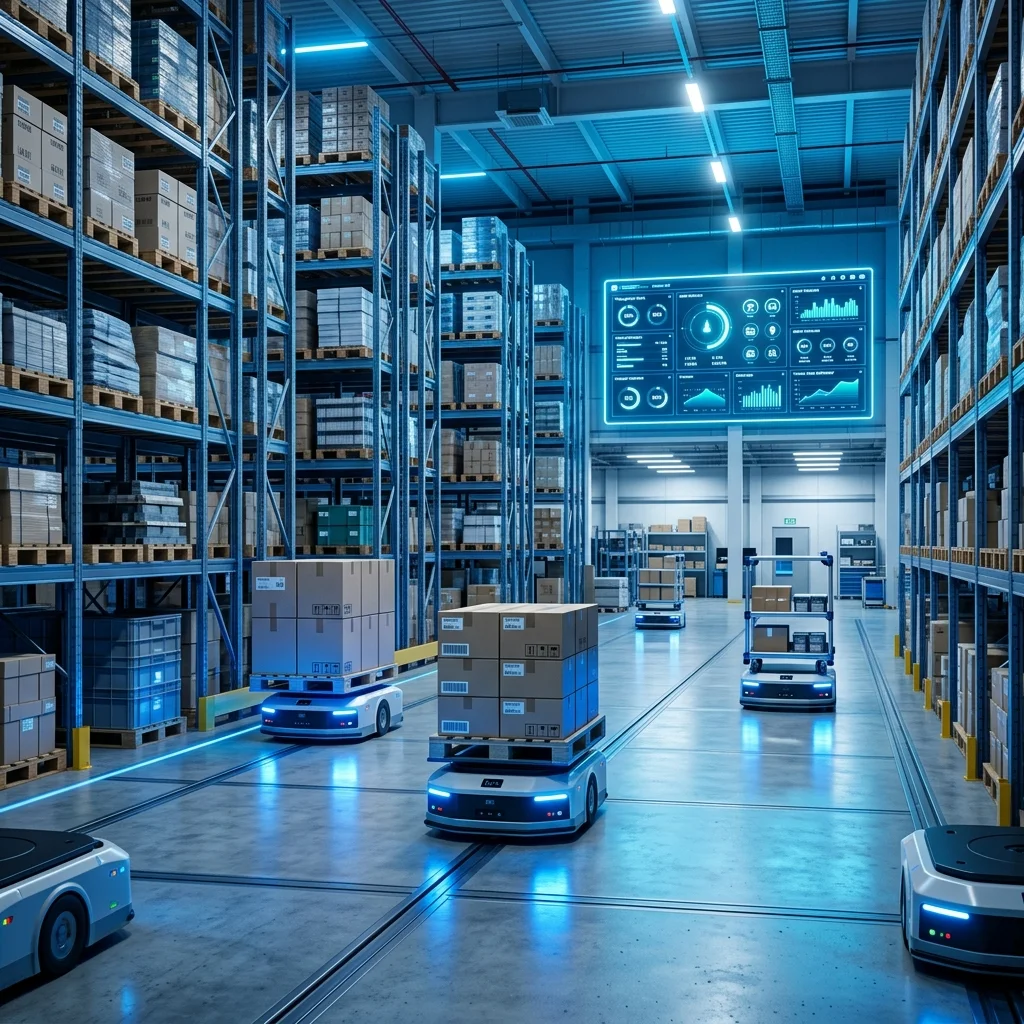
McKinsey’s research on warehouse automation provides a concrete lens. Their data shows that targeted automation — such as deploying autonomous mobile robots (AMRs) for case picking or using AI-driven put walls — can improve throughput by 20–40% and reduce picking travel time by up to 60%. Crucially, these gains are not uniform: the return on investment depends on labor cost, facility layout, and order profile. But in high-volume, high-mix environments — exactly the kind that dominate e-commerce and omnichannel distribution — the ROI case is now compelling.
Edge computing adds another layer. Instead of sending all data to a centralized cloud, edge devices process information locally, enabling real-time decision-making on the warehouse floor. For example, a camera system equipped with edge AI can identify picking errors in milliseconds and reroute an AMR without consulting a central server. This reduces latency, improves reliability, and allows facilities to scale automation without overwhelming network bandwidth.
The link to inventory strategy is direct. With IoT sensors and edge AI, companies can implement segmented safety stock models — holding different levels of buffer inventory based on SKU velocity, lead time variability, and demand volatility. They can also shift to dynamic inventory placement, moving products between regional distribution centers in real time based on predicted demand. This was a theoretical concept three years ago; today, it’s operational reality for leading retailers and third-party logistics providers.
But the technology leap is not just about hardware. Agentic AI — software agents that can plan, execute, and learn from tasks autonomously — is beginning to handle procurement negotiations, carrier selection, and even load tendering. While full autonomy remains distant, early adopters report 15–25% reductions in manual transaction costs and faster response to disruptions.
3PL Consolidation and Warehouse Real Estate: The New Rules of Flexibility
The third-party logistics market entered 2026 in a state of structural transformation. After years of fragmentation, the 3PL sector is consolidating rapidly, driven by shippers’ demands for scale, technology integration, and end-to-end capability. Large players — XPO Logistics, Ryder, J.B. Hunt, and FedEx — have aggressively acquired mid-sized regional operators and technology startups, aiming to offer integrated services spanning transportation, warehousing, and last-mile delivery.
The logic is simple: shippers are reducing their carrier and warehouse provider bases, seeking partners who can manage complexity across multiple modes and geographies. A Data Insights Market analysis found that the top 10 North American 3PLs now control nearly 45% of the market by revenue, up from 32% in 2020. This concentration is reshaping negotiation dynamics: larger 3PLs command better rates on real estate and equipment, but they also face higher expectations for service reliability and technology transparency.
[IMAGE: A bar chart showing the market share of top 10 North American 3PLs from 2020 to 2026 (projected), with a clear upward trend]
The impact on warehouse real estate is profound. As 3PLs consolidate, they are rationalizing their facility networks — closing smaller, older warehouses and opening larger, automated hubs. This reduces overall footprint in some regions while concentrating capacity in strategic locations. For shippers who relied on a network of small, flexible warehouses, the shift means longer lead times to some markets unless they adapt their distribution strategies.
At the same time, the rise of regional distribution centers (RDCs) is accelerating. Rather than maintaining a single, massive national DC, shippers are building or leasing networks of mid-sized facilities (200,000–500,000 square feet) positioned within 200 miles of major population centers. This “regionalization” reduces last-mile costs, improves delivery speed, and buffers against disruptions like weather events or port congestion. In 2025, lease volumes for industrial space in secondary markets — such as Memphis, Columbus, and Salt Lake City — grew at double the rate of primary markets like the Inland Empire.
The economic logic is clear: while regionalization increases inventory holding costs slightly (due to more stock points), it reduces transportation expense and improves service levels. For high-value, time-sensitive goods — which account for a growing share of GDP as e-commerce penetrates new categories — the trade-off is favorable. McKinsey estimates that optimized regionalization can cut total logistics costs by 5–10% compared to a hub-and-spoke model.
But flexibility comes at a price. Lease terms for industrial space are tightening: landlords are demanding longer commitments (5–7 years vs. the previous 3–5) and higher rent escalations. Shippers and 3PLs are responding by embedding flexibility clauses — such as expansion rights, early termination options, or co-investment in automation — into their contracts. Negotiating these terms has become a core competency for supply chain leaders.
The Strategic Path Forward: Inventory Segmentation, Near-Site Positioning, and Automation ROI
As 2026 unfolds, the companies that will outperform are those that treat supply chain not as a cost center, but as a source of competitive advantage. Three strategic levers stand out.
First, inventory segmentation. The one-size-fits-all approach to safety stock is obsolete. Leading firms are using AI to segment their inventory by SKU profitability, demand volatility, and supply risk. For high-value, fast-moving items, they are willing to hold higher buffers — sometimes distributed across multiple RDCs. For slow-moving or low-margin SKUs, they are centralizing inventory in fewer locations and relying on cross-dock or drop-ship models. This targeted approach reduces overall inventory carrying costs while improving service for the most important products.
Second, near-site positioning. The data center and cold storage boom has created a new geography of demand. Shippers that locate their distribution facilities near these infrastructure hubs can capture premium business — serving construction sites, hospital systems, or hyperscaler colocation facilities — while benefiting from the resulting connectivity. Near-site is not just about physical distance; it’s about aligning with the digital infrastructure that enables real-time data exchange and automated logistics.
Third, automation ROI with clear metrics. The temptation is to automate everything, but the smartest players are applying a surgical approach. They are calculating ROI per facility based on labor savings, throughput gains, and error reduction, then matching technology to the specific workflow. A 20% improvement in picking productivity might not justify a multi-million-dollar AMR deployment in a low-volume facility, but in a high-volume e-commerce fulfillment center, the payback can be under 18 months.
The 2026 supply chain landscape is not one of dramatic upheaval, but of steady, selective tightening. The soft market of 2025 has given way to a more demanding environment where capacity is firming, technology is maturing, and the winners are those who adapt their networks, their partnerships, and their mindsets. For shippers, carriers, and 3PLs alike, the year ahead is a test of strategic discipline — and an opportunity to build the supply chain of the next decade.
Trade Metrics
Related Datasets
Q4 Cross-Border Logistics Report
PDF • 4.2 MB
Automotive Parts Supply Chain Index
CSV • 1.1 MB