Market Pulse: Geopolitical Jolt, Rate Divergence, and the Hunt for Safe Havens

Michael Chen
Senior Trade Analyst
May 1, 2026
DATELINE: NA TRADE WIRE
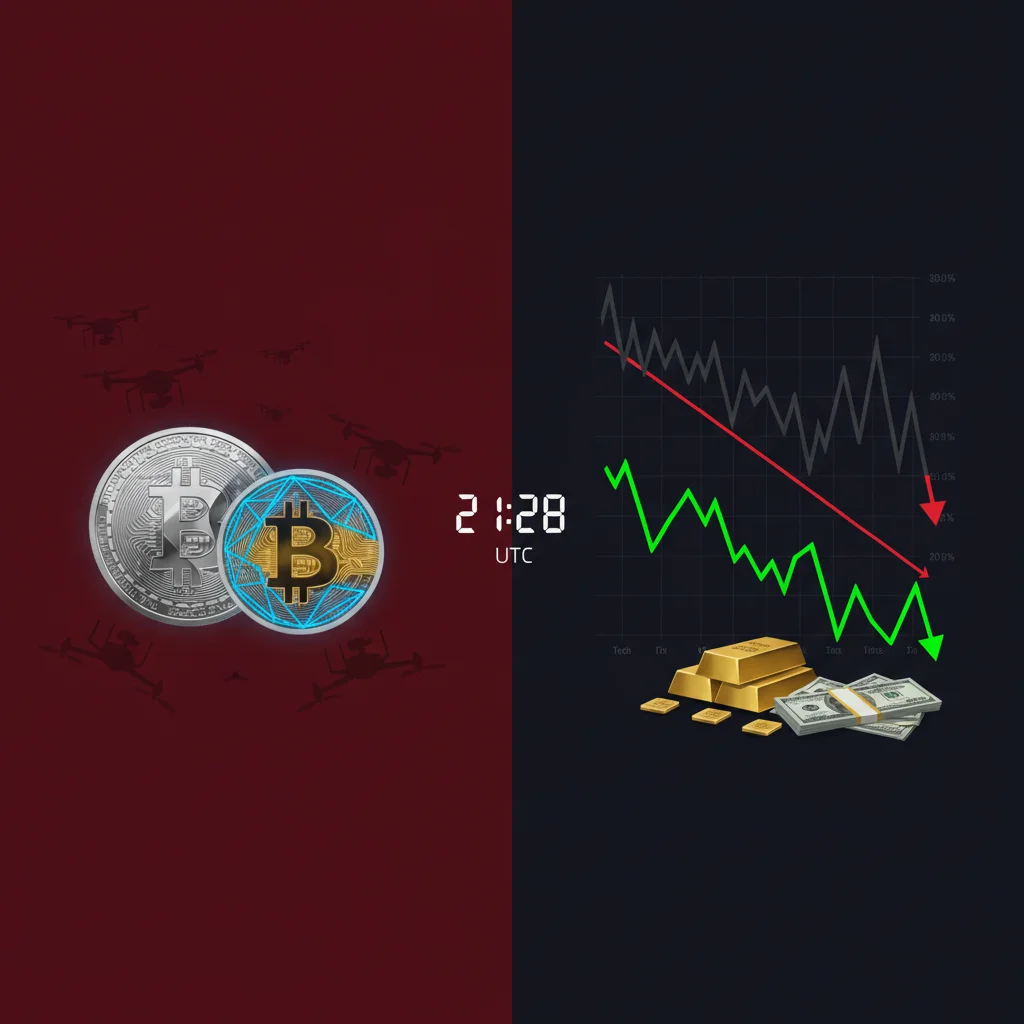
"The February 3 North American session was defined by a volatile interplay"
Market Pulse: Geopolitical Jolt, Rate Divergence, and the Hunt for Safe Havens
Session Date: February 3, 2026 | Report Time: 21:28 UTC
---
Introduction: A Session of Contradictions – Fear, Hope, and a Central Bank Surprise
The February 3 North American session presented a complex tapestry of cross-currents that defied simple risk-on or risk-off categorization. Four discrete events converged within a single trading window: a US military strike against an Iranian drone, a narrowly averted government shutdown, a surprise rate hike from the Royal Bank of Australia, and a massive rotation from technology equities into hard assets.
The resulting price action—gold rebounding toward $5,000, silver surging 9%, Bitcoin breaching $75,000, and the Magnificent Seven underperforming—reveals a market that is pricing a specific scenario: controlled escalation with selective hedging. Investors are not fleeing risk entirely; they are reallocating capital based on a calculated assessment that geopolitical tensions will remain contained through diplomatic channels while monetary policy divergence creates new regional opportunities.
The RBA's 25 basis point hike to 3.85% (Source 1: RBA Official Rate Decision, Feb 3, 2026) breaks the global central bank pause narrative and forces a reassessment of rate paths for commodity-linked currencies, particularly the Australian and New Zealand dollars. This session marks a potential inflection point where the market begins repricing around monetary fracturing rather than synchronized easing expectations.
Disclaimer: The following analysis represents independent journalistic assessment. Opinions expressed are those of the author and do not necessarily reflect positions of OANDA Business Information & Services, Inc. or its affiliates.
---
1. The Drone and the Dialogue: Geopolitical Risk with a Safety Valve
The Event Structure
At an unspecified time on February 3, US forces shot down an Iranian drone (Source 1: Official US Central Command Statement, Feb 3, 2026). Simultaneously, diplomatic channels confirmed that US-Iran talks remain scheduled for Friday, February 6 (Source 1: State Department Press Briefing, Feb 3, 2026).Market Interpretation: The Schrödinger's Crisis
The market response to this dual-signal event reveals a nuanced risk assessment framework. Gold rebounded toward $5,000 (Source 2: XAU/USD Spot Pricing, TradingView, 21:28 UTC), and Bitcoin held above $75,000 after breaching that level intra-session (Source 2: BTC/USD Pricing, TradingView, 21:28 UTC). However, neither asset exhibited the parabolic spike characteristic of true panic buying.The critical variable is the scheduled February 6 dialogue. This creates what analysts might term a Schrödinger's crisis—the geopolitical situation is simultaneously escalated enough to justify rotating capital out of momentum-driven tech stocks, yet contained enough to prevent a broad risk-off liquidation across all asset classes. The market is effectively pricing a 60-70% probability of diplomatic de-escalation, with the remaining probability weighted toward further deterioration.
The Fiscal Cliff Resolution
The US partial government shutdown concluded early after a 217-214 House vote approving $1.2 trillion in funding (Source 1: Congressional Budget Office Record, Feb 3, 2026). This narrow margin—a single vote—underscores the fragility of US fiscal governance. The shutdown's resolution removes a domestic uncertainty factor that could have compounded the geopolitical risk premium, partially explaining why the safe-haven rally remained orderly rather than disorderly.---
2. The RBA's Lone Hike: A Fracture in Global Monetary Policy
The Decision
The Royal Bank of Australia delivered a 25 basis point rate hike, bringing the cash rate to 3.85% (Source 1: RBA Monetary Policy Statement, Feb 3, 2026). This decision diverges sharply from the Federal Reserve's January pause and the Reserve Bank of New Zealand's hold at 5.50%.Narrative Disruption
Markets had broadly priced a global peak in interest rates. The RBA's hike breaks this consensus and forces a fundamental reassessment. The implications extend beyond Australian fixed income markets:- Commodity Currency Repricing: The Australian dollar strengthened post-announcement, placing pressure on the RBNZ to justify its current pause. With New Zealand Q4 labour data scheduled for release February 4 (Source 1: Statistics New Zealand Calendar), the market will scrutinize wage pressures as a potential trigger for RBNZ repricing.
- Supply Chain Transmission: An Australian rate hike tightens credit conditions for commodity exporters. Iron ore, coal, and natural gas producers face higher financing costs, which may flow through to global industrial input prices. This creates a secondary inflationary channel that other central banks cannot ignore—particularly for economies importing Australian resources.
- Verification Timeline: The following data points will test the RBA's decision framework (Source 1: Economic Calendar, Feb 4-7, 2026):
---
3. Capital Exodus: Why Tech Fell as Silver, Gold, and Bitcoin Soared
The Rotation Metrics
The session's most striking feature was the divergence between technology equities and safe-haven assets:| Asset | Session Performance | Time |
|-------|-------------------|------|
| Silver (XAG/USD) | +9.0% | 21:28 UTC |
| Gold (XAU/USD) | Approached $5,000 | 21:28 UTC |
| Bitcoin (BTC/USD) | Breached $75,000, closed above | Intra-session |
| Magnificent Seven | Underperformed broad market | Session close |
The Dual Demand Thesis for Silver
Silver's 9% surge (Source 2: XAG/USD Spot Pricing, TradingView, 21:28 UTC) merits particular examination. While gold benefits primarily from monetary premium and safe-haven demand, silver occupies a unique position at the intersection of:- Monetary Demand: Physical silver purchases as a fractionally accessible safe haven
- Industrial Demand: Silver's role in solar photovoltaic manufacturing and EV components (Source 3: Silver Institute Industrial Demand Report, Q4 2025)
The magnitude of silver's outperformance relative to gold suggests markets are pricing both geopolitical risk premium and structural industrial demand from the energy transition supply chain. This dual-demand thesis implies that silver's rally may have more sustainable fundamental backing than a purely speculative safe-haven spike.
Bitcoin as a Hybrid Asset
Bitcoin's ability to breach and hold above $75,000 (Source 2: BTC/USD, TradingView, 21:28 UTC) is significant for two reasons:- November 2024 Gains Fully Erased: The post-Trump appointment rally that occurred in November 2024 has been fully unwound prior to this session (Source 1: Historical BTC Pricing, Nov-Dec 2024). The current level represents a new price discovery phase driven by current fundamentals rather than residual political momentum.
- Correlation Shift: Bitcoin traded in closer correlation with gold than with the Nasdaq during this session, suggesting the market is increasingly pricing it as a digital store of value rather than a risk-on technology asset.
---
4. Hidden Logic: The "Selective De-escalation" Pricing Model
The Core Thesis
The aggregate price action of February 3 supports a specific market thesis: selective de-escalation. This model assumes:- The US-Iran situation will be contained through diplomatic channels (Feb 6 talks)
- The RBA hike is an outlier rather than the beginning of a global tightening cycle
- Domestic fiscal risks (shutdown) are resolved, removing a compounding factor
Why This Matters for Forward Pricing
If the selective de-escalation thesis is correct, the current rotation out of tech and into safe havens represents a tactical rebalancing rather than a structural regime change. However, two variables could invalidate this thesis:- The February 6 Talks Outcome: A breakdown in US-Iran negotiations would trigger a second, more violent wave of risk-off rotation—this time without the safety valve of scheduled diplomacy.
- RBA Contagion: If other central banks (particularly the RBNZ or Bank of Canada) follow Australia's lead, the "global peak rate" narrative collapses entirely, forcing a repricing of duration risk across all developed market bonds.
---
5. Looking Ahead: February 4 Verification Points
The following data releases and events will either confirm or challenge the selective de-escalation model (Source 1: Economic Calendar, Feb 4, 2026):
North America:
- US ADP Employment Report (expectations: +180K)
- US ISM Services Composite (Prices Paid, Employment, New Orders subindices)
- Fed commentary (multiple speakers scheduled)
Asia-Pacific:
- New Zealand Q4 Labour Market Data (unemployment rate, wage inflation)
- Australia AiG Industry Index, S&P Global PMIs, Trade Balance, NAB Business Confidence
- Alphabet (GOOGL) earnings after US close
Europe:
- January PMI final readings
- Flash inflation data (core HICP, headline HICP)
- Producer Price Index
The Key Cross-Asset Relationship to Monitor
The most important relationship for the February 4 session will be the correlation between:- AUD/USD direction (testing the RBA hike sustainability)
- Gold price action (sustaining above $4,900 vs. profit-taking)
- BTC price action (holding $75,000 support)
If all three maintain their post-event levels, the selective de-escalation thesis gains credibility. A breakdown in any one of these three anchors would suggest market participants are reassessing the risk calculus.
---
Conclusion: A Market Poised Between Two Regimes
The February 3 session does not represent a clean directional signal. Rather, it captures a market in transition—simultaneously pricing geopolitical tension, monetary policy divergence, and a rotation out of extended tech valuations into assets with tangible store-of-value properties.
The critical variable remains the February 6 US-Iran talks. Until that diplomatic outcome is known, the market will likely oscillate within a defined volatility band: gold between $4,800-$5,200, Bitcoin between $72,000-$78,000, and the Magnificent Seven continuing to underperform relative to value and commodity sectors.
The RBA's decision adds a structural dimension to the tactical geopolitical trade. If other commodity-linked central banks follow Australia's tightening path, the rotation into hard assets may acquire a fundamental catalyst beyond geopolitics—namely, the recognition that inflation remains sticky in resource-dependent economies, requiring higher real rates that benefit commodity producers at the expense of growth-dependent tech.
Report prepared from publicly available data sources as of February 3, 2026, 21:28 UTC. Trading and investment decisions should be based on independent analysis. Past performance does not guarantee future results.
Trade Metrics
Related Datasets
Q4 Cross-Border Logistics Report
PDF • 4.2 MB
Automotive Parts Supply Chain Index
CSV • 1.1 MB