Fleet Management 2026: Cost Savings Top Priority as Tariffs and AI Reshape

Michael Chen
Senior Trade Analyst
May 9, 2026
DATELINE: NA TRADE WIRE
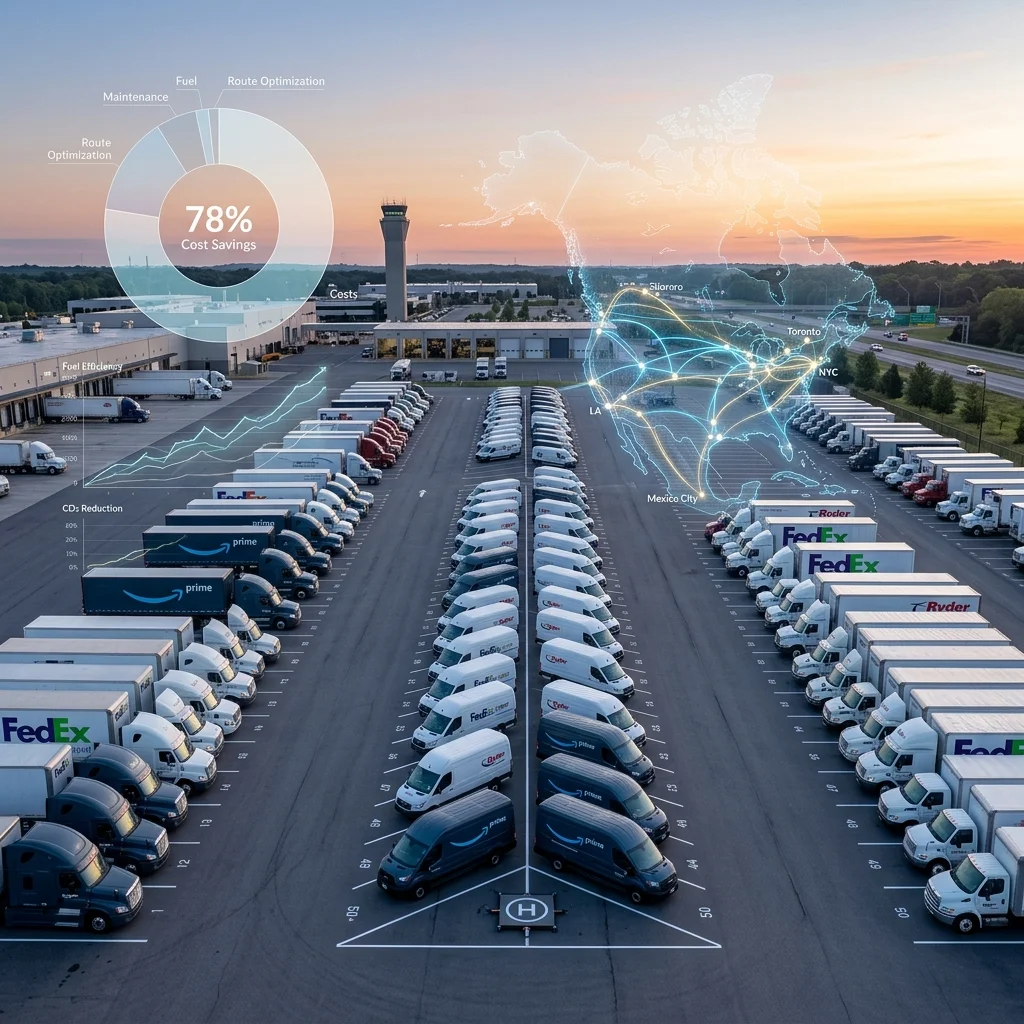
"Element Fleet Management''s 2026 Market Pulse Report reveals that 78% of"
Fleet Management 2026: Cost Savings Top Priority as Tariffs and AI Reshape North American Mobility – Element Fleet Market Pulse Report Analysis
Executive Summary: The 2026 Fleet Landscape – Stability Over Shock
On 4 May 2026, Element Fleet Management Corp. (TSX: EFN) released its fifth annual Market Pulse Report, based on a survey conducted across the United States, Canada, and Mexico over a two-month period. The report captures the strategic priorities of fleet leaders operating in an environment shaped by persistent trade tensions, accelerating digital tool adoption, and a measured approach to vehicle electrification.
The headline finding: 78% of fleet leaders rank cost savings as their top priority for 2026 (Source: Element Fleet Management 2026 Market Pulse Report). This figure signals a distinctly defensive posture, in which total cost of ownership (TCO) reduction supersedes fleet expansion or technological novelty. Simultaneously, 54% of respondents report moderate-to-significant impact from tariffs and broader economic factors—a direct consequence of ongoing North American trade policy adjustments under the USMCA framework and the reimposition of steel and aluminum tariffs.
Yet the data does not indicate a broad contraction. Exactly 50% of fleet operators plan to maintain their current fleet size, a signal of cautious stability rather than aggressive downsizing. The emerging pattern is one of pragmatic resilience: fleets are optimizing existing assets through data and artificial intelligence while making selective, incremental investments in alternative mobility solutions. Element, which manages over 1.5 million vehicles globally and identified more than $1.6 billion in cost savings opportunities for clients in the past year, provides a credible lens through which to interpret these industry-wide trends.
The Cost Imperative: Why 78% Say Savings Rule – And How They’re Achieving It
The primacy of cost savings represents a structural shift in fleet management KPIs. In prior years, fleet leaders balanced growth, innovation, and sustainability alongside cost discipline. The 2026 data consolidates these priorities: cost savings are no longer one objective among many but the dominant lens through which all other decisions are evaluated.
The methods deployed to achieve these savings reveal a clear technological vector. Fifty-three percent of respondents are actively exploring or implementing artificial intelligence and digital tools specifically for safety improvement, route optimization, and predictive maintenance (Source: same report). This is a direct causal link: fleets are investing in technology not for its own sake but as a lever to reduce operating expenditures. Route optimization reduces fuel consumption and driver hours; predictive maintenance lowers unscheduled downtime and repair costs; AI-driven safety systems decrease accident-related liability and insurance premiums.
David Madrigal, a senior executive at Element Fleet Management, contextualized the shift: “Clients are operating in an environment where every decision must deliver measurable value. They’re focused on reducing total cost of ownership while maintaining performance — and increasingly turning to data and strategic insights to guide those decisions.” The statement aligns with Element’s own operational findings: the $1.6 billion in identified cost savings across client fleets in the past year is not a hypothetical target but a realized outcome of data-driven fleet management interventions.
The implication for OEMs and technology vendors is clear: adoption of advanced digital tools will be tied directly to demonstrable ROI. Solutions that cannot prove a short-term cost reduction impact will face slower uptake, regardless of their long-term strategic value.
Navigating Economic Headwinds: Tariffs, Trade Policy, and the Stability-First Mindset
The 54% of fleet leaders reporting moderate-to-significant impact from tariffs and economic factors must be understood in the context of North America’s integrated automotive supply chain. The renegotiated USMCA rules of origin, combined with renewed tariffs on steel and aluminum, have increased the cost of vehicle acquisition and replacement parts. For fleets operating across borders—particularly those in logistics, construction, and last-mile delivery—these cost pressures compound with rising interest rates and labor market tightness.
The response, however, is not panic. The finding that 50% of fleets plan to maintain current fleet size reflects a deliberate “wait-and-see” posture. This approach avoids overcommitment to capital expenditure in a volatile pricing environment but carries its own risk: stable fleet size may lead to capacity constraints if demand unexpectedly increases or if vehicle replacement cycles are deferred beyond optimal economic life.
Supply chain implications extend beyond fleet size. While stable order volumes reduce volatility for OEMs, the shift toward alternative mobility solutions—cited by 31% of respondents—alters vehicle lifecycle demand. Within that 31%, short-term rentals lead adoption, suggesting fleets are using rental vehicles as a flexible buffer to manage peak demand without permanent fleet expansion. This behavior reduces the need for new vehicle purchases and shifts capital expenditure into operational expenditure, a structural change that leasing companies and rental firms may need to incorporate into their long-term planning.
Avninder Buttar, another Element executive, framed the cautious posture: “For most organizations, progress isn’t about making bold, immediate shifts; it’s about taking practical steps that align with operational realities. That’s especially true as fleets balance sustainability goals with cost, infrastructure, and performance considerations.” The statement underscores the tension between environmental targets and economic constraints—a friction that has delayed the EV transition.
Electric vehicle adoption remains nascent: only 19% of fleets are in early stages of EV transition. The low penetration is consistent with infrastructure gaps, higher upfront costs, and range limitations for certain vocational applications. Rather than forcing a rapid transition, fleets are using alternative mobility solutions (short-term rentals, car-sharing, or flexible leasing) as interim strategies, further delaying large-scale EV fleet commitments.
Future Implications: The Steady Hand Strategy and Market Consequences
The 2026 Market Pulse Report reveals a fleet management sector that is neither retreating nor charging forward. The “steady hand” strategy—cost optimization, stable fleet size, guarded technology adoption, and cautious EV experimentation—has three probable consequences for North American mobility markets over the next 12 to 24 months.
First, demand for AI-driven fleet management software and telematics will accelerate, but with a clear focus on cost-saving applications. Vendors offering predictive maintenance, dynamic routing, and driver behavior analytics will outperform those emphasizing autonomous driving or futuristic features without near-term TCO impact.
Second, OEMs will face persistent order book stability but declining per-vehicle margins if fleets continue to extend replacement cycles. The shift toward short-term rentals may also reduce the total number of vehicles purchased per annum, even as utilization rates rise. Manufacturers will need to offer financing and service packages that align with fleets’ preference for operational expenditure over capital expenditure.
Third, the EV transition will remain a slow, regionally uneven process. Fleets in urban last-mile delivery and light-duty applications may accelerate adoption where total cost of ownership parity is achieved, but heavy-duty and long-haul operations will lag. Alternative mobility solutions will serve as a bridge technology, keeping overall fleet carbon footprints flat rather than declining sharply.
In summary, the 2026 data depicts a sector that has internalized external shocks and is optimizing within constraints. The emphasis on cost savings is not a cyclical response but a structural realignment—one that will persist as long as trade policy uncertainty and interest rates remain elevated. Fleets are not betting on a dramatic breakthrough; they are reducing variance, and that conservatism itself will shape the North American mobility landscape for years to come.
Trade Metrics
Related Datasets
Q4 Cross-Border Logistics Report
PDF • 4.2 MB
Automotive Parts Supply Chain Index
CSV • 1.1 MB