Beyond the Module: The Unseen Economic and Technological Implications of the

Michael Chen
Senior Trade Analyst
March 24, 2026
DATELINE: NA TRADE WIRE
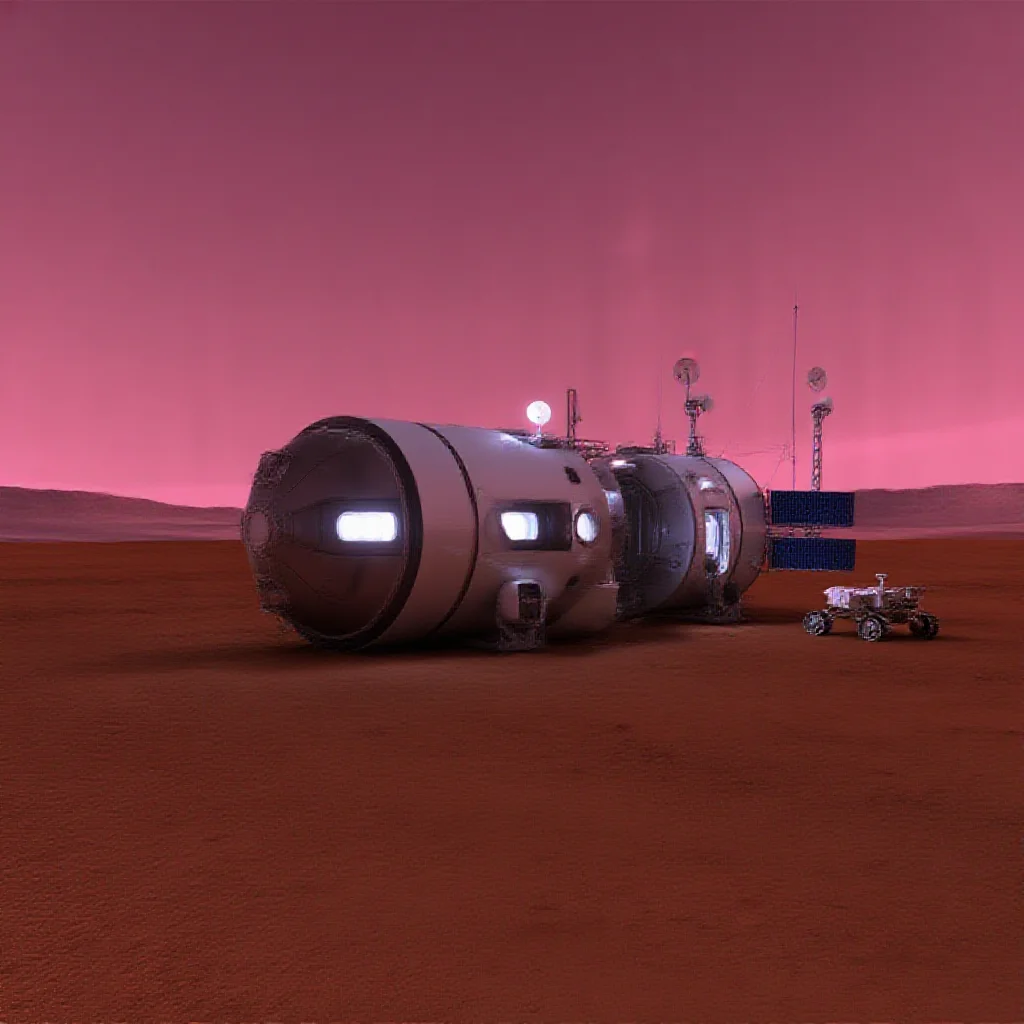
"The completion of the first permanent habitat module for a Mars colony project"
Beyond the Module: The Unseen Economic and Technological Implications of the First Permanent Mars Habitat
Cover Image Description: A hyper-realistic, futuristic rendering of a sleek, cylindrical habitat module on the rust-colored surface of Mars under a dark pink sky. The module has illuminated windows and connected airlocks, with solar panels and communication antennae extending from its structure. A small rover is parked nearby. The scene is dramatic, showcasing both isolation and advanced human engineering.
Introduction: A Milestone with Multilayered Meaning
The reported completion of the first permanent habitat module for a Mars colony project (Source 1: [Primary Data]) represents a quantifiable advance in aerospace engineering. According to the report, this module is designed to support a crew of four for two years and integrates life support systems, living quarters, and a laboratory (Source 1: [Primary Data]). The announcement, as disseminated by World News International, provides a surface-level technical achievement. A deeper analysis, however, positions this event not merely as an engineering feat, but as a critical inflection point for the economic and logistical models governing deep-space activity. This module functions as the first tangible, high-value asset in a nascent off-world real estate and services market, shifting the paradigm from transient exploration to sustained occupation.
!Concept art of the completed habitat module in a clean-room assembly facility on Earth.
Deconstructing the Module: A Blueprint for Commercial Viability
The published specifications of the habitat—four-person, two-year capacity with integrated core systems—establish a foundational architectural template. The design choices reveal a primary focus on ensuring crew survival and scientific functionality within a constrained mass and volume budget. The inclusion of a dedicated laboratory is a significant indicator, prioritizing initial in-situ research return over expansive living space or recreational facilities. This configuration can be analyzed through a commercial lens as a minimum viable product (MVP) for future revenue-generating operations. The module’s core systems provide a proof-of-concept platform that can be scaled or replicated for paid research missions hosted by national agencies, private corporations, or consortia. Furthermore, the life support and habitation elements form the essential backbone for any future expansion into high-value space tourism or specialized manufacturing outposts.
The Birth of a New Supply Chain: From Earth-Reliant to Mars-Ready
This milestone validates and stimulates a previously theoretical supply chain. It creates concrete demand for serial-produced, space-grade components distinct from those used in low-Earth orbit. Key sectors include manufacturers of advanced radiation-shielding composites, ultra-reliable closed-loop water and air revitalization systems, and compact, automated laboratory equipment. The development signals a potential shift from the historical model of one-off, bespoke modules for the International Space Station—each a unique, government-funded project—toward standardized, serially produced "habitat kits." This shift implies economies of scale, reduced unit costs over time, and the emergence of specialized subcontractors whose business models are predicated on interplanetary, rather than orbital, infrastructure needs. The module is not a singular artifact but a prototype for a product line.
The Slow Analysis: Long-Term Implications for the Space Industry Ecosystem
This event warrants a "Slow Analysis" approach; it is less a breaking news item and more a definitive trend point for a deep audit of the space industry's trajectory. The designation "permanent" introduces a fundamental change in financial calculus. Unlike a spacecraft for a single mission, a permanent habitat is a capital asset designed for depreciation over decades. This enables new accounting and financing models, including long-term leasing and asset-backed investment. The integrated laboratory space specifically points toward a future market for "lab-as-a-service" on Mars, where pharmaceutical, materials science, or astrobiology research can be conducted in a unique environment, with the habitat owner providing power, life support, and data connectivity for a fee. The module’s existence makes the business case for in-situ resource utilization (ISRU) technologies—such as extracting water from regolith or producing oxygen from the Martian atmosphere—more urgent and financially justifiable, as these technologies directly reduce the long-term operating costs of a permanent base.
Conclusion: From Prototype to Precedent in Interplanetary Industry
The completion of the first permanent Mars habitat module is a technological predicate for economic transformation. Its primary function is to ensure human survival, but its secondary and more profound role is to de-risk and standardize the core product of off-world habitation. The module serves as a precedent, establishing design norms, operational protocols, and performance benchmarks that will influence all subsequent developments. It moves the discussion from theoretical feasibility to practical logistics and unit economics. The long-term market patterns will likely see closed-loop life support and ISRU technologies become high-value export commodities, while the habitat model itself evolves into a platform for diverse commercial and scientific activities. This milestone, therefore, marks the point where the economics of deep-space exploration began a tangible transition from a cost-centric government endeavor to a potential asset-centric industrial domain.
Trade Metrics
Related Datasets
Q4 Cross-Border Logistics Report
PDF • 4.2 MB
Automotive Parts Supply Chain Index
CSV • 1.1 MB