The Thawing Ledger: How Arctic Permafrost Carbon Release is Rewriting Global

Michael Chen
Senior Trade Analyst
April 8, 2026
DATELINE: NA TRADE WIRE
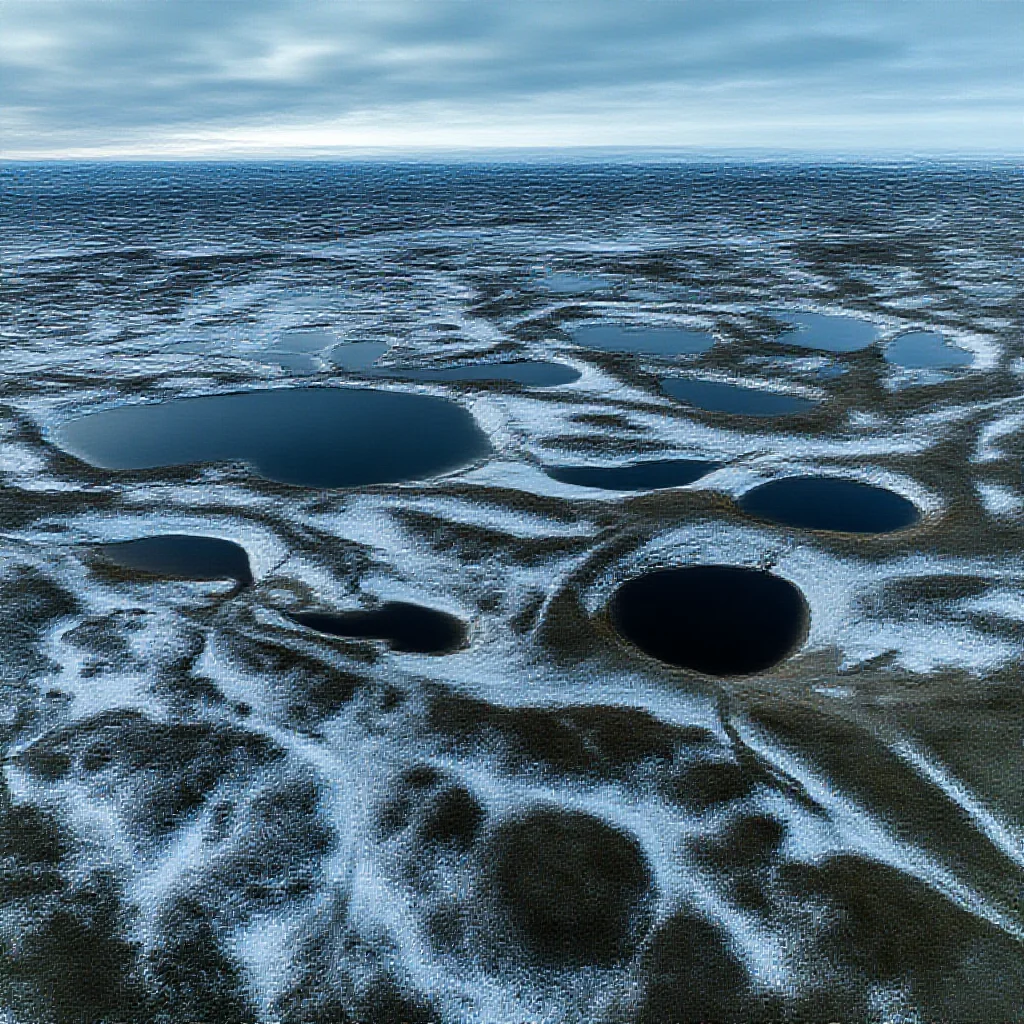
"The accelerating thaw of Arctic permafrost is not just an environmental crisis"
The Thawing Ledger: How Arctic Permafrost Carbon Release is Rewriting Global Economic and Climate Risk Models
The Arctic permafrost, a once-stable frozen repository, is undergoing a phase change. Its accelerating thaw represents not merely an environmental alteration but a fundamental recalibration of planetary systems. This process is releasing carbon sequestered over millennia, initiating a feedback loop that operates independently of anthropogenic emissions. The economic and systemic implications of this thaw are now moving from scientific projection to material risk, challenging the foundational assumptions of global climate policy and long-term financial stability.
Beyond the Tipping Point: Permafrost Thaw as a Non-Negotiable Climate Feedback
The narrative of gradual climate change is invalidated by the behavior of permafrost. Observations indicate thaw rates are exceeding the worst-case scenarios outlined in previous Intergovernmental Panel on Climate Change (IPCC) assessments. This acceleration is not linear; it is driven by self-reinforcing feedbacks, such as the expansion of thermokarst lakes which increase lateral thaw, and the reduction of surface albedo as ice gives way to darker land and water.
The carbon being released is not contemporary. It is ancient, originating from biomass accumulated over thousands of years. This distinction is critical for atmospheric carbon budgeting. Modern carbon cycles operate within a relatively constrained system. The introduction of this ancient carbon constitutes a net new input, effectively reducing the remaining carbon budget available to meet the targets of the Paris Agreement. The permafrost system has transitioned from a carbon sink to a source, operating as an autonomous, amplifying mechanism that erodes humanity's capacity to manage atmospheric greenhouse gas concentrations through emission reductions alone.
Image Suggestion: An infographic-style diagram illustrating the permafrost carbon feedback loop: thaw -> microbial activity -> GHG release -> warming -> more thaw.
The Slow Analysis: Long-Term Economic Repercussions and Market Blind Spots
The financial ramifications are vast and systematically under-priced. First, the "Carbon Debt" crisis emerges. Projected emissions from thawing permafrost, estimated in the tens to hundreds of gigatons of carbon equivalent this century, are frequently omitted from corporate carbon accounting and national net-zero pathways. This unaccounted-for flux invalidates the arithmetic of many long-term decarbonization plans, creating a liability that is not reflected on any balance sheet.
Second, physical infrastructure risk is acute. The value of fixed assets in the Arctic region—including oil and gas extraction facilities, mining operations, and transportation corridors—is contingent upon ground stability. Permafrost thaw induces subsidence, buckling, and structural failure. A 2021 report by the Carbon Tracker Initiative highlighted the vulnerability of billions in hydrocarbon assets to strandment from both climate policy and the physical degradation of their operating environment. Third, supply chain assumptions are challenged. While thaw may open new Arctic shipping routes, the intensification of weather volatility and the unpredictable transformation of the terrain make these routes unreliable and hazardous chokepoints, not stable trade arteries.
Evidence Arrangement: Studies from NASA's Arctic-Boreal Vulnerability Experiment (ABoVE) detail the physical processes of thaw. The IPCC's Special Report on the Ocean and Cryosphere in a Changing Climate (SROCC) provides consensus projections on carbon release. Financial analyses from the Carbon Tracker Initiative quantify stranded asset risk.
The Unseen Geopolitical Fault Line: Sovereignty, Security, and Scramble for Resources
The rapidity of environmental change is outpacing the development of governance frameworks. As sea ice recedes, vast maritime and subsea resource areas become accessible, creating a regulatory vacuum. This leads to a paradox: the thaw that enables access to previously unreachable oil, gas, and mineral deposits simultaneously increases the physical and financial risk of extracting them due to ground instability and escalating operational costs.
This environment fosters geopolitical tension. Nations are advancing competing sovereignty claims over extended continental shelves and newly navigable waterways like the Northern Sea Route and the Northwest Passage. The strategic militarization of the Arctic is a direct response to this uncertainty, as states seek to secure perceived national interests in a region where the rules are being written in real-time. Security concerns now encompass environmental disasters, search and rescue in increasingly trafficked but poorly charted waters, and the potential for conflict over resource access.
Image Suggestion: A map of the Arctic Circle highlighting new shipping routes (Northern Sea Route, Northwest Passage) and zones of contested sovereignty.
Modeling the Unmodelable: The Failure of Linear Economics in a Non-Linear World
The dominant tools for climate-economics, such as Dynamic Integrated Climate-Economy (DICE) models, are ill-equipped for this reality. They traditionally rely on smooth, marginal cost curves for climate damage and abatement. The permafrost feedback loop is a non-linear, discontinuous process that can trigger abrupt shifts in system state. Its economic impact is not a marginal cost increase but a potential for cascading, systemic failure. This represents a "Gray Rhino" risk: a highly probable, high-impact threat that is systematically ignored by conventional modeling and market pricing.
This modeling failure creates both risk and opportunity. The inability of existing frameworks to price permafrost risk points to a significant market inefficiency. It may catalyze the development of novel financial instruments designed to hedge against or securitize this specific climate risk. Potential innovations could include specialized insurance products for Arctic infrastructure, catastrophe bonds linked to permafrost carbon release thresholds, or derivatives that allow institutions to manage exposure to the volatility introduced by this feedback loop. The demand for next-generation, complex-system-integrated climate risk models will grow, creating a new frontier in financial and economic analytics.
Evidence Arrangement: Economic research on climate feedback loops in integrated assessment models, such as work published in Nature Climate Change or Proceedings of the National Academy of Sciences, critiques current modeling limitations. Analyses from central banks and financial stability boards, like the Network for Greening the Financial System (NGFS), have begun to flag non-linear climate risks as a threat to systemic stability.
Neutral Market/Industry Prediction: The materialization of permafrost-derived risks will follow a non-linear trajectory. In the near term (5-10 years), the primary economic impact will be felt through rising insurance premiums and capital costs for Arctic-based industries, and increased spending on infrastructure adaptation and repair. Mid-term (10-25 years), the unaccounted "carbon debt" will force a painful recalibration of global carbon budgets, leading to more stringent and abrupt policy interventions that could shock fossil fuel and heavy industry valuations. Long-term, the financial sector will develop a suite of instruments to price and trade permafrost-related risks, formally integrating this feedback loop into global capital allocation decisions. The entities that succeed will be those that replace linear, backward-looking risk models with dynamic systems that acknowledge the autonomous, amplifying nature of the thawing ledger.
Trade Metrics
Related Datasets
Q4 Cross-Border Logistics Report
PDF • 4.2 MB
Automotive Parts Supply Chain Index
CSV • 1.1 MB