Beyond the 300% Yield: The Hidden Economic and Technological Revolution of

Michael Chen
Senior Trade Analyst
April 8, 2026
DATELINE: NA TRADE WIRE
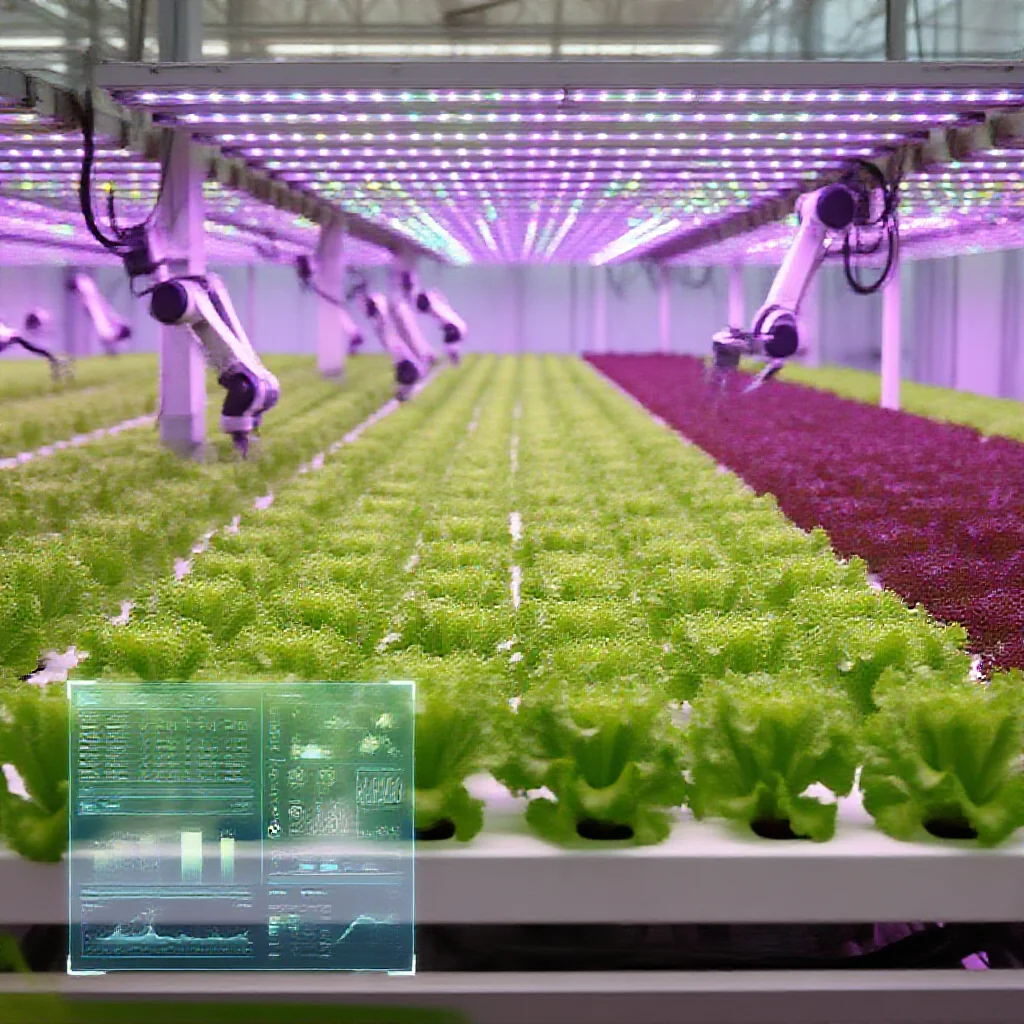
"While headlines tout a 300% yield increase from AI-controlled vertical farms,"
Beyond the 300% Yield: The Hidden Economic and Technological Revolution of AI-Controlled Vertical Farming
Summary: While headlines tout a 300% yield increase from AI-controlled vertical farms, the real story lies beneath the surface. This article moves beyond the impressive statistic to explore the profound economic logic and technological trends it represents. We analyze how this leap in productivity is not merely about growing more food, but about fundamentally restructuring agricultural economics—shifting from land-intensive to data-intensive production. This transition promises to disrupt traditional supply chains, alter the geography of food production, and create new dependencies on technology platforms. We examine the long-term implications for labor, energy consumption, and food security, positioning AI-driven vertical farming as a pivotal force in the future of sustainable urbanization and resilient food systems.
---
Deconstructing the 300%: What the Yield Figure Really Means
The assertion that AI-controlled vertical farming systems can increase yield by 300% functions as a powerful headline, but its meaning is contingent on the baseline of comparison. (Source 1: [Primary Data]) The figure typically references yield per unit area per year against traditional open-field agriculture. For a crop like lettuce, a traditional farm may yield 3-4 harvests annually, while a controlled environment vertical farm can achieve 12-16 harvests due to consistent, optimized conditions. The 300% metric is a composite result of multiple factors.
The vertical structure itself provides the physical multiplier, stacking growing layers to utilize cubic air space. However, the AI component is the critical optimization engine. Machine learning algorithms process real-time data from sensors monitoring photosynthetic photon flux density (PPFD), nutrient concentration in hydroponic solutions, ambient CO2 levels, and root-zone temperature. These systems do not simply maintain setpoints; they engage in predictive growth modeling, dynamically adjusting variables to shave days off growth cycles and maximize biomass production per input unit.
Research from institutions such as Wageningen University & Research on closed-loop plant production systems validates the role of integrated climate and irrigation control in pushing biological efficiency. The 300% yield increase, therefore, is not an arbitrary number but a quantifiable outcome of transitioning from heuristic, observation-based farming to a fully deterministic, data-driven production model.
The Core Axis: From Land Economics to Data Economics
The fundamental economic shift enabled by AI-vertical farming is the decoupling of agricultural output from two historical constraints: geographic latitude and climatic seasonality. The primary capital asset ceases to be fertile land and becomes the proprietary algorithm suite. The algorithm functions as the new "soil," with its fertility defined by code efficiency, dataset depth, and predictive accuracy.
This shift redefines the industry's value chain. The traditional chain is linear: land acquisition, weather risk management, manual labor, and long-distance logistics. The AI-vertical farming chain is a tightly integrated loop: data acquisition from sensors, algorithmic processing, automated actuation (light, nutrients, climate), and hyper-local distribution. The most significant cost centers morph from land, water, and pesticides to electricity, semiconductor-based lighting, sensor hardware, and computational resources.
A direct market manifestation of this shift is the emergence of "Farming-as-a-Service" (FaaS) models. Technology companies are developing centralized AI operating systems—platforms that manage growth recipes, predict maintenance needs, and optimize resource allocation—which are then licensed to vertical farm operators. This creates a new layer of dependency, where agricultural success is tied to software updates, API reliability, and cybersecurity, mirroring trends seen in other industrial sectors.
Slow Analysis: The Deep Audit of Industry Transformation
The 300% yield statistic is a snapshot of a rapid technological evolution. A "slow analysis" audit requires examining the scalability hurdles and second-order effects that will determine its long-term viability and impact.
The primary limitation is economic scalability. High capital expenditure (CAPEX) for facility build-out and energy intensity, particularly for LED lighting and climate control, present significant barriers. The 300% yield must generate sufficient revenue per cubic meter to offset these costs, which currently restricts commercial viability to high-value, fast-growing leafy greens and herbs. The economic equation must also factor in the declining cost of renewables and LEDs versus volatile commodity prices in traditional agriculture.
The long-term supply chain impact is paradoxical. Hyper-local production within urban centers drastically reduces food miles, spoilage, and logistics costs, enhancing resilience to global transport disruptions. However, it creates a new vulnerability: dependence on stable, high-capacity energy grids and complex, just-in-time tech maintenance networks. A power outage or critical software failure could halt production entirely within days.
Concurrently, a labor metamorphosis is underway. The demand for traditional broad-acre farming skills diminishes, while new roles emerge in mechatronics (for maintaining robotic harvesters), data science (for refining growth models), and system biology (for developing crop varieties optimized for spectral recipes). The workforce transitions from seasonal, physical labor to permanent, technical specialization.
Finally, the geopolitical dimension of food security is altered. Nations with limited arable land but advanced technological infrastructure can develop domestic food production capabilities, reducing reliance on imports. Conversely, traditional agricultural exporters may face reduced demand for certain high-value, perishable commodities, necessitating economic adaptation.
Conclusion: The Neutral Trajectory of an Agricultural Paradigm
The 300% yield increase is a measurable indicator of a deeper transition. AI-controlled vertical farming represents the maturation of agriculture into a form of precision manufacturing. Its trajectory will not be determined by biological potential alone, but by the complex interplay of energy economics, data platform dominance, and the evolving cost-benefit analysis of food resilience versus efficiency.
Market adoption will follow a sigmoid curve, expanding as technological learning drives down CAPEX and operational algorithms become more crop-diverse. The end state is not a wholesale replacement of traditional agriculture, but the stratification of the food system. Field farming will persist for staple grains and oilseeds, while controlled environment agriculture will dominate the production of perishable, high-nutrient-density vegetables for urban populations.
The ultimate impact is the formalization of food production as a data-centric industry. The competitive advantage will belong to entities that control the most robust datasets linking phenotypic expression to controlled environmental variables, making the AI platform, not the physical farm, the core asset of future agricultural value.
Trade Metrics
Related Datasets
Q4 Cross-Border Logistics Report
PDF • 4.2 MB
Automotive Parts Supply Chain Index
CSV • 1.1 MB