Beyond the Headline: Why Uber''s $1.25B Rivian Bet Is a Strategic Pivot, Not

James Wilson
Industry Analyst
March 22, 2026
DATELINE: NA TRADE WIRE
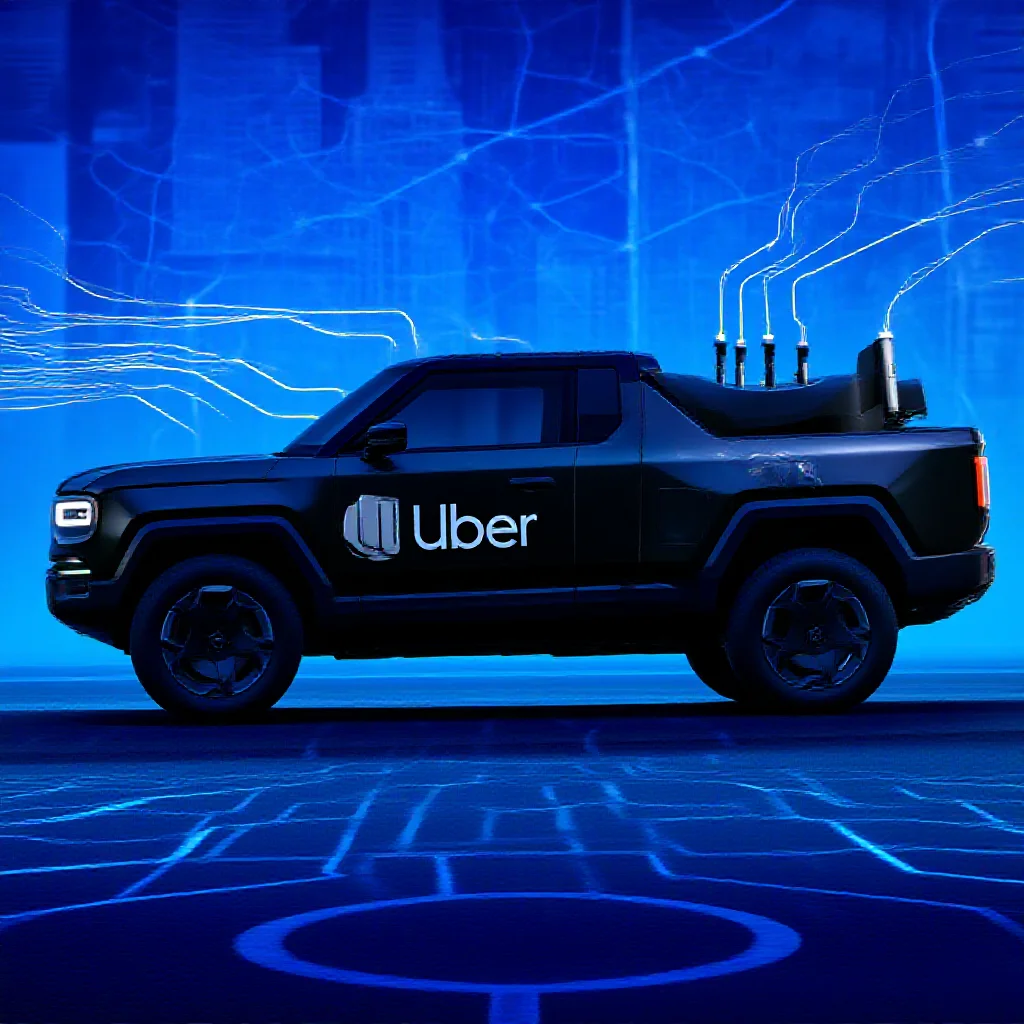
"Uber''s commitment of up to $1.25 billion in Rivian, sparking an 8% stock"
Beyond the Headline: Why Uber's $1.25B Rivian Bet Is a Strategic Pivot, Not Just a Robotaxi Deal
On March 19, 2026, Uber Technologies Inc. announced a commitment of up to $1.25 billion in electric vehicle manufacturer Rivian Automotive Inc. (Source 1: [Primary Data]). The market responded immediately, with Rivian’s share price rallying 8% on the news (Source 2: [Primary Data]). The stated objective of the partnership is the integration of Rivian’s purpose-built commercial electric vehicles into Uber’s future autonomous ride-hailing network. While superficially a straightforward supplier agreement, a structural analysis reveals this transaction represents a fundamental strategic pivot for Uber, moving the company from a pure mobility platform toward a vertically integrated fleet operator and asset owner.
The Surface Deal: A $1.25B Vote of Confidence in Electric Robotaxis
The announced partnership positions Uber and Rivian directly within the escalating competition for autonomous ride-hailing dominance. Key competitors include Tesla, with its vertically integrated approach to vehicle manufacturing and autonomy; Waymo, a leader in autonomous software deploying through partnerships with automakers like Jaguar and Geely; and GM’s Cruise, which leverages its parent company’s manufacturing capacity. The Uber-Rivian alliance combines a global network with a dedicated manufacturer of electric commercial vehicles. The $1.25 billion commitment, which will be executed through a combination of direct investment and vehicle financing over the coming years, provides Rivian with critical capital for scaling production while granting Uber preferential access to its output.
The Hidden Logic: Uber's Pivot from Platform to Fleet Capitalist
The core strategic implication of this investment is a fundamental departure from Uber’s foundational asset-light, platform-only business model. For over a decade, Uber’s value proposition was built on aggregating demand and connecting it to independently owned vehicles and drivers, minimizing capital expenditure on hard assets. The Rivian deal signals a deliberate shift toward an integrated fleet operator model, where control over the vehicle asset itself becomes a central component of the business.
This move is driven by a clear long-term calculus. As autonomous vehicle (AV) technology matures and scales, securing a dedicated, scalable supply of purpose-built electric vehicles will become a critical competitive moat. The investment pre-empts potential future scarcity and price volatility in the EV market, mitigating a significant procurement risk. Financially, it transforms Rivian from a third-party supplier into a quasi-captive manufacturing arm. This grants Uber influence over vehicle design for optimal ride-hailing and autonomy integration, control over deployment timelines, and a direct financial stake in the vehicle’s lifecycle cost and residual value—advantages a pure software platform cannot secure.
Evidence & Verification: Reading Between the Financial Lines
Financial disclosures and strategic communications substantiate this pivot thesis. Analysis of Uber’s recent SEC filings indicates a gradual but perceptible shift in capital allocation, with growing forecasts for expenditures related to owned or leased fleet assets, diverging from its historically minimal capital expenditure profile. The $1.25 billion figure is strategically significant when contextualized against Uber’s past R&D investment in its now-divested Advanced Technologies Group (ATG) and Rivian’s own substantial capital requirements for production scaling. It represents a strategic capital allocation aimed at securing a foundational hardware stack, not a mere partnership fee.
Statements from corporate leadership further verify the strategic depth. Uber’s CEO has increasingly framed such collaborations as “strategic partnerships” essential for building the future of mobility, moving beyond the language of simple marketplace facilitation. Concurrently, Rivian’s leadership has emphasized a strategic focus on commercial vehicle platforms, for which Uber now represents a flagship, high-volume anchor client. This alignment of capital and strategic vision underscores a move from transactional partnership to integrated operation.
The Ripple Effect: Supply Chain, Competition, and Market Reconfiguration
The long-term implications of this deal will reconfigure competitive dynamics across multiple industries. For the automotive supply chain, it signals the rising importance of direct, large-scale partnerships between mobility networks and manufacturers, potentially marginalizing traditional fleet sales channels. For Uber’s direct competitors, the deal raises the stakes in the autonomy race; companies like Waymo may face increased pressure to secure similar dedicated manufacturing partnerships to ensure vehicle supply and cost control, while Tesla’s integrated model receives validation.
The most significant pressure, however, falls on traditional automakers. The emergence of “fleet-as-a-service” as a primary sales channel demands new capabilities in vehicle design for autonomy, lifecycle management, and direct partnership with technology firms. Automakers that fail to secure anchor partnerships with leading mobility platforms risk being relegated to a lower-margin, branded supplier role. For Uber, the strategic risk is equally tangible: the company is voluntarily adopting a more capital-intensive model, betting that the competitive advantages of supply chain control and vehicle-level economics will outweigh the dilution of its historically capital-efficient platform returns.
Conclusion: A New Phase in the Mobility Wars
The Uber-Rivian partnership is a definitive marker of a new phase in the mobility industry. The era where software and network effects alone guaranteed dominance is evolving into a more complex paradigm where control over the physical vehicle—its supply, design, and lifecycle—is becoming equally crucial. Uber’s investment is a strategic pivot to secure this control. The success of this bet will be measured not only by the performance of the eventual robotaxi service but by Uber’s ability to master the intricate financial and operational logistics of large-scale fleet ownership and management, a competency far removed from its origins as a pure digital intermediary. This move redefines the battlefield, ensuring that the future of urban transport will be shaped by those who command both the network and the node.
Trade Metrics
Related Datasets
Q4 Cross-Border Logistics Report
PDF • 4.2 MB
Automotive Parts Supply Chain Index
CSV • 1.1 MB