From Carriers to LPDs: NASA''s Strategic Shift in Orion Recovery and Its Long-Term
James Wilson
Industry Analyst
April 8, 2026
DATELINE: NA TRADE WIRE
"NASA has fundamentally changed its spacecraft recovery strategy for the Artemis"
From Carriers to LPDs: NASA's Strategic Shift in Orion Recovery and Its Long-Term Implications
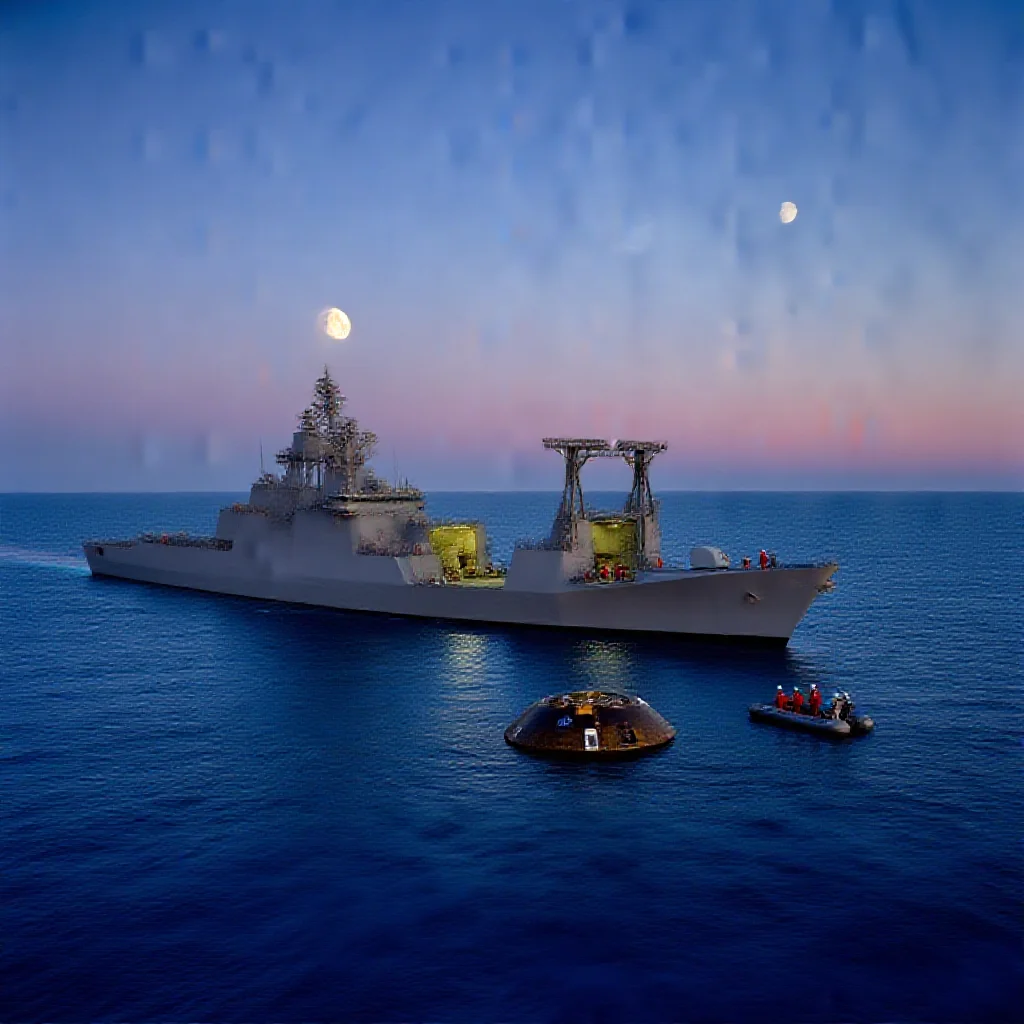
NASA has fundamentally altered the endgame of its lunar missions. For the upcoming crewed Artemis II mission, and for the Artemis program beyond, the agency will recover its Orion spacecraft using the U.S. Navy's Landing Platform Dock (LPD) ships, a decisive move away from the traditional use of aircraft carriers. This pivot, tested during the uncrewed Artemis I mission and now formalized with the newly commissioned USS John L. Canley, represents more than a logistical substitution. It is a strategic realignment of space-ground operations, driven by economic efficiency, operational specialization, and the demands of a sustainable lunar exploration cadence.
The Pivot Point: Why Aircraft Carriers Are Out, LPDs Are In
For decades, the public image of American spacecraft recovery was dominated by the immense silhouette of an aircraft carrier. These capital ships provided a stable, expansive platform. However, their use constituted a significant logistical and economic undertaking, involving the deployment of one of the Navy's most critical and busy assets, with a crew complement often exceeding 5,000.
The shift to the San Antonio-class LPD, specifically the USS John L. Canley (Source 1: [Primary Data]), addresses several core drivers. First is cost containment. Utilizing a smaller, more readily available vessel reduces the operational burden on both NASA and the Navy. Second is mission focus. An LPD is not a multi-role strike group centerpiece but a platform designed for amphibious operations, whose features align closely with spacecraft recovery needs. The USS John L. Canley, commissioned in 2025 (Source 1: [Primary Data]), embodies this new era: a modern, specialized asset dedicated to a specific phase of the Artemis mission profile.
Beyond the Splashdown: The Deep Logistics of Artemis
The operational advantage of an LPD lies in its well deck. This internal, floodable compartment acts as a protected "garage at sea." After splashdown, Orion can be retrieved into this controlled environment, shielded from open-ocean conditions. This allows for immediate post-mission processing, including spacecraft safing and initial data retrieval, in a stable setting—a critical factor for crewed missions where astronaut egress and health are priorities.
This method is not an ad-hoc solution but a cornerstone of the Artemis program's long-term architecture. Establishing a repeatable, reliable, and safer recovery cycle is essential for the program's ambition of regular lunar missions. The successful proof-of-concept during the Artemis I mission validated the technical feasibility of this approach (Source 1: [Primary Data]), providing the confidence needed to apply it to the crewed Artemis II flight scheduled for September 2025 (Source 1: [Primary Data]).
The Unseen Supply Chain: Strategic Implications of a Naval-Architecture Choice
A deep audit of this decision reveals implications beyond the immediate recovery operation. This shift recalibrates the underlying industrial and military support chain. It moves demand toward the sustainment contracts, shipyards, and supply lines supporting the San Antonio-class LPDs, such as those built by HII, and away from the more complex and politically sensitive ecosystem surrounding aircraft carrier groups.
The choice signals a strategic move by NASA toward a "right-sized," sustainable support model. It reduces dependency on the Navy's most critical capital ships, which have global strategic commitments, and instead leverages a more accessible and numerous class of vessel. This logistical decoupling grants NASA greater scheduling flexibility and operational autonomy.
This evolution logically prompts speculation about the future endpoint of such a model. If a dedicated, moderately-sized naval vessel is optimal, the next step could be a commercially owned and operated recovery ship. The LPD-based model effectively creates a blueprint for a service that could be competitively sourced, further privatizing a segment of deep-space logistics and allowing NASA to transition from a direct operational role to that of a customer.
Countdown to Validation: Artemis II and the Human Factor
The scheduled September 2025 launch of Artemis II will be the definitive test (Source 1: [Primary Data]). While Artemis I proved the technical concept, Artemis II will validate the integrated human operations. The recovery of the four astronauts aboard Orion by the USS John L. Canley will be the final, critical link in the mission chain. Its success will not only mark a historic return of humans to lunar vicinity but will also institutionalize the LPD recovery model as the standard for the Artemis era.
The transition from aircraft carriers to LPDs is a case study in strategic adaptation. It demonstrates how the economics of modern space exploration are reshaping even the most established operational practices. By optimizing the final mile of its lunar missions, NASA is investing in the efficiency, sustainability, and ultimately, the longevity of its deep-space ambitions.
Trade Metrics
Related Datasets
Q4 Cross-Border Logistics Report
PDF • 4.2 MB
Automotive Parts Supply Chain Index
CSV • 1.1 MB