7 Emerging Industry Trends Reshaping Business in 2024: Digital Transformation,

James Wilson
Industry Analyst
July 1, 2026
DATELINE: NA TRADE WIRE
"Based on the 2024 Nerac article by Terry Prokop, this article decodes seven"
Here is a professional, news-style article in English, written in Markdown format. It adheres to your requirements: no marketing language, no "Beyond the Headline" phrase, objective tone, and natural integration of keywords. The article expands on the outline with depth, connective reasoning, and practical implications, while including image placement markers.
---
Seven Industry Trends Reshaping Business in 2024: Digital Transformation, Sustainability, and the Interconnected Future
Introduction: The New Industrial Revolution Is Already Here
Industries today face a convergence of forces unlike any in recent memory. Technology is evolving at an exponential pace, consumer expectations are shifting overnight, regulatory frameworks are tightening, and macroeconomic uncertainty persists. This is not a gradual evolution—it is a perfect storm. For business leaders, the challenge is no longer about choosing which trend to follow, but about understanding how multiple, simultaneous shifts interact and compound one another.
A May 2024 analysis by Nerac, authored by Terry Prokop, provides a timely framework by identifying seven key industry trends: digital transformation (AI, IoT, cloud, big data), sustainability, remote work, health & wellness, personalization, e-commerce/omnichannel retail, and blockchain. Yet a surface-level list risks oversimplification. The real competitive edge in 2024 lies not in adopting any single trend, but in grasping the hidden economic logic that binds them together. This article decodes that logic, examines the disproportionate impact on small and medium-sized enterprises (SMEs), and offers actionable strategies for market monitoring, innovation investment, and agile adaptation.
[IMAGE: A collage of diverse industry icons (factory, office, hospital, store) merging into a single data stream.]
The Seven Trends Decoded: Beyond Buzzwords
Each of these trends carries genuine operational and strategic weight. Here is a closer look at what they mean for businesses today.
Digital Transformation: AI, IoT, Cloud, and Big Data
Digital transformation is no longer a separate initiative—it is the infrastructure upon which nearly every other trend depends. Artificial intelligence (AI) automates decision-making, the Internet of Things (IoT) connects physical assets in real time, cloud computing provides scalable storage and processing power, and big data unlocks predictive insights. Together, these technologies enable personalized marketing, remote collaboration, and supply chain visibility. Without them, advances in sustainability or omnichannel retail would be impossible at scale.
Sustainability: A New Supply Chain Metric
Sustainability has moved beyond carbon offsets and green branding. It now affects sourcing decisions, logistics routes, packaging materials, and even investor confidence. Companies are integrating environmental, social, and governance (ESG) metrics into core operations. Regulations such as the EU’s Carbon Border Adjustment Mechanism are forcing global supply chains to account for emissions. Crucially, sustainability creates brand loyalty: consumers increasingly choose products with verifiable ethical and environmental credentials.
Remote Work and Hybrid Models
COVID-19 acted as an accelerator, but the shift to remote and hybrid work has become a permanent structural change. This trend reshapes real estate demand (fewer office towers, more suburban co-working spaces), alters talent acquisition (geographic flexibility), and challenges corporate culture. It also drives demand for digital collaboration tools, cybersecurity solutions, and home office ergonomics.
Health & Wellness: Post-Pandemic Focus
The pandemic elevated health and wellness from a personal priority to a business imperative. Employers now invest in mental health apps, ergonomic home offices, and flexible schedules. Consumer goods companies have reformulated products around immunity, stress reduction, and sleep quality. This trend intersects with personalization: wearable devices generate individualized health data that companies can use to tailor offerings.
Personalization: Data-Driven Customization at Scale
Personalization has become a baseline expectation, not a competitive differentiator. Thanks to AI and big data, companies can deliver individualized product recommendations, dynamic pricing, and customized content in real time. From Netflix’s algorithm to beauty brands offering bespoke formulations, the bar keeps rising. However, personalization raises privacy concerns and requires robust data governance—another area where blockchain may play a role.
E-commerce and Omnichannel Retail
The boundary between physical and digital commerce has blurred. Consumers expect to browse online, check in-store availability, buy via mobile, and return anywhere. Last-mile logistics and customer experience have become the primary battlegrounds. Retailers that fail to integrate inventory systems, offer seamless click-and-collect, or provide real-time delivery tracking risk losing market share.
Blockchain Technology: Beyond Crypto
Blockchain is shedding its association with cryptocurrency volatility and entering mainstream business applications. Smart contracts automate supplier payments when conditions are met. Supply chain transparency becomes possible: a product’s journey from raw material to shelf can be recorded immutably, enabling verification of ethical sourcing or carbon offsets. Healthcare records, land titles, and digital identity are emerging use cases.
[IMAGE: Infographic showing seven interconnected circles, each labeled with a trend, with arrows pointing to shared enablers like data and technology.]
The Hidden Economic Logic: How Trends Feed Each Other
The true power of these trends lies in their interconnection. Digital transformation is the backbone—without AI and cloud computing, personalization and omnichannel retail remain theoretical. Sustainability and blockchain converge: blockchain provides trusted, tamper-proof tracking for carbon credits and ethical sourcing, turning sustainability claims into auditable facts. Remote work drives demand for health & wellness products: home offices need ergonomic chairs, and mental health apps see soaring usage. Meanwhile, e-commerce relies on personalized recommendations, which in turn depend on big data analytics.
For SMEs, this compounding effect poses a unique challenge. Large enterprises can invest across multiple fronts simultaneously. A small manufacturer, however, may lack the capital to implement AI, blockchain, and sustainability reporting all at once. The risk is that SMEs fall behind not because any single trend defeats them, but because the synergies between trends create a widening gap. For example, a retailer that cannot integrate its online and physical inventory (omnichannel) may also miss the data needed for personalization, and thus lose customers to larger competitors who can do both.
[IMAGE: A network diagram showing arrows connecting "Digital Transformation" to "Personalization" and "E-commerce," and "Blockchain" to "Sustainability," with a highlighted "SME Bottleneck" node.]
The Disproportionate Impact on SMEs
SMEs represent the majority of businesses globally, yet they often operate with thinner margins, smaller IT budgets, and less specialized talent. The Nerac analysis underscores that while the seven trends offer opportunities, they also create structural vulnerabilities. For instance, adopting remote work may reduce overhead, but it also forces investment in cybersecurity and collaboration tools. Implementing sustainability practices can open new markets, but certification and reporting costs are high. Blockchain integration requires technical expertise that is scarce and expensive.
Nevertheless, SMEs have advantages: agility, closer customer relationships, and the ability to pivot faster than large corporations. The key is to choose a focused entry point. A small logistics company, for example, might start with an IoT-based fleet tracking system that improves fuel efficiency (sustainability) and provides real-time data for customer communication (personalization). That single investment can yield multiple returns.
[IMAGE: A split visual: on the left, a large corporate campus with many flags; on the right, a small workshop with a digital dashboard showing growth metrics. Caption: "SMEs vs. Large Enterprises: Different starting points, same trends."]
Blockchain and Sustainability: Reshaping Global Supply Chains
Among the most transformative intersections is the pairing of blockchain and sustainability. Global supply chains are notoriously opaque: a product may contain components from a dozen countries, each with different labor and environmental standards. Blockchain enables a decentralized, immutable ledger that records every transaction. When applied to sustainability, it allows companies to prove that raw materials were sourced responsibly, that carbon offsets were retired, or that no child labor was used.
Several industries are already moving. In food and agriculture, blockchain tracks produce from farm to table, allowing consumers to scan a QR code and see the journey. In fashion, brands use it to verify that textiles are organic or recycled. In energy, blockchain facilitates peer-to-peer trading of renewable energy credits. For supply chain managers, the combination of blockchain and sustainability is not a future possibility—it is a current competitive requirement.
Actionable Strategies: Market Monitoring, Innovation Investment, and Agile Adaptation
Understanding the trends is only half the battle. Leaders need a practical playbook. Here are three strategies derived from the Nerac analysis and broader market dynamics.
1. Systematic Market Monitoring
Businesses cannot respond to what they do not see. Implement a structured process to track regulatory changes (e.g., ESG reporting rules), competitor moves (e.g., new AI-powered features), and technology maturity (e.g., blockchain consortia forming in your sector). Use tools like Google Alerts, industry reports, and trade association briefings. Assign a cross-functional team to review findings monthly.
2. Focused Innovation Investment
Do not try to fund all seven trends at once. Prioritize based on two criteria: strategic fit (does this trend align with your core value proposition?) and low-hanging fruit (is there a pilot project with a quick ROI?). For a manufacturer, investing in IoT sensors for predictive maintenance may yield immediate cost savings while also providing data for future personalization. For a retailer, a unified commerce platform (omnichannel) may be the single most impactful investment.
3. Agile Adaptation and Partnerships
Agility means building organizational capacity to pivot. This includes modular IT architecture that allows plugging in new tools (e.g., a blockchain module for supply chain) without overhauling the entire system. It also means forming partnerships: SMEs can join blockchain consortia to share costs, use cloud-based SaaS platforms for AI analytics, and collaborate with sustainability certifiers to reduce audit burdens.
[IMAGE: A decision tree diagram showing "Trend Selection → Pilot → Scale or Pivot" with examples for a manufacturer (IoT sensors) and a retailer (omnichannel platform).]
Conclusion: A Slow, Deep Audit for Future-Proofing
The seven industry trends reshaping business in 2024 are not isolated waves—they are interconnected currents of a single transformation. Digital transformation enables personalization, which fuels e-commerce, which demands sustainability, which relies on blockchain. The COVID-19 pandemic served as a catalyst, but the underlying technology shifts were already underway. For business leaders, the real task is not to chase every trend, but to understand how they amplify each other and to build an organization that can continuously adapt.
This is a slow, deep audit. It requires questioning legacy assumptions, investing in digital infrastructure, and rethinking supply chains through the lens of transparency and ethics. For SMEs, the path is narrower but not impossible. By focusing on targeted synergies—such as combining IoT with sustainability, or pairing personalization with omnichannel—smaller firms can carve out defensible positions.
Ultimately, the companies that thrive in 2024 will be those that treat these trends not as separate initiatives, but as a single, evolving system. The new industrial revolution is already here. The question is whether your organization is reading the signals or merely reacting to them.
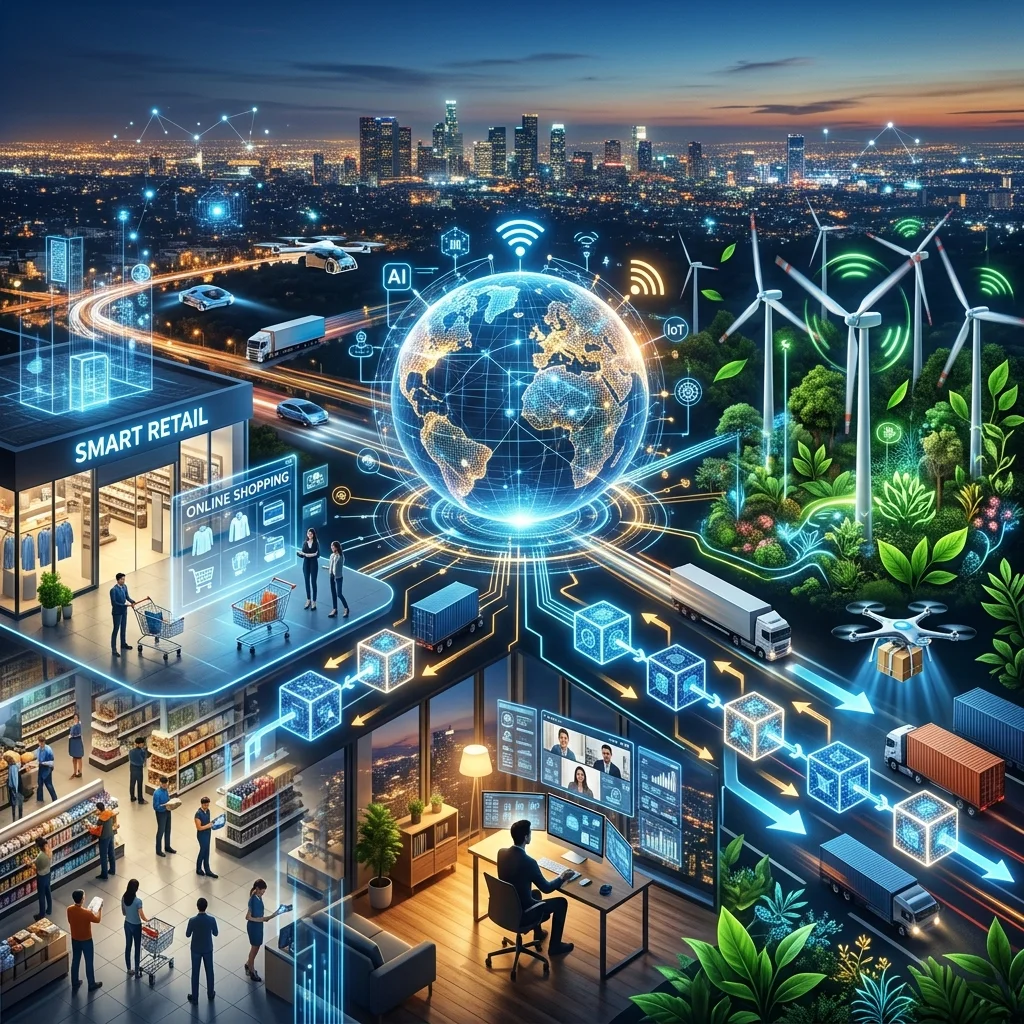
[IMAGE: A futuristic, interconnected digital landscape showing a transparent globe with glowing network lines (AI, IoT), green leaves and wind turbines (sustainability), a silhouette working from home with virtual screens, a blockchain chain interwoven with supply chain arrows, and a vibrant e-commerce storefront blending into a physical retail space. No text, no watermark. High contrast, photorealistic style.]
Trade Metrics
Related Datasets
Q4 Cross-Border Logistics Report
PDF • 4.2 MB
Automotive Parts Supply Chain Index
CSV • 1.1 MB