America’s Advanced Industries and Regional Innovation Growth: What Brookings

James Wilson
Industry Analyst
June 5, 2026
DATELINE: NA TRADE WIRE
"This article examines Brookings’ analysis of America’s advanced industries—50"
America’s Advanced Industries and Regional Innovation Growth in North America
America’s industrial future is increasingly being shaped not by individual firms alone, but by the strength of regional ecosystems built around research, technical talent, and supply-chain coordination. Brookings’ analysis of advanced industries offers a useful lens for understanding this shift. These are the 50 sectors that rely heavily on R&D and STEM workforce capacity, and they now play an outsized role in productivity, exports, and high-wage employment across the United States and broader North America.
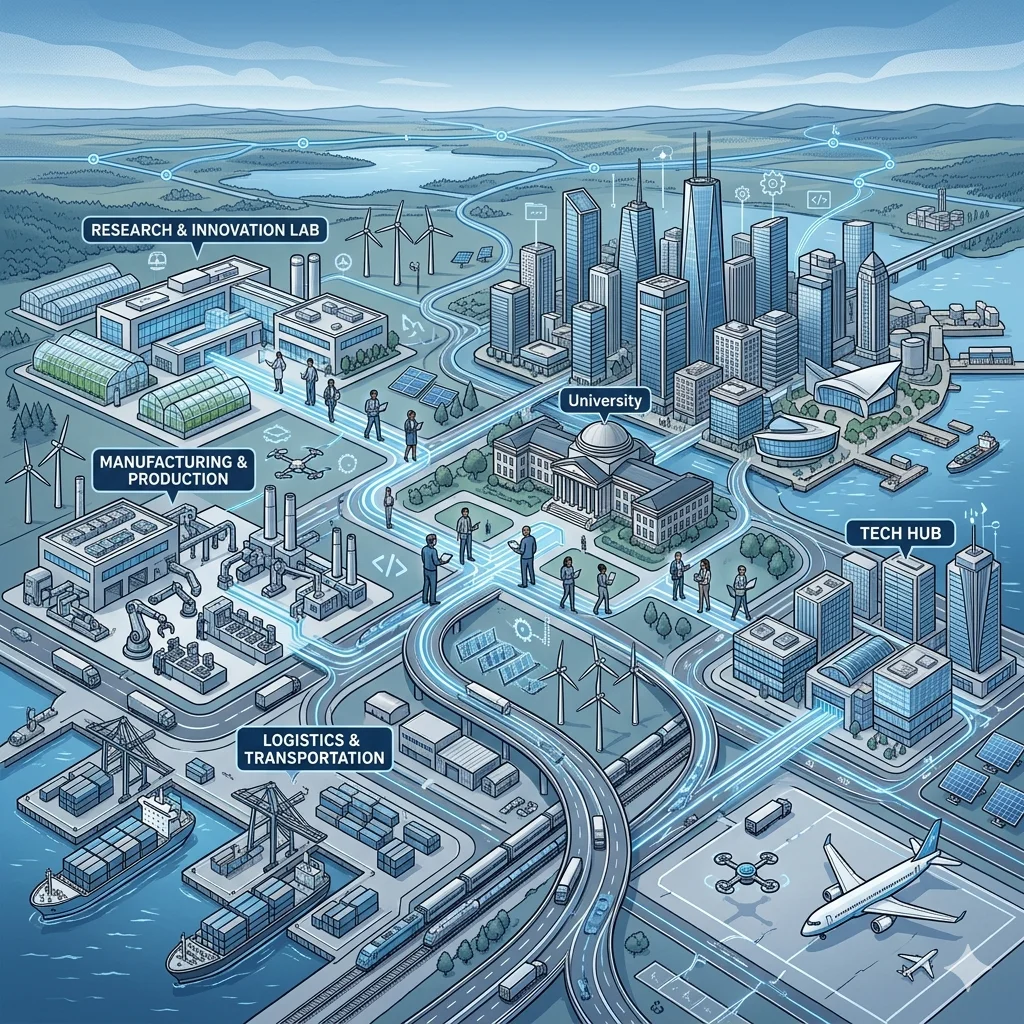
[IMAGE: A wide editorial-style illustration of a modern North American innovation ecosystem, showing a city skyline connected to research labs, manufacturing facilities, logistics routes, universities, and digital networks.]
The Core Logic: Why Advanced Industries Matter More Than Individual Firms
Advanced industries matter because they function as a system-level engine of economic performance. They generate more than output from a single plant, campus, or office tower. They support innovation pipelines, create spillovers into supplier networks, and anchor long-term regional competitiveness. In practice, their influence extends into logistics, engineering services, software, clean energy, life sciences, aerospace, and a range of other fields where technical knowledge is central.
Brookings defines these industries as 50 sectors that are unusually intensive in R&D and STEM workers. That definition is important because it shifts attention away from broad labels like “manufacturing” or “technology” and toward the actual structure of modern industrial capacity. The result is a more precise understanding of where growth comes from and why some places consistently outperform others.
The key point is not only that these sectors are expanding. It is that innovation capacity is unevenly distributed. The geography of advanced industries reveals where talent is concentrated, where institutions collaborate effectively, and where capital can translate into scalable economic activity.
[IMAGE: An infographic-style map showing advanced industries distributed unevenly across regions.]
Fast Analysis or Slow Analysis? Why This Topic Demands a Deep Audit
This is a slow analysis topic, not a fast-news topic. The main value lies in structural economic patterns that evolve over years, not days. Brookings’ framing is useful precisely because it helps readers examine underlying trends: where R&D investment is accumulating, how STEM labor markets are changing, and why some metropolitan regions are better positioned to capture new industrial growth.
A timeliness check still matters, but only as verification. It is useful to confirm the Brookings source, the report’s title, and its framing around emerging industrial trends. Beyond that, the more important task is to treat the material as a regional competitiveness audit. That means asking which regions are building durable innovation systems, which are dependent on legacy industries, and which have the institutional capacity to adapt.
In this sense, the Brookings analysis is not about short-term market movement. It is about the long-term architecture of growth.
[IMAGE: A researcher reviewing regional economic data on a large screen in a policy office.]
What Brookings Is Really Signaling About North America’s Industrial Future
The Brookings perspective suggests that advanced industries are becoming a primary channel for regional development across North America. This is an important shift. For much of the industrial era, policy debates often centered on broad manufacturing strength, factory employment, or sectoral decline. Those categories still matter, but they do not fully capture how modern industrial competitiveness works.
Today, the more relevant question is how regions combine R&D-intensive sectors, technical labor, and institutional support to generate durable growth. That is why a North America industry focus analysis increasingly needs to examine innovation clusters rather than just production sites. The most successful areas are not necessarily the ones with the most facilities. They are the ones that can connect firms, universities, labs, suppliers, and public agencies into a working ecosystem.
Brookings’ work helps clarify that advanced industries scale through place-based networks. A single company can relocate. An ecosystem cannot be built overnight. It requires talent pipelines, supplier depth, research capacity, and trust among institutions.
[IMAGE: A connected network of labs, factories, startups, and universities across a North American map.]
The Hidden Geography of Growth: Cities, Metro Areas, and States as Innovation Platforms
One of the most important lessons from Brookings is that regional growth is not distributed evenly across space. The analysis is designed to speak to leaders in cities, metropolitan areas, and states because those are the units where policy and investment decisions actually shape outcomes.
Urban regions matter because they concentrate the assets advanced industries depend on:
- universities and technical colleges,
- national labs and research institutions,
- transportation and digital infrastructure,
- specialized suppliers and service providers,
- and a workforce with deep STEM capabilities.
These elements work together. When they do, they create innovation platforms that can support both new firm formation and the expansion of established companies. When they do not, even regions with strong industrial histories can struggle to adapt.
This is why metropolitan governance matters. Regional growth increasingly depends on the ability to coordinate firms, labs, workforce systems, and public institutions. A metro area that aligns land use, transit, education, and economic development has a better chance of retaining talent and scaling advanced activity.
[IMAGE: A metro region visualization with transport links, campuses, and industrial parks connected by glowing lines.]
Supply Chains and the New Industrial Map
Advanced industries are also changing how supply chains are organized. In older industrial models, supply chains often followed a straightforward logic: raw materials moved to factories, and finished goods moved outward. Today, supply chains are more complex and more knowledge-intensive. They rely on specialized components, software integration, precision manufacturing, and constant feedback between design and production.
This matters for regional development because supply-chain strength is increasingly tied to innovation capacity. Regions that host advanced industries often attract complementary firms that handle testing, prototyping, logistics, and technical services. Over time, this produces a deeper industrial base.
That is also why local shocks can have broader effects. When one part of an advanced-industries ecosystem weakens—whether in semiconductors, aerospace, medical devices, or clean energy—the impact can spread through related suppliers and labor markets. The reverse is also true: when a region strengthens its core innovation sectors, the gains can extend across the broader economy.
Brookings’ framing helps explain why supply chains are not just about resilience in the abstract. They are about the geographic clustering of capability.
[IMAGE: A supply-chain diagram showing research, design, component manufacturing, logistics, and final assembly across multiple regions.]
National Labs and Regional Innovation Systems
Brookings’ related work on connecting national labs to their regions is a useful verification anchor for understanding how advanced industries scale through place-based networks. National labs are not simply isolated federal assets. In strong regional systems, they can act as anchors for collaboration, talent development, and technology transfer.
The regional impact of a national lab depends on whether surrounding institutions can absorb and apply its knowledge. That requires local universities, startup ecosystems, supplier firms, and workforce programs that can translate research into commercial or public value. In other words, a lab becomes more economically powerful when it is embedded in a functioning regional innovation system.
This is one reason advanced industries often cluster near major research institutions. The physical proximity of expertise matters. So does the ability to move ideas quickly among researchers, entrepreneurs, engineers, and manufacturers.
For policymakers, the implication is clear: innovation policy should not stop at funding research. It should also consider the regional systems that turn research into economic activity.
[IMAGE: A research lab connected by lines to nearby startups, universities, and industrial partners.]
STEM Talent as the Central Constraint
If there is one common bottleneck across advanced industries, it is talent. The sectors Brookings identifies are unusually intensive in STEM workers, which means their growth depends on sustained access to engineers, scientists, technicians, software developers, and highly trained production workers.
This creates a challenge for many regions. It is not enough to recruit a single flagship employer. Without a deep labor pipeline, the gains will be hard to sustain. That is why community colleges, apprenticeships, universities, and continuing education systems are so important. They help regions adapt to technological change while giving employers a more reliable talent base.
Talent also shapes location decisions. Firms in advanced sectors often choose regions where they can hire specialized workers quickly and where those workers are likely to stay. That reinforces the importance of quality of life, housing affordability, transit access, and school systems. Economic development is no longer only an industrial policy question. It is also a workforce and urban systems question.
What This Means for Regional Policy
Brookings’ analysis points toward a practical policy conclusion: regional competitiveness depends on coordination. Cities and states that want to grow advanced industries need to think across silos. Workforce development, infrastructure planning, R&D support, land-use policy, and education strategy all affect the same economic system.
Several priorities stand out:
- Strengthen STEM pipelines through education and training partnerships.
- Link research institutions to local industry so innovation can move more easily into production.
- Support supplier networks that can serve advanced firms at scale.
- Invest in metro infrastructure that improves mobility and business connectivity.
- Use national labs and universities as anchors for broader regional ecosystems.
These are not quick fixes. But they are the kinds of investments that help regions participate in the next industrial shift rather than merely react to it.
Conclusion: A Regional Model for the Next Industrial Shift
Brookings’ work on advanced industries offers a clear message: the future of industrial growth in North America will be shaped by regional systems, not just sector headlines. The places that succeed will likely be those that can connect R&D, STEM talent, manufacturing capability, logistics, and public institutions into a coherent whole.
That is why advanced industries should be understood as more than a list of sectors. They are a map of where innovation is happening, how it moves, and which regions are positioned to benefit. For cities, metro areas, and states, the challenge is not simply to host economic activity. It is to build the conditions under which innovation can compound over time.
In that sense, Brookings is pointing to a broader truth about regional innovation: growth increasingly belongs to places that can organize knowledge, not just land or labor.
[IMAGE: A final wide shot of a modern North American region at dusk, with universities, labs, industrial sites, and transport corridors linked by subtle digital light trails.]
Trade Metrics
Related Datasets
Q4 Cross-Border Logistics Report
PDF • 4.2 MB
Automotive Parts Supply Chain Index
CSV • 1.1 MB