Trucker Path + Truckstop.com: The Hidden Supply Chain Logic Behind Load Board

Emily Rodriguez
Cross-Border Trade Reporter
April 22, 2026
DATELINE: NA TRADE WIRE
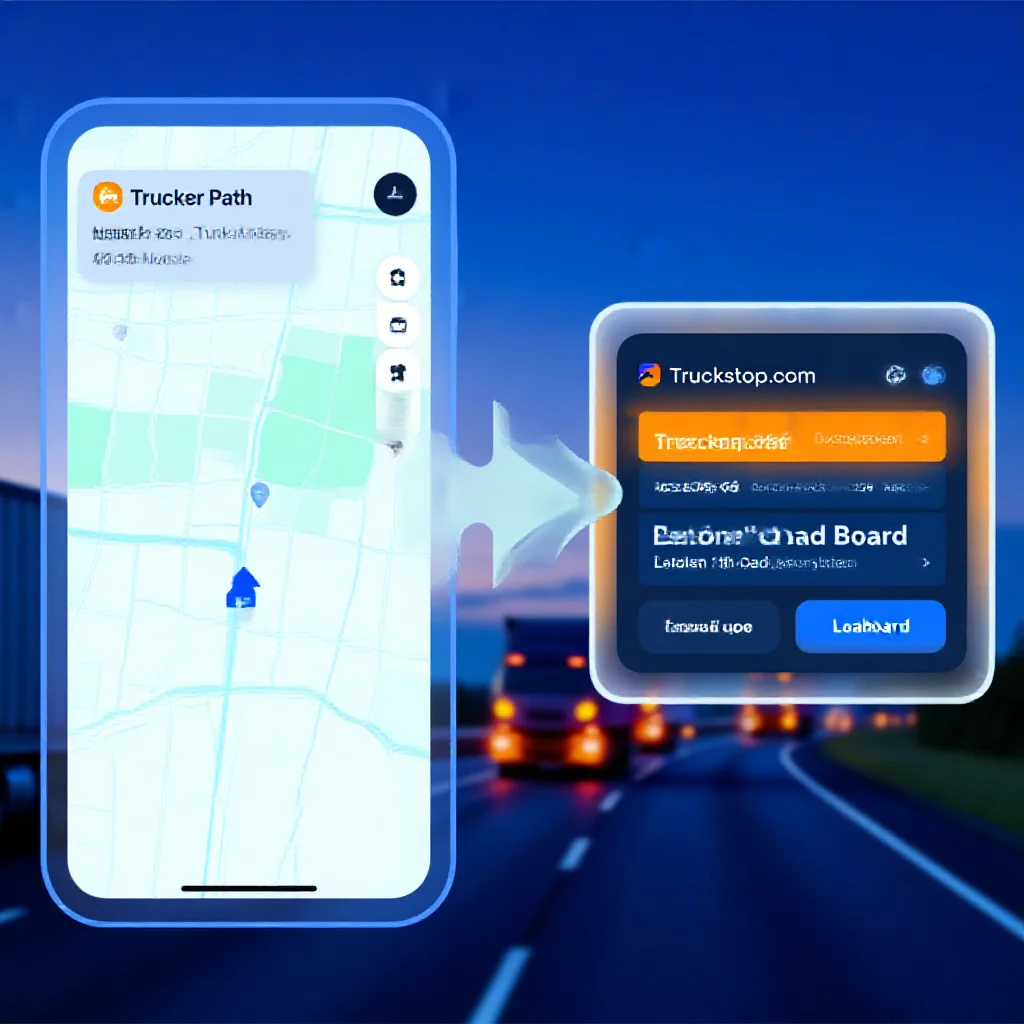
"The integration of Truckstop.com''s load board into Trucker Path is more"
Trucker Path + Truckstop.com: The Hidden Supply Chain Logic Behind Load Board Integration
Introduction: The Integration That Almost Feels Inevitable
Trucker Path, the navigation application commanding dominant market share among U.S. commercial truck drivers, has integrated the Truckstop.com load board directly into its platform. The integration, reported by FreightWaves (Source 1: [Industry Trade Publication]), allows drivers to view available freight loads from Truckstop.com without leaving the navigation interface. The move represents a convergence of two previously separate digital tools: routing guidance and freight matching.
The core question is not whether this integration benefits users—it does—but why it occurs now, and what it signals about the structural evolution of digital freight marketplaces. The answer lies in the maturation of data aggregation layers within supply chain technology, where standalone value propositions are being subsumed by platforms that capture both the spatial and transactional dimensions of trucking operations.
The Economic Logic: Reducing Deadhead Miles Through Unified Data
The U.S. trucking industry operates with 20-30% of all truck miles driven empty—a phenomenon termed "deadhead miles" or "empty miles" (Source 2: [American Transportation Research Institute, 2023 Annual Report]). For a truck averaging 100,000 miles annually, this represents 20,000-30,000 miles generating revenue for neither carrier nor driver.
The integration addresses this through contextual matching. Traditional load boards present a list of available loads; the driver must independently cross-reference that list against their planned route, current location, and equipment configuration. Trucker Path now possesses real-time positional data, route intent, and load availability within a single interface. The system can surface loads that lie along or near the driver's existing route, minimizing detour distance.
Quantitatively, a 5% reduction in empty miles for a truck averaging 100,000 total miles and $1.80 per loaded mile yields approximately $9,000 in additional annual revenue per truck (Source 3: [Industry Cost Model Calculation]). For a fleet of 100 trucks, this represents $900,000 in recovered capacity. The value is not merely in having a list of loads—it is in having loads filtered by spatial proximity to the driver's actual trajectory, equipment compatibility, and pickup/delivery time windows.
Network Effects: Why Two Platforms Are Stronger Than One
The integration creates a two-sided network effect that standalone load boards cannot replicate. Trucker Path's user base consists of active drivers in transit; Truckstop.com's network comprises brokers and shippers posting loads. The combined platform generates a flywheel:
- More active drivers using the navigation platform increases the visibility of posted loads to qualified carriers.
- Higher load visibility and faster matching attract more brokers to post loads on Truckstop.com.
- Greater load density on the platform increases driver stickiness, as the platform becomes the primary tool for both navigation and freight procurement.
- Increased driver engagement generates richer behavioral data—route preferences, dwell times, equipment utilization patterns—which improves load matching algorithms.
This contrasts with standalone load boards such as DAT or 123Loadboard, which operate as transactional marketplaces without spatial context. A driver on DAT must manually triangulate between the load board and a separate navigation application. The integrated platform eliminates this cognitive and operational friction.
The potential extension of this data layer includes real-time bidding mechanisms and dynamic pricing models. If the platform can calculate a driver's exact deviation cost for a given load—accounting for fuel, time, and regulatory hours-of-service constraints—it can suggest optimal pricing that maximizes both carrier margin and broker load coverage probability.
Who Wins and Who Loses? The Carrier vs. Broker Dynamic
The distribution of benefits is uneven across the freight ecosystem.
Small carriers and owner-operators are the primary beneficiaries. These operators typically lack the scale to negotiate directly with shippers or maintain subscriptions to multiple load boards. The integration provides broker-level load access within a tool they already use for navigation, reducing the information asymmetry that historically favored larger fleets and brokerages.
Traditional freight brokers face structural disintermediation risk. The core broker function—matching available trucks with available loads—is being automated through this integration. If drivers can self-match efficiently using contextual data, the broker's role shifts from transaction facilitation to exception handling and specialized service provision. The margin compression on standard, repeatable loads becomes inevitable.
Data ownership represents the most consequential long-term shift. Trucker Path now captures two distinct data streams: route behavior (where drivers go, when they stop, how they deviate) and load selection patterns (which loads are accepted, rejected, or ignored). This combined dataset is uniquely valuable for training machine learning models that predict load acceptance probability, optimal pricing, and driver retention. The platform operator effectively owns the observational data that governs future freight matching algorithms.
The Long Game: Integration as a Stepping Stone to Autonomous Dispatch
The current integration is functionally limited—users can view loads but the full transaction flow remains external. However, the trajectory suggests a progression toward automated dispatch systems.
Future capabilities may include: automated load suggestions based on historical route patterns, weather conditions, fuel prices, and hours-of-service compliance; dynamic rerouting to capture opportunistic loads; and eventually, fully autonomous load assignment where the platform selects and books loads without driver intervention, subject to approval.
The economic logic of autonomous dispatch is compelling. The current process requires drivers to interrupt navigation to search for loads, compare options, and negotiate terms. Each interruption costs productive driving time. An integrated system that pre-screens loads against driver preferences and constraints, and presents only the optimal matches, reduces non-driving time while increasing revenue per mile.
The technological prerequisites are largely in place: real-time telematics, digital freight documentation, automated payment settlement, and now, spatial load matching. The remaining barriers are behavioral—driver trust in automated recommendations—and regulatory, particularly around hours-of-service compliance when loads require route deviations.
Conclusion
The Trucker Path-Truckstop.com integration is not a feature enhancement; it is a structural consolidation of two previously separate layers of the freight technology stack: spatial navigation and transactional freight matching. The economic logic centers on deadhead mile reduction through contextual load visibility, while the competitive implications point toward broker disintermediation and data-driven market power concentration.
Small carriers gain access to previously inaccessible load networks. Traditional brokers face margin compression on standardized transactions. The platform operator accumulates a dataset that combines spatial behavior with transactional preference—a combination that positions it to develop AI-driven dispatch systems.
The freight brokerage ecosystem, which has operated on information asymmetry for decades, is moving toward a model where the platform that best integrates routing data with load data will define the market structure. Standalone load boards, without spatial context, will face increasing pressure to either integrate or be integrated. The question is not whether further consolidation will occur, but which platforms will emerge as the dominant data aggregators.
Trade Metrics
Related Datasets
Q4 Cross-Border Logistics Report
PDF • 4.2 MB
Automotive Parts Supply Chain Index
CSV • 1.1 MB