Beyond Parcels: Qantas'' Singapore Freighter Signals Australia''s E-Commerce

Emily Rodriguez
Cross-Border Trade Reporter
April 8, 2026
DATELINE: NA TRADE WIRE
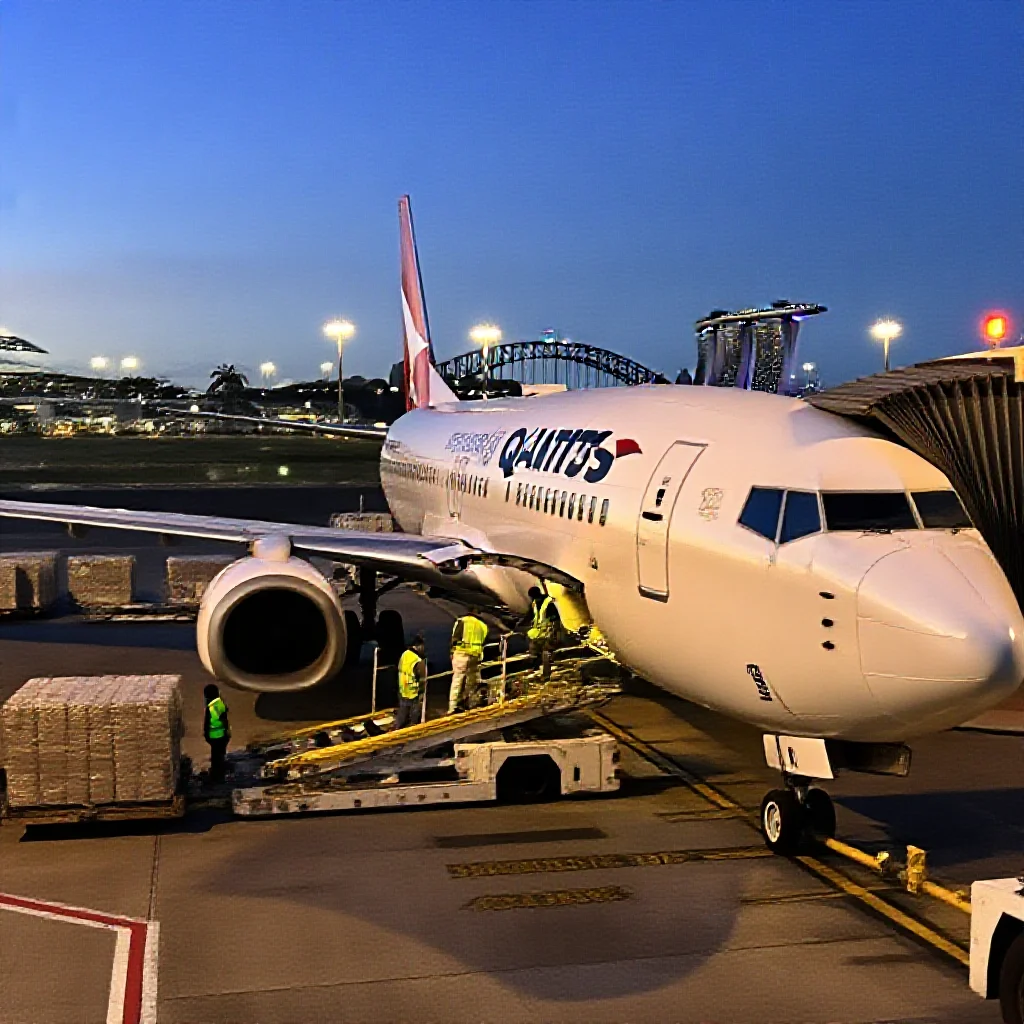
"Qantas'' launch of its first dedicated freighter service to Singapore, using"
Beyond Parcels: Qantas' Singapore Freighter Signals Australia's E-Commerce & Supply Chain Pivot
Date: May 2024
On May 1, 2024, Qantas Freight commenced its first dedicated freighter service to Singapore, operating a Boeing 737-800F aircraft on a triangular Sydney-Melbourne-Singapore route three times weekly (Source 1: [Primary Data]). The service is configured to carry general cargo, mail, and e-commerce freight. This operational detail represents a strategic infrastructure investment beyond the addition of a single cargo flight, indicating a calculated pivot to secure Australia's position within evolving Asia-Pacific trade and logistics networks.
The Surface Facts: Decoding Qantas' New Cargo Link
The service's parameters reveal its targeted design. The use of a Boeing 737-800F, a converted narrow-body aircraft, is a deliberate choice for regional cargo agility rather than intercontinental bulk transport. Its capacity and range are optimized for high-frequency, short-to-medium haul operations, enabling rapid turnarounds between Australia's two largest eastern seaboard markets and a key Asian hub.
The routing itself is instructive. Singapore is not merely a destination but a premier global logistics nexus and air cargo transshipment hub. Direct, dedicated freighter access from Sydney and Melbourne provides a scheduled air bridge into Singapore's extensive network, which connects to major markets across Asia, Europe, and beyond. This establishes a predictable channel distinct from the variable capacity available in the belly-hold of passenger aircraft.
The Hidden Economic Logic: E-Commerce, Exports, and Strategic Defense
The stated cargo mix—general cargo, mail, and e-commerce freight—uncovers the service's core economic drivers. This combination targets high-yield, time-sensitive goods. For exports, it caters to premium Australian products like fresh horticulture, seafood, and pharmaceuticals, which require fast, reliable transit to maintain value. For imports, it directly addresses the logistical demands of cross-border e-commerce, where consumer expectations for rapid delivery have compressed supply chain timelines.
This move functions as a strategic defense and market capture play. Global integrated carriers (e.g., DHL, FedEx) have long dominated the express parcel and freight market on key Australia-Asia corridors. By deploying its own dedicated capacity, Qantas Freight asserts control over a critical trade lane, aiming to retain revenue and customer relationships that might otherwise be ceded to foreign operators. It is an infrastructure-led strategy to reclaim sovereignty over premium freight flows.
Supply Chain Ripple Effects: From Just-in-Time to Just-in-Case
The introduction of predictable, scheduled freighter capacity has tangible implications for Australian business supply chains. It provides an alternative to the volatility of sea freight schedules and the ancillary nature of passenger flight belly space, which remains subject to passenger network priorities and demand fluctuations.
This capacity enables a hybrid approach to inventory management. For importers of consumer goods or manufacturing components, it supports more responsive "just-in-time" models by reducing air freight lead-time uncertainty. Concurrently, it allows businesses to pursue "just-in-case" strategies with greater efficiency, enabling the holding of smaller, faster-turning buffer stock that can be replenished via a reliable air link. This enhances supply chain resilience, a priority identified in post-pandemic industry analyses.
Market data indicates sustained growth in Asia-Pacific e-commerce and a corporate emphasis on supply chain diversification. The Qantas Freighter service is positioned to capture these trends. The strategic use of the 737-800F provides operational flexibility; frequency or capacity can be adjusted in response to market demand without the cost burden of a larger wide-body freighter.
Neutral Market Prediction
The service's success will be measured by its ability to secure long-term contracts with major logistics providers and exporters, filling capacity consistently beyond peak seasonal demand. Its thrice-weekly frequency is likely a starting point; demonstrated demand on the corridor could lead to increased service density or the potential deployment of additional freighters on similar regional routes, such as to Hong Kong or mainland Chinese hubs. The move signals a broader industry recognition that dedicated air cargo infrastructure is a critical component of national trade competitiveness in an era defined by e-commerce velocity and supply chain resilience.
Trade Metrics
Related Datasets
Q4 Cross-Border Logistics Report
PDF • 4.2 MB
Automotive Parts Supply Chain Index
CSV • 1.1 MB