Outpost''s $1B Bet: How AI and EV Charging Are Redefining America''s Invisible

Emily Rodriguez
Cross-Border Trade Reporter
March 21, 2026
DATELINE: NA TRADE WIRE
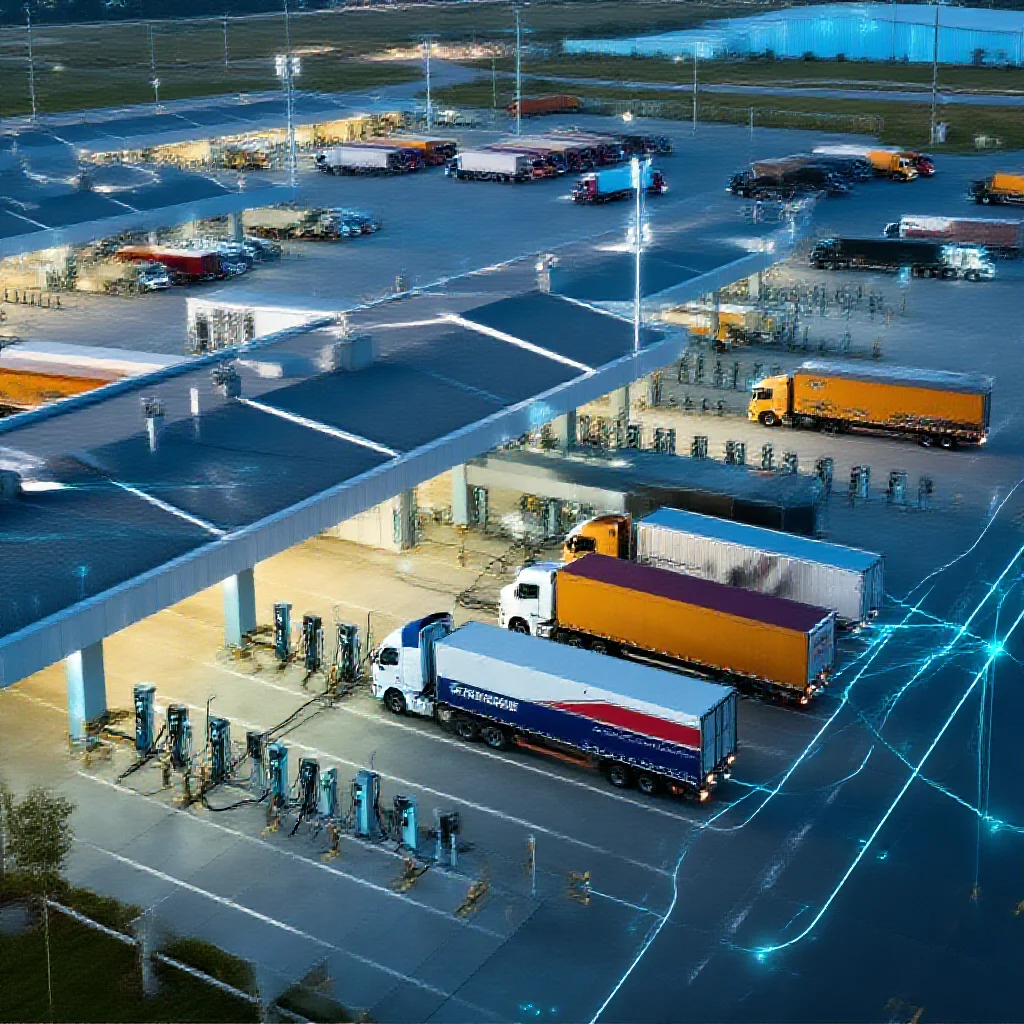
"Outpost's March 2026 announcement of five new truck terminals and an investment"
Outpost's $1B Bet: How AI and EV Charging Are Redefining America's Invisible Trucking Infrastructure
March 2026 — Outpost, a truck terminal owner based in Austin and Seattle, has announced a dual-track expansion strategy. On March 19, 2026, the company revealed the addition of five new terminal properties and a strategic investment in EV charging infrastructure firm EV Realty (Source 1: [Primary Data]). This move, part of a broader $1 billion deployment plan, targets a fundamental inefficiency in the U.S. supply chain: the lack of a unified, dedicated infrastructure for a trucking industry that moves approximately 70% of the nation's freight annually (Source 1: [Primary Data]).
The Invisible Crisis: Trucking's 70% Share and 0% Dedicated Infrastructure
The expansion is framed by a critical observation from Outpost leadership. "Air cargo has airports, intermodal has rail yards, and ocean freight has ports, but trucking, which moves over 70% of U.S. freight every year, has no unified infrastructure to power the flow of goods across the country," stated Trent Cameron, Outpost co-founder and CEO (Source 1: [Primary Data]). This statement highlights a core market inefficiency. While other freight modes operate through centralized, capital-intensive hubs, trucking relies on a fragmented patchwork of public roads, rest stops, and privately owned yards. Outpost's $1 billion deployment plan is a direct economic bet on solving this infrastructure gap. The thesis is that the company is not merely aggregating parking spaces but constructing the first dedicated, technology-integrated "port system" for over-the-road freight.
Decoding the Expansion: A Strategic Map of Freight Chokepoints
The five new properties reveal a deliberate pattern of targeting critical intermodal junctures and constrained logistics real estate markets.
* Newark, New Jersey (7.1 acres): Located at 90 Kingsland Ave. in Clifton, this site marks Outpost's entry into the Northeast market. Its strategic value is defined by proximity: eight miles from the Lincoln Tunnel and 13 miles from the Port Newark Container Terminal (Source 1: [Primary Data]).
* Miami, Florida (17 acres): Situated at 3200 NW 67th Ave. within Foreign Trade Zone 281, this terminal is adjacent to Miami International Airport and less than nine miles from PortMiami (Source 1: [Primary Data]). Its FTZ status and dual airport/port adjacency position it for international and time-sensitive freight.
* California Trio (Stockton, Livermore, Torrance): These three EV Realty properties, totaling approximately 9 acres, anchor key California corridors. The Stockton site is within two miles of I-5 and SR-99; Livermore is along I-580; and Torrance is near I-405 and the Ports of Los Angeles and Long Beach (Source 1: [Primary Data]).
The geographic logic is one of targeting high-volume, capacity-constrained freight arteries. This is a long-term "slow analysis" play: acquiring and controlling strategic land at these intermodal junctures creates a durable moat, as the value of such assets appreciates with persistent supply chain congestion and urban expansion.
The Dual-Track Strategy: Real Estate Scale Meets Energy Transition
Outpost's strategy operates on two synchronized tracks.
Track One: Physical Network Growth. The expansion adds over 30 acres to Outpost's national network, with the Newark property specifically establishing a critical Northeast foothold (Source 1: [Primary Data]). This scales the foundational real estate portfolio.
Track Two: Strategic Capability Investment. Concurrently, the investment in EV Realty addresses what Outpost identifies as the principal bottleneck for trucking's energy transition. "What's really holding back the energy transition is charging infrastructure. The power constraints for Class 8 trucks are much more significant than for passenger cars. You also need more space and a secure environment to charge trucks carrying freight," Cameron noted (Source 1: [Primary Data]).
The synthesis of these two tracks creates a powerful synergy. Outpost's terminal network provides the secured, spacious real estate required for heavy-duty charging depots. In turn, EV Realty's expertise in developing grid-ready charging hubs can be immediately activated on these sites. "Our partnership with Outpost allows us to activate our grid-ready properties immediately for fleets already moving freight through these high-volume markets," said Patrick Sullivan, CEO of EV Realty (Source 1: [Primary Data]). This landlord-tenant dynamic positions Outpost to monetize the impending electrification of freight fleets by providing the essential underlying infrastructure.
The AI Layer: Gate Automation as the Tip of the Data Iceberg
A stated feature of all new locations is the implementation of AI-powered gate automation technology (Source 1: [Primary Data]). While presented as a tool for driver convenience and security, its strategic function is deeper. The automated gate serves as a primary data capture node. Each truck entry and exit generates timestamped, identifiable data points. This data stream is the feedstock for optimizing terminal throughput, predicting asset dwell times, managing yard space dynamically, and, critically, forecasting energy demand for future charging fleets. The AI layer is therefore positioned not as a standalone feature but as the invisible operating system that will integrate the physical real estate and energy assets into a unified, intelligent network.
Long-Term Impact: Reshaping the Underlying Supply Chain
The long-term impact of this integrated model extends beyond real estate development. By providing a reliable, tech-enabled network of terminals, Outpost could enable more efficient routing, reduce dwell time uncertainty, and lower asset repositioning costs for carriers. The strategic investment in EV charging infrastructure preemptively addresses the most significant technical hurdle for fleet electrification. The combined effect is the creation of a foundational layer for a more efficient, electrified, and data-driven national freight system. This approach suggests a shift in trucking infrastructure from a passive, fragmented cost center to an active, networked, and technologically integrated utility.
Market/Industry Predictions: This expansion will likely accelerate competition for strategic parcels of land near major intermodal hubs. Other logistics real estate firms may seek similar partnerships with energy infrastructure specialists. The success of the model will be measured by its ability to attract and retain anchor tenants from both traditional carrier fleets and early-adopter electric trucking operations, validating the premise that dedicated, smart infrastructure commands a premium in an otherwise invisible market.
Trade Metrics
Related Datasets
Q4 Cross-Border Logistics Report
PDF • 4.2 MB
Automotive Parts Supply Chain Index
CSV • 1.1 MB