Cross-Border
Beyond the Rate Slump: How OOCL''s Q1 Reveals a Structural Shift in Transpacific

Emily Rodriguez
Cross-Border Trade Reporter
April 21, 2026
DATELINE: NA TRADE WIRE
Wire Insight
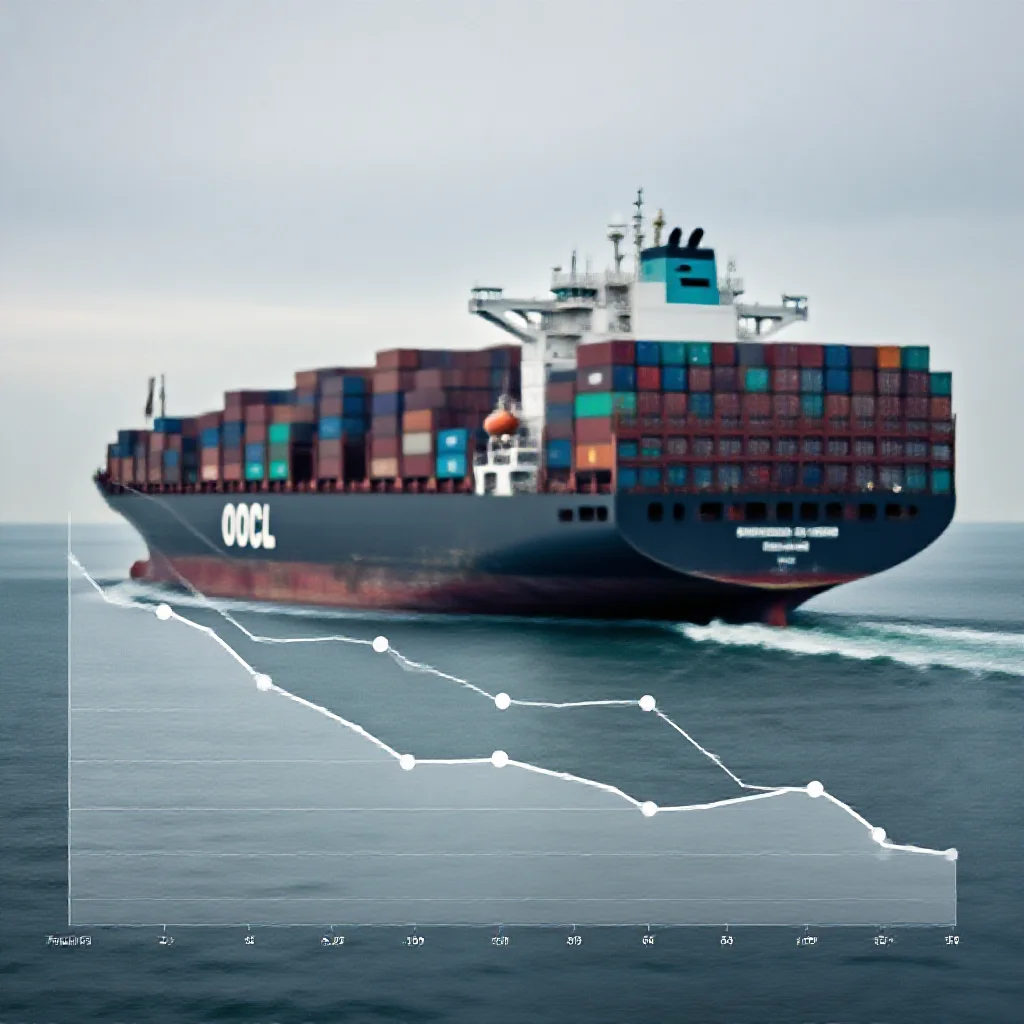
"OOCL's Q1 2024 results, showing a revenue decline despite increased cargo"
Beyond the Rate Slump: How OOCL's Q1 Reveals a Structural Shift in Transpacific Shipping
The OOCL Paradox: Rising Volumes, Falling Revenue
The financial performance of Orient Overseas Container Line (OOCL) in the first quarter of 2024 presents a defining contradiction for the container shipping industry. The carrier reported a 4.7% year-over-year decline in revenue, totaling $1.9 billion, against an 8.8% increase in total liftings. (Source 1: [Primary Data]) This divergence resulted in a 12.4% plunge in average revenue per TEU. The company explicitly noted that "the performance of the Transpacific trade lane was below expectations." (Source 2: [Primary Data]) This data point is not an isolated anomaly but a critical indicator of a fundamental recalibration of market mechanics on the world's most consequential trade route. The decoupling of cargo volume from financial yield serves as the entry point for an analysis that extends beyond cyclical rate fluctuations.Deconstructing the Rate Collapse: Cyclical Downturn or Structural Reset?
Market data underscores the severity of the pricing environment. As of May 10, 2024, the spot rate from Asia to the US West Coast stood at $2,713 per forty-foot equivalent unit (FEU), as tracked by the Freightos Baltic Index (FBX). (Source 3: [Primary Data]) This represents a 36% decrease from the same period in 2023 and a 70% collapse from the peak recorded in January 2022. (Source 4: [Primary Data]) While the industry is historically cyclical, the depth and persistence of this decline suggest a move beyond a standard correction. The erosion of pricing power appears structural, indicating that the extraordinary market conditions of 2021-2022 were an aberration, not a new baseline. The core issue has transitioned from demand shock to the systemic challenge of overcapacity absorption.The Capacity Conundrum: How New Ships Are Rewriting the Rulebook
The direct link between falling revenue per TEU and systemic overcapacity is analytically clear. The record-breaking vessel orders placed during the pandemic-driven boom are now entering service, flooding major trade lanes with new tonnage. For carriers, this creates a strategic bind. To achieve the economies of scale that justify these mega-vessel investments, the capacity must be deployed, even when demand growth is insufficient. This deployment suppresses freight rates, creating a self-reinforcing cycle of yield dilution. For OOCL, operating within the integrated network of parent company COSCO Shipping, the strategic calculus may increasingly prioritize network share, fleet utilization, and alliance cohesion over maximizing profitability on any single lane like the Transpacific. The financial result is a volume-driven model where increased liftings no longer guarantee increased revenue.Long-Term Ripples: Implications for Supply Chains and Shippers
The immediate effect of low spot rates is a reduction in transportation costs for shippers and Beneficial Cargo Owners (BCOs). However, this short-term boon may mask longer-term systemic risks. Sustained financial pressure on carriers raises questions about future investment cycles. Capital expenditures on service reliability, vessel decarbonization technology, and port infrastructure partnerships could be curtailed, potentially degrading the long-term resilience and sustainability of global supply chains. Furthermore, the cost advantage of low ocean freight may reinvigorate just-in-time inventory models, which were heavily scrutinized during the supply chain crisis. This could signal a shift away from the inventory-buffering strategies adopted in recent years, with implications for logistics planning and warehouse demand.Navigating the New Normal: Strategic Outlook for Carriers and the Market
The synthesis of these factors indicates the Transpacific trade lane is undergoing a structural transition from a revenue-growth paradigm to a volume-and-cost-optimization game. Carrier strategy will likely focus on meticulous capacity management through increased blank sailings, a renewed emphasis on securing long-term contract volume over volatile spot market exposure, and deeper operational integration within alliances to reduce per-unit costs. For the market, the era of extreme volatility may moderate, but not disappear, replaced by a prolonged period of competitive pressure where operational excellence and strategic agility determine carrier performance. The "below expectations" result reported by OOCL is less a quarterly disappointment and more a benchmark for this emerging, structurally distinct phase of global container shipping.#OOCL-financial-performance#Transpacific-shipping-rates#Asia-US-West-Coast-trade#container-shipping-market#supply-chain-economics#freight-rate-decline#COSCO-Shipping
Trade Metrics
Sector ImpactCritical
Growth Potential+12.4%
Risk LevelModerate
Related Datasets
Q4 Cross-Border Logistics Report
PDF • 4.2 MB
Automotive Parts Supply Chain Index
CSV • 1.1 MB