North America Cross-Border Trade 2025: The Hidden Supply Chain Dynamics Beyond

Emily Rodriguez
Cross-Border Trade Reporter
April 29, 2026
DATELINE: NA TRADE WIRE
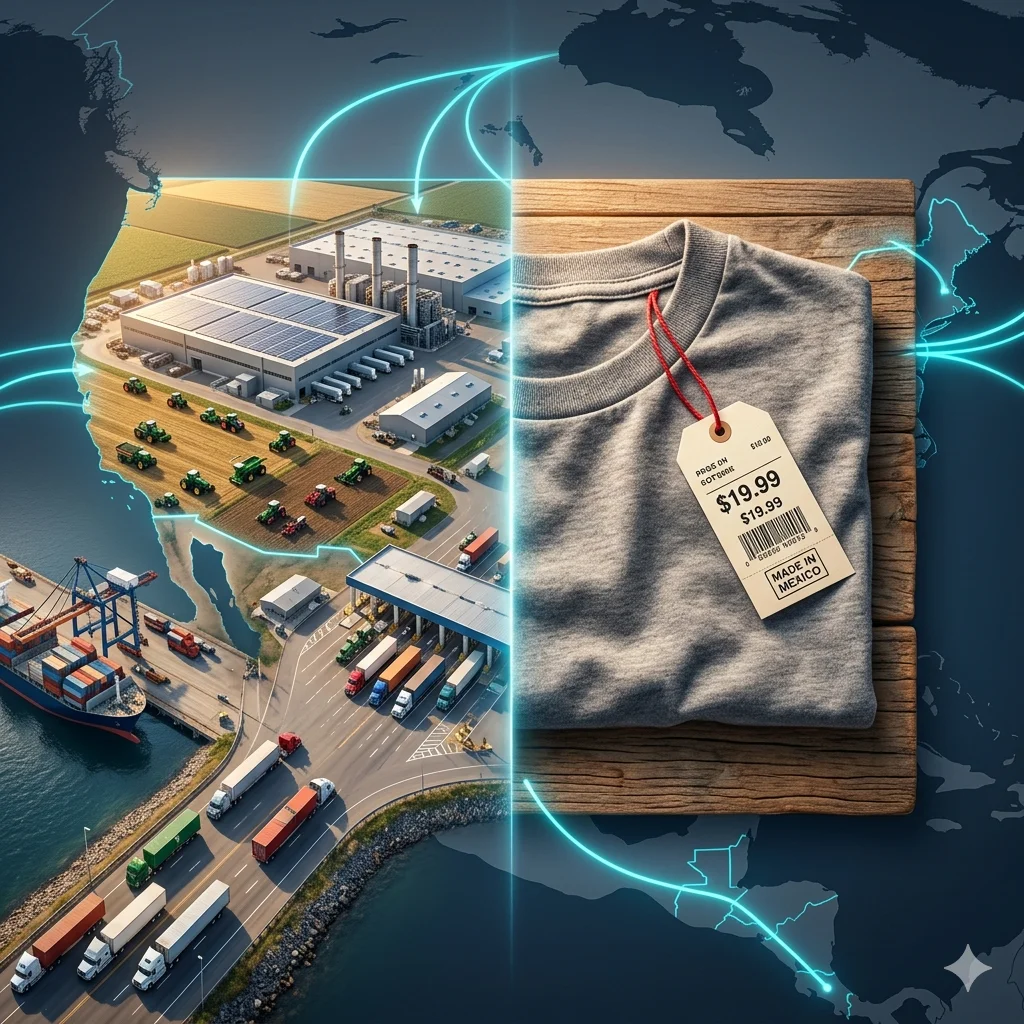
"In 2024, U.S. goods trade with Mexico and Canada surpassed $1.6 trillion,"
North America Cross-Border Trade 2025: The Hidden Supply Chain Dynamics Beyond Tariffs and Nearshoring
By Senior Technical/Financial Audit Journalist
---
The $1.6 Trillion Entanglement: Setting the Scene for 2024–2025
In 2024, the United States conducted approximately $762 billion in goods trade with Canada and approximately $840 billion with Mexico, producing a combined cross-border flow exceeding $1.6 trillion (Source 1: U.S. Census Bureau). These figures represent the highest recorded bilateral trade volumes in North American history, yet they obscure a fundamental tension beneath the surface.
The dominant narrative—that nearshoring offers shorter lead times, reduced geopolitical risk, and supply chain resilience—collides with three structural realities. First, Mexican labor costs for certain labor-intensive goods remain significantly higher than Asian alternatives. Second, critical raw materials for North American production continue to flow from China, partially negating the resilience benefits of regionalization. Third, proposed U.S. tariffs of 25% on specific cross-border goods threaten to restructure profit margins across entire product categories.
David Cox of Polaris Transportation Group captured this complexity: “There’s churn in the water right now just because we don’t know what the new rules of engagement are. Yet the three countries are entangled, in a good way.”
This entanglement creates a bifurcated market—one where high-value, time-sensitive goods flourish under nearshoring logic, while cost-driven, margin-sensitive products face existential pressure.
---
The Nearshoring Mirage: Mexico’s Tractor Success vs. Labor Cost Reality
Mexico produces approximately 180,000 tractors annually, with roughly 90% of that output exported to the United States and Canada (Source 2: Industry Production Data). This concentration represents a definitive nearshoring success story: heavy, high-value equipment that benefits from proximity to North American agricultural markets and the logistics efficiencies of ground transportation.
Tractors are capital goods with high unit margins, substantial weight-to-value ratios, and assembly processes that benefit from regional specialization. The economics of producing these goods in Mexico versus Asia are unambiguous—shipping heavy machinery across the Pacific incurs costs that proximity eliminates.
However, this success masks a countervailing reality in labor-intensive sectors. Jason Miller, from Michigan State University’s Department of Supply Chain Management, provided a stark comparison: the labor cost to produce a T-shirt in Mexico is approximately four times the rate in China (Source 3: Comparative Labor Cost Analysis). For goods where labor constitutes a dominant share of total production cost, this differential erodes the entire nearshoring value proposition.
Miller’s analysis is precise: “Slap a 25% tariff on them, and it no longer makes sense to bring them in.”
The implication is that North American cross-border trade is developing a dual-track structure:
| Track | Product Profile | Nearshoring Viability | Tariff Vulnerability |
|-------|----------------|----------------------|---------------------|
| Track A | High-value, heavy goods (tractors, machinery, automotive) | High - logistics cost advantages dominate | Low - margins absorb tariff shocks |
| Track B | Low-margin, labor-intensive goods (textiles, basic consumer products) | Low - labor cost disadvantages dominate | High - tariffs eliminate marginal profitability |
This bifurcation suggests that aggregate trade statistics—$1.6 trillion—conceal divergent trajectories for different product categories. The nearshoring phenomenon is not monolithic; it is selective, and the selection criteria are economic, not geographical.
---
USMCA Agility: The Hidden Logic of Ground Transportation and Supply Chain Switching
The United States-Mexico-Canada Agreement (USMCA), implemented post-pandemic, has delivered measurable improvements in supply chain agility and lead time reduction (Source 4: Trade Agreement Implementation Data). Unlike ocean freight, which imposes fixed transit schedules and port congestion risks, ground transportation allows for dynamic routing, real-time inventory adjustments, and rapid market response.
Alex Garza of Hub Group articulated this advantage: “Companies that move operations from other parts of the world to North America can often lower transportation costs and shorten lead times, while gaining the flexibility to pivot quickly if market conditions change.”
The physical geography of North America reinforces this logic. Brad Colvin of Tri-National, Inc. noted: “Nearshoring is not as logistically challenging as offshore manufacturing, as everything is thousands of miles closer to where the end product is produced.”
Key ground transportation corridors—Interstate 35, the NAFTA Highway system, and major border crossings at Laredo, El Paso, and Detroit—have become the arterial networks for this integrated supply chain. These routes allow manufacturers to shift production volumes between plants in different countries within days, not weeks.
Yet the agility advantage has a critical limitation. Diego Anchustegui of EASO observed: “The factories are already set up in Mexico. The production operations and supply chains took a lot of years to build.” The sunk costs of existing infrastructure create inertia. More significantly, the continued reliance on Chinese raw materials—steel, electronics components, specialty chemicals—means that supply chain resilience is only partial. A disruption in Pacific shipping still cascades through North American production, regardless of final assembly location.
Jason Miller’s research at Michigan State University confirms that ground routes reduce port delays, but the raw material dependency on China undermines the full resilience potential of nearshoring (Source 5: Supply Chain Resilience Study).
---
Logistics as a Shield: CTPAT, Cultural Nuance, and Regulatory Navigation
The complexity of North American cross-border trade extends beyond tariffs and labor costs into the operational realities of customs compliance, transportation law, and cultural adaptation. For logistics providers, the ability to navigate this complexity has become a competitive differentiator—and a protective mechanism for shippers facing regulatory uncertainty.
Jose Minarro of Sunset Transportation emphasized the multidimensional nature of the challenge: “For U.S. shippers, understanding the nuances of cross-border logistics, including cultural, operational, and regulatory differences, is vital for success.”
Ken Cochran of Alvarez & Marsal provided context on the scale of regulatory navigation required: cross-border shipments must comply with three distinct customs regimes, multiple state-level transportation regulations, and evolving USMCA rules of origin requirements. The cost of non-compliance—delays, fines, seized goods—can exceed the tariff exposure itself.
The Customs-Trade Partnership Against Terrorism (CTPAT) certification has emerged as a critical credential for logistics providers operating across North American borders. CTPAT-certified carriers receive expedited customs processing, reduced inspection rates, and priority treatment at border crossings. For shippers of time-sensitive goods—the Track A products that thrive under nearshoring—this certification translates directly to reduced transit times and lower inventory carrying costs.
Alex Garza further noted: “Knowing how to navigate customs requirements and transportation laws across multiple countries is crucial.” The operational sophistication required includes dedicated Mexico equipment (specialized tractors and trailers maintained to different regulatory standards), bilingual documentation teams, and real-time tracking systems that integrate with U.S., Mexican, and Canadian customs platforms.
---
The Dual-Track Market: Strategic Implications for 2025 and Beyond
The evidence assembled from production data, labor cost comparisons, and logistics provider testimony supports a structured prediction: North American cross-border trade will continue to grow in aggregate volume, but the distribution of that growth will be uneven and increasingly stratified by product economics.
For high-value, heavy goods (Track A): The nearshoring trend will accelerate. Tractors, automotive components, aerospace parts, and industrial machinery will benefit from proximity, agility, and the sunk costs of existing Mexican production infrastructure. Tariff proposals, while disruptive, are unlikely to fundamentally alter the cost calculus for these products. Logistics providers with CTPAT certification and dedicated cross-border equipment will capture premium margins.
For low-margin, labor-intensive goods (Track B): The trajectory is toward contraction or relocation. If proposed 25% tariffs materialize, the combined effect of higher Mexican labor costs and punitive duties will render nearshoring uneconomical for products where labor constitutes over 30% of total cost. Some production may return to Asia; some may shift to U.S. automation; some will simply disappear from cross-border trade statistics.
For raw material dependencies: The unresolved vulnerability remains Chinese inputs. Until nearshored production achieves genuine input independence—through North American steel, semiconductor, and chemical production—the resilience benefits of regionalization will remain incomplete. This creates an opportunity for targeted industrial policy and capital investment, but no evidence suggests rapid resolution.
---
Neutral Market Predictions
Based on the structural analysis of trade volumes, production economics, and logistics capabilities, three market predictions emerge:
- Divergence by 2027: The cross-border trade growth rate for heavy equipment and automotive goods will exceed the growth rate for consumer goods by a factor of three, as the tariff environment and labor cost differentials restructure trade composition.
- Logistics consolidation: CTPAT certification and dedicated Mexico equipment will become table stakes rather than differentiators. Smaller logistics providers without these capabilities will be acquired by larger firms, reducing the number of cross-border carriers by an estimated 15-20% over three years.
- Policy risk premium: Shippers of Track B goods will build tariff contingency clauses into their logistics contracts, creating a new pricing tier in cross-border transportation. This premium will persist regardless of whether specific tariffs are enacted, as the uncertainty itself imposes real costs on supply chain planning.
North America’s $1.6 trillion entanglement is not unraveling. It is restructuring—along lines of economic logic rather than geographical proximity. The border remains open, but the economics of what crosses it are becoming increasingly selective.
Trade Metrics
Related Datasets
Q4 Cross-Border Logistics Report
PDF • 4.2 MB
Automotive Parts Supply Chain Index
CSV • 1.1 MB