North America Cross-Border Business: The Hidden Forces Reshaping Trade, Supply

Emily Rodriguez
Cross-Border Trade Reporter
June 7, 2026
DATELINE: NA TRADE WIRE
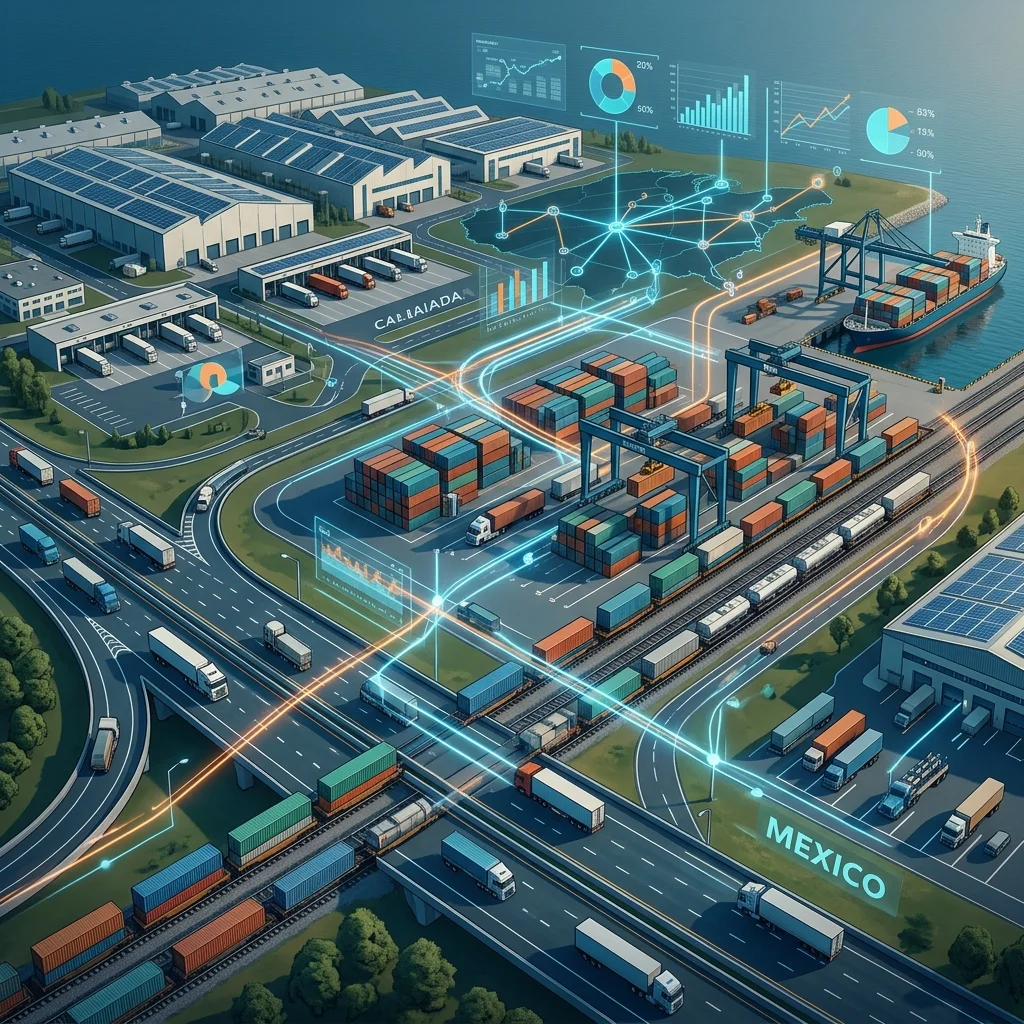
"This article will examine North America cross-border business through a deep-audit"
North America Cross-Border Business: Trade Flows, Supply Chains, and Market Strategy
Sources and basis: This article is a synthesized analysis drawing on public materials and widely cited policy frameworks, including USMCA trade rules, customs and border agency guidance from the U.S., Canada, and Mexico, and recent industry reporting on nearshoring, manufacturing investment, and logistics networks in North America. Specific examples are used to illustrate operational patterns rather than to claim exhaustive coverage of any one company.
1. The Core Economic Logic Behind North America Cross-Border Business
North America cross border business is not driven by geography alone. It is shaped by a dense web of production links that connect factories, warehouses, ports of entry, and final markets across the United States, Canada, and Mexico. In practice, firms are not simply moving goods across a border; they are moving parts, subassemblies, data, and compliance records through an integrated production system.
That is why the economics of cross-border trade have changed. For many companies, the decision is no longer based on price alone. Cost still matters, but it now competes with speed, inventory exposure, policy stability, and supply chain resilience. A sourcing model that is cheap on paper can become expensive if it creates long lead times, high safety stock, or exposure to one disruption point.
[IMAGE: A map-based visualization of interconnected industrial corridors across the U.S., Canada, and Mexico.]
A key operating consideration is total system reliability. That includes transport cost, customs clearance time, labor availability, tariff treatment, and the ability to recover quickly from shocks. In other words, firms increasingly evaluate the full landed cost of a product, not just the factory gate price. This helps explain why cross-border trade has become a strategic issue for operations, finance, and risk management teams rather than only for trade departments.
2. Why This Story Fits a Slow Analysis Lens
This topic is better understood as a multi-year structural shift than as a short-term trade headline. Nearshoring, automation, regulatory adaptation, and network redesign do not happen in a single quarter. They unfold through capital spending plans, site selection decisions, supplier qualification cycles, and logistics contracts that usually span years.
[IMAGE: A long-term planning scene with executives reviewing supply chain maps, logistics charts, and factory network diagrams.]
The deeper signal is not a one-time change in freight volume. It is the repositioning of industrial capacity. When a company decides to build a plant in northern Mexico, expand a distribution center in Texas, or add Canadian supplier capacity for an automotive platform, that choice affects procurement, inventory, workforce planning, and customs processes for years. These are structural decisions, and they are best evaluated with a slow analysis lens.
Public data and industry reporting support this longer horizon. Cross-border investment decisions are often made alongside broader moves toward redundancy, shorter lead times, and regional sourcing. That means the relevant question is not whether trade is rising this month, but how the operating model is being rebuilt to handle policy variation and supply volatility over the next cycle.
3. Cross-Border Business as a Supply Chain Architecture Shift
The most important shift is architectural. Cross-border business is no longer just a trade flow story; it is a redesign of North America’s production map. The question companies are asking is not only “Where can we sell?” but also “Where should each stage of production sit?”
This matters because supply chain geometry affects performance. If components are sourced from multiple states or provinces and then assembled near a border, lead times can be shortened, but the network becomes more dependent on border throughput and customs execution. If final assembly is placed closer to the end market, inventory can fall, but the company may need more disciplined supplier coordination.
A concrete example can be seen in the automotive sector. A typical cross-border vehicle or component network may involve steel or advanced materials from the U.S. or Canada, stamped parts assembled in Mexico, electronics sourced from regional suppliers, and final shipment back into the U.S. market. That structure allows firms to distribute labor-intensive steps while keeping production within one integrated regional framework. But it also means that a delay at a bridge crossing or a documentation error can affect downstream assembly schedules.
The same logic applies to industrial equipment and consumer goods. Companies increasingly place warehouses, postponement centers, and customs-bonded operations near border corridors so they can delay final product configuration until demand is clearer. That reduces inventory risk and allows firms to manage SKU complexity more efficiently.
4. Nearshoring and the New Geography of Competitive Advantage
Nearshoring is often described as a simple move closer to market, but the operational mechanism is more specific. Firms are trying to reduce exposure to long ocean routes, geopolitical disruption, and extended replenishment cycles. In North America, this has made border-adjacent manufacturing and logistics corridors more attractive.
The industries most likely to benefit are those with high coordination needs and time-sensitive supply chains. Automotive remains central because of its tiered supplier systems and cross-border parts movement. Electronics and electrical equipment also fit the pattern, particularly where product cycles are short and demand forecasting is uncertain. Industrial machinery and consumer goods follow similar logic when shipping speed and inventory flexibility matter more than the lowest possible unit cost.
[IMAGE: An industrial park near a border region with trucks, rail infrastructure, and advanced manufacturing facilities.]
One practical example is the expansion of manufacturing and supplier ecosystems around northern Mexico. As firms add capacity there, they often cluster suppliers, logistics providers, and customs brokers nearby. That clustering creates a regional ecosystem: parts move more quickly between suppliers and assembly plants, and companies can use cross-docking or just-in-time replenishment with fewer long-haul movements. The advantage is not only lower transport cost. It is also reduced cycle time and better coordination across the network.
A second example is the decision by some firms to locate warehousing and final assembly in the U.S. border states while maintaining component sourcing in Mexico. This hybrid structure allows companies to keep production regional while preserving access to labor and supplier advantages on both sides of the border. Over time, such arrangements can become durable if supplier investment, transport capacity, and customs expertise mature together. If not, they remain temporary responses to disruption.
The key analytical question is whether nearshoring produces a lasting regional platform or only a short-term relocation wave. Evidence from ongoing capital projects suggests that for some sectors, especially automotive and industrial equipment, the answer may be a regional platform. Once suppliers, training systems, and logistics routes are established, switching back to distant sourcing becomes harder.
5. Technology as the Hidden Enabler: Digital Customs, Visibility, and Automation
Technology is now central to cross-border execution because it reduces friction in the steps that are least visible but most disruptive: documentation, classification, filing, inspection readiness, and shipment visibility. Without digital tools, even a well-designed supply chain can lose time at the border.
A practical customs automation workflow illustrates the point. Consider a shipment moving from a Mexican plant to a U.S. distribution center. Before departure, the exporter may use enterprise software to generate commercial invoices, product classifications, country-of-origin data, and advance shipment notifications. A customs broker or trade compliance platform checks the documents against import requirements and flags missing fields. The shipment is then transmitted with digital records that can be reviewed before arrival. If the records are complete, clearance can occur faster; if not, the shipment may be held, reworked, or inspected.
This process matters because delays are not usually caused by one dramatic event. They are often caused by small documentation errors, inconsistent product codes, or a mismatch between physical cargo and digital records. Visibility platforms help reduce those errors by linking inventory systems, transportation management systems, and customs data.
[IMAGE: A layered supply chain schematic showing factories, ports, warehouses, customs nodes, and distribution hubs.]
Technology also supports better risk segmentation. Firms can use real-time tracking to identify which shipments are urgent, which can be delayed, and which require additional compliance review. That enables more targeted interventions instead of broad, costly buffers across the entire network. For example, a manufacturer moving thousands of line items may use automated classification tools to flag only the products subject to special origin rules or duty treatment.
This is why visibility platforms have become strategic rather than merely operational. They are not just tools for tracking trucks. They are systems for synchronizing manufacturing, compliance, and customer delivery. In a cross-border environment, that synchronization can directly affect margins.
6. Regulatory Fragmentation and the Compliance Burden
A frequently cited operational challenge is regulatory fragmentation. North America is economically integrated, but its regulatory environment remains divided across jurisdictions. Companies moving goods across the U.S.-Canada-Mexico corridor must manage customs rules, product standards, labor requirements, tax treatment, and documentation obligations that can differ by country and, in some cases, by sector.
This creates a compliance cost that is often underestimated. Even within an integrated economic region, a company may need different origin calculations, labeling practices, broker procedures, and audit trails for each market. A product that qualifies under one trade rule may need additional documentation in another. That means compliance is not a back-office formality; it is part of the operating model.
For strategy, this has two major effects. First, it raises the value of trade compliance expertise, whether in-house or through specialized providers. Second, it affects location decisions. Some firms choose border-adjacent facilities specifically because they can centralize customs processing, reduce filing errors, and shorten resolution time if a shipment is flagged.
Regulatory differences also influence organizational structure. Larger multinationals often separate global sourcing, regional logistics, and customs compliance into linked but distinct teams. Smaller firms may rely more heavily on brokers and third-party logistics providers because the fixed cost of internal expertise is too high. Either way, the practical result is the same: regulatory variation shapes how companies allocate resources and manage risk.
7. What the Next Phase Means for Market Strategy
The next phase of North America cross-border business is likely to be defined by three pressures at once: resilience, digitization, and regional specialization. Firms will continue to shorten supply chains where possible, but they will do so selectively. Not every product needs to be nearshored, and not every function benefits from border proximity.
The companies most likely to gain advantage are those that can treat the border as an operational interface rather than an obstacle. That requires investment in transport planning, supplier development, compliance systems, and data visibility. It also requires management teams to think in network terms: where each node is located, how it interacts with the others, and where the failure points are.
For logistics providers, the implication is clear. Demand will likely continue to favor services that combine transportation, warehousing, customs support, and digital coordination. For manufacturers, the issue is footprint design: how much capacity to place in each country, how to balance labor cost with lead time, and how to protect against disruption. For policymakers, the challenge is to support a system that is more integrated in practice than in regulation.
Conclusion
North America cross-border business is being reshaped by deeper forces than trade volume alone. Nearshoring is changing plant location decisions, automation is reducing documentation friction, and supply chain resilience is becoming a core strategic metric. At the same time, regulatory fragmentation continues to impose real costs on firms that move goods across borders.
The central takeaway is that cross-border commerce in North America should be understood as a production architecture issue. Companies that manage the network well can improve speed, reduce risk, and strengthen competitive position. Those that treat it as a simple transport problem may miss the operational details that now determine performance.
In that sense, the future of cross-border trade will be decided less by the border itself than by how firms redesign the systems that run through it.
Trade Metrics
Related Datasets
Q4 Cross-Border Logistics Report
PDF • 4.2 MB
Automotive Parts Supply Chain Index
CSV • 1.1 MB