North America Cross-Border Business: Unlocking Supply Chain Resilience Through

Emily Rodriguez
Cross-Border Trade Reporter
May 26, 2026
DATELINE: NA TRADE WIRE
"Despite geopolitical noise, North American cross-border commerce is quietly"
``markdownNorth American Cross-Border Trade Gets a Digital Overhaul: How Data and Infrastructure Are Reshaping Supply Chains
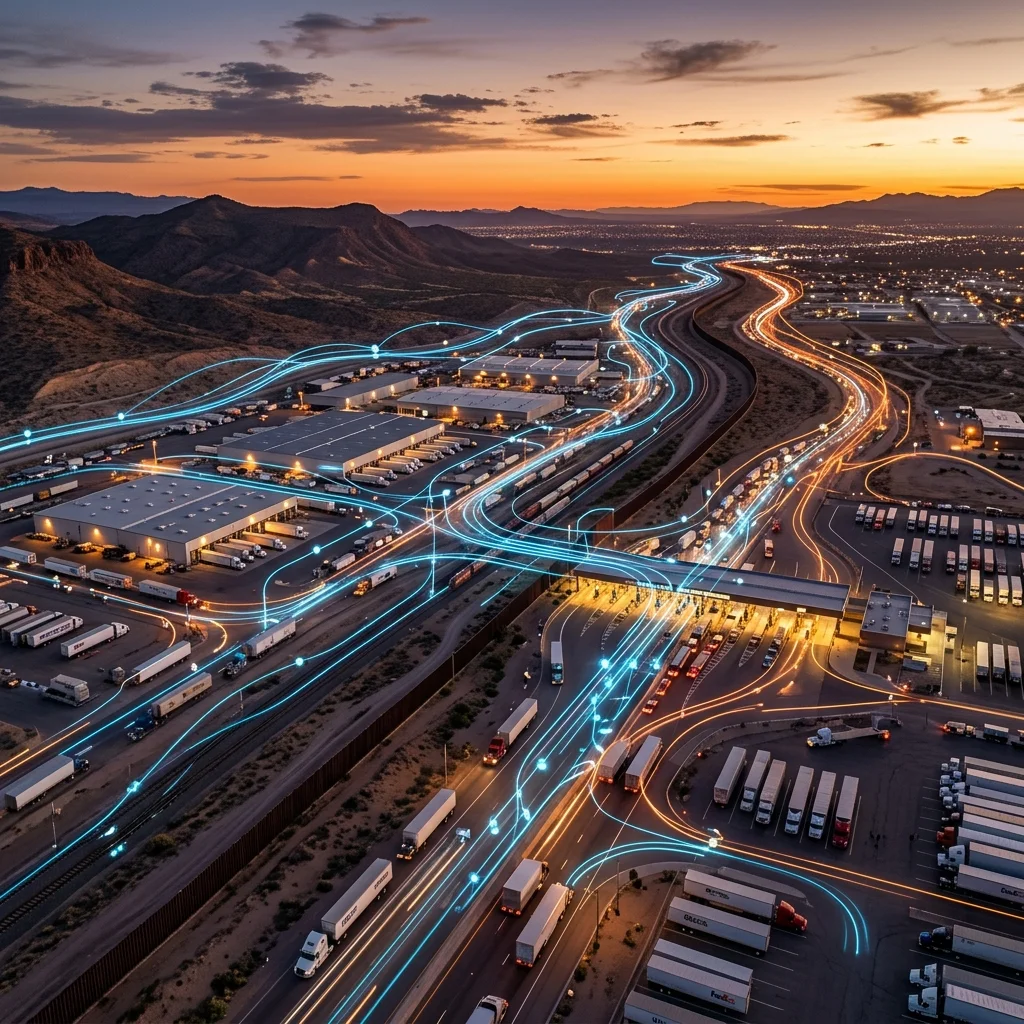
[IMAGE: A busy border crossing at sunset with digital data streams (blue and orange lines) flowing over real cargo trucks and warehouses. No text or watermarks. Clean, high-tech, industrial yet futuristic.]
Introduction: A Structural Shift Beneath the Surface
For years, the narrative around North American cross-border commerce has been dominated by tariff headlines—the back-and-forth of trade disputes, the political theater of renegotiations. Yet beneath this noise, a quieter but more consequential revolution is underway. The days when competitive advantage hinged solely on the text of a trade agreement or the level of a duty rate are fading. Today, the true edge in North America cross border business comes from digital integration, logistics efficiency, and the ability to move goods faster and more predictably than competitors.
This structural shift is built on three interconnected pillars: the digitization of customs processes, the maturation of nearshoring infrastructure, and the gradual harmonization of regulatory standards across the United States, Canada, and Mexico. Companies that invest in these areas—particularly in cross-border supply chain technology—are not merely surviving volatility; they are building durable cost advantages that will define the next decade of regional trade.
---
1. The Hidden Engine: Customs Digitization and Real-Time Data
When the United States-Mexico-Canada Agreement (USMCA) came into force in 2020, much of the public debate focused on rules of origin for automobiles and dairy market access. But one of the agreement’s most transformative provisions is buried in Chapter 19, which commits the three countries to “paperless trade” and the adoption of digital customs systems. This clause has acted as a catalyst for accelerating a trend already underway: the shift from manual, document-heavy border clearance to real-time, data-driven processes.
[IMAGE: Infographic showing average border wait times pre- and post-digitization. Use icons and a timeline to show reductions from days to hours.]
The results are measurable. U.S. Customs and Border Protection’s (CBP) Automated Commercial Environment (ACE) system now processes over 97% of all entries electronically. Canada’s CBSA has similarly expanded its Single Window initiative, while Mexico’s SAT (Servicio de Administración Tributaria) has rolled out digital customs declarations for the majority of commercial shipments. These systems allow importers, exporters, and customs brokers to submit data in real time, verify compliance automatically, and receive clearance within minutes rather than days.
The business impact is profound. For a company running just-in-time cross-border inventory strategies—say, an automotive parts supplier shipping from Monterrey to Detroit—every hour of delay at the border carries a cost. Digitization has reduced average clearance times from multiple days to a matter of hours, and in some corridors, such as the Laredo-Nuevo Laredo crossing, express lanes using pre-clearance data now allow trucks to pass in under 30 minutes.
Moreover, emerging technologies like blockchain-based certificates of origin are gaining traction. Pilot programs between Canadian and U.S. customs authorities have demonstrated that smart contracts can verify the origin of goods instantly, reducing the risk of fraud and eliminating costly paperwork. While full adoption remains years away, the trend is clear: customs automation is becoming a competitive necessity, not a nice-to-have.
Verification sources: CBP annual trade statistics (fiscal year 2023), USMCA implementation reports from the Office of the United States Trade Representative, and McKinsey & Company’s “Digital Trade in North America” study (2023).
---
2. Nearshoring’s Second Wave: From Cost Arbitrage to Capability Clusters
The first wave of nearshoring to Mexico, which gained momentum after the COVID-19 pandemic exposed the fragility of long-distance supply chains, was largely driven by labor cost differentials. But the second wave, currently underway, is about something more strategic: the creation of integrated manufacturing ecosystems that combine low-cost production with advanced engineering, R&D, and logistics.
Mexico is no longer just a place to assemble products cheaply. In states like Nuevo León, Querétaro, and Baja California, industrial parks are filling with factories that produce electric vehicle batteries, medical devices, aerospace components, and semiconductors—all industries that require high skill levels and sophisticated quality control. These “capability clusters” are attracting foreign direct investment not just from the United States, but also from Asian and European multinationals seeking to reduce their exposure to geopolitical risk.
[IMAGE: A map of North America with highlighted industrial corridors: Monterrey-Saltillo, Tijuana-San Diego, Windsor-Detroit, and others. Use colored nodes to mark R&D and production hubs.]
Data from Mexico’s Ministry of Economy shows that foreign direct investment in industrial real estate and manufacturing capacity rose 18% year-over-year in the first half of 2024, with the largest inflows going to automotive (especially EV supply chains) and electronics. The Bajío region—an industrial belt spanning Guanajuato, Querétaro, and San Luis Potosí—has become a magnet for advanced manufacturing, while northern border states like Sonora and Chihuahua continue to attract cross-border logistics and assembly operations.
Perhaps the most telling sign of this shift is the co-location of R&D centers. Companies like Tesla, Foxconn, and John Deere are establishing engineering and design teams near their Mexican production lines, allowing them to shorten product iteration cycles from months to weeks. This trend is also visible in the Canada-US trade corridors, where Ontario-based manufacturers are building innovation hubs in Michigan and New York to accelerate the flow of ideas across the border.
The implication for North America cross border business is clear: nearshoring is no longer just about labor arbitrage. It is about building tightly integrated supply chains that can respond to demand changes faster than any global competitor. Companies that treat Mexico as a low-cost outsource destination will be overtaken by those that treat it as a strategic partner in innovation.
Verification sources: Mexico’s Ministry of Economy FDI data (2024), Banco de México’s “Nearshoring Report” (Q2 2024), and company case studies from Tesla’s Gigafactory in Nuevo León and Foxconn’s expansion in Chihuahua.
---
3. The Logistics Backbone: Rail, Trucking, and the Final Mile
Digital customs systems and manufacturing clusters are only part of the equation. The physical movement of goods—the trucks, trains, and last-mile delivery networks—remains the backbone of cross-border supply chains. And here, too, the landscape is changing.
One of the most significant developments has been the gradual reform of cross-border trucking regulations under the USMCA. After years of delays and legal challenges, Mexican carriers now have greater access to U.S. interior points beyond the border commercial zones, provided they meet strict safety and emissions standards. This has opened up new possibilities for shippers who previously had to transfer cargo at the border, incurring time and cost penalties.
[IMAGE: A photograph of trucks lined up at the Laredo World Trade Bridge, with a digital overlay showing real-time wait times and throughput data. No text, just visual.]
Investment in border infrastructure is keeping pace. The Laredo World Trade Bridge expansion, a $1.2 billion project, is expected to double truck processing capacity at the busiest inland port on the U.S.-Mexico border. Meanwhile, the expansion of the Blue Water Bridge connecting Port Huron, Michigan, with Sarnia, Ontario, is easing congestion on the busiest Canada-US trade corridor. These physical upgrades are being paired with digital tools—such as the Drayage Visibility Platform used by the Port of Laredo—that allow logistics managers to track shipments in real time and reroute around delays.
Rail intermodal volumes between the United States and Mexico are growing at 5-7% annually, driven by the rise of dedicated freight corridors operated by companies like CPKC (Canadian Pacific Kansas City) and Union Pacific. The CPKC merger, finalized in 2023, created the first single-line rail network connecting Canada, the U.S., and Mexico, eliminating the need for train swaps at the border. This has slashed transit times from Chicago to Mexico City from six days to four, and from Toronto to Monterrey from eight days to five—a dramatic improvement for industries like automotive and consumer goods that rely on predictable lead times.
But the final mile remains a challenge. Mexican carriers often face regulatory bottlenecks at the border, while Canadian trucking capacity is constrained by a shortage of drivers. Companies that are investing in cross-border supply chain technology—such as real-time tracking, electronic logging devices, and AI-powered route optimization—are gaining a clear edge. A recent study by the Boston Consulting Group found that companies with advanced digital logistics capabilities spend 12-15% less on cross-border transportation than those relying on manual processes.
Verification sources: U.S. Department of Transportation data on border crossing times (2023-2024), CPKC investor presentations (Q2 2024), and the BCG Supply Chain Resilience Report (2023).
---
Conclusion: The New Baseline for Competitiveness
The narrative of North American trade is being rewritten. Tariff disputes and political brinkmanship will not disappear, but they are becoming background noise to a more fundamental transformation. The companies that will thrive in this environment are those that embrace trade digitization, invest in nearshoring infrastructure, and integrate their logistics operations across the three countries.
For executives, the message is straightforward: stop obsessing over what the next tariff might be, and start looking at how fast your customs data flows, how close your R&D team is to your production line, and how seamlessly your trucks move from Laredo to Detroit. The winners in North America cross border business will not be those who negotiate the best trade deal—they will be those who build the most resilient, data-driven supply chains.
The infrastructure—both digital and physical—is already being built. The question now is who will use it best.
[IMAGE: A stylized nighttime shot of a rail yard near the U.S.-Mexico border, with containers stacked and a train moving under a digital data overlay. No text.]
``
Trade Metrics
Related Datasets
Q4 Cross-Border Logistics Report
PDF • 4.2 MB
Automotive Parts Supply Chain Index
CSV • 1.1 MB