Beyond the Sun Belt: Kodiak AI''s Ohio-Indiana Test Signals a Strategic Shift

Emily Rodriguez
Cross-Border Trade Reporter
April 8, 2026
DATELINE: NA TRADE WIRE
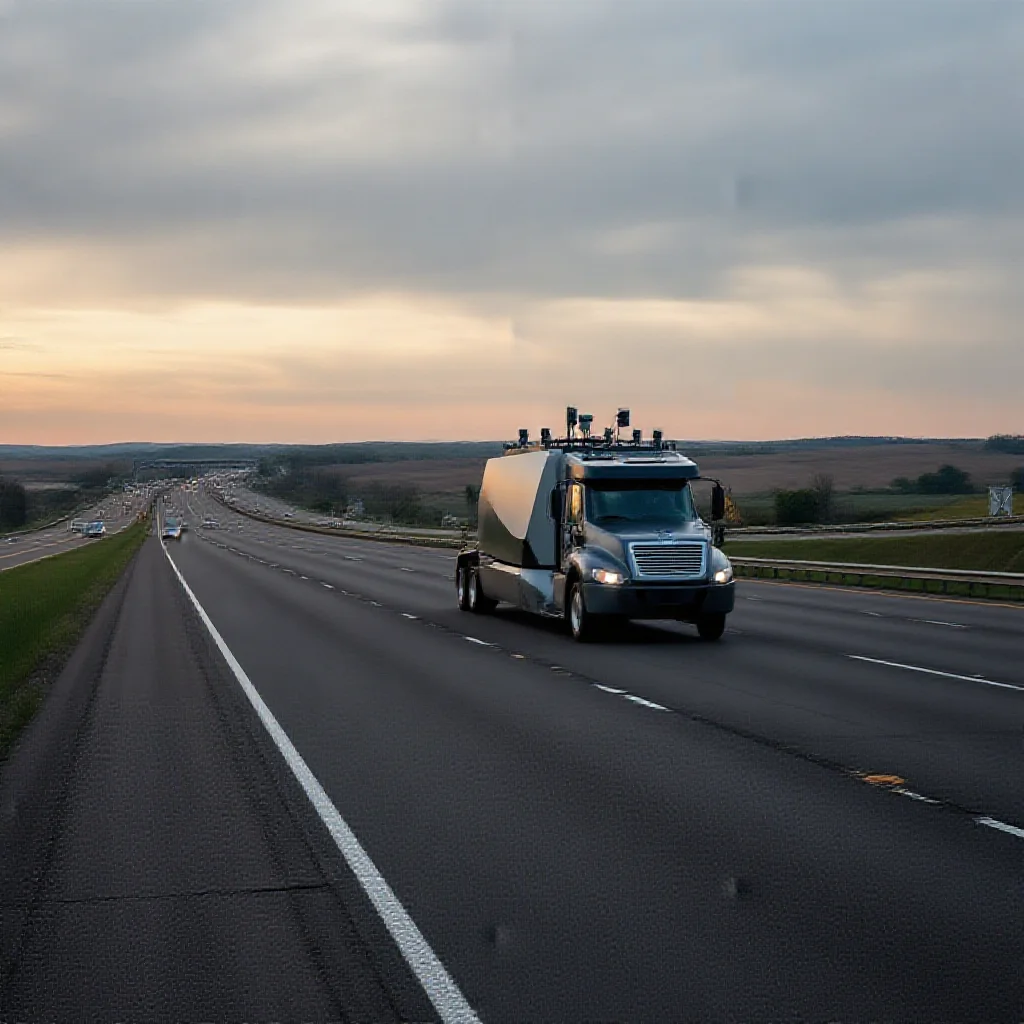
"Kodiak AI's recent completion of a driverless trucking program on Interstate"
Beyond the Sun Belt: Kodiak AI's Ohio-Indiana Test Signals a Strategic Shift in Autonomous Trucking
Introduction: The Sun Belt Ceiling and the Midwest Mandate
The established proving grounds for autonomous trucking have long been the Sun Belt. States like Texas, Arizona, and Nevada offer predictable climates, straightforward highway geometries, and regulatory frameworks conducive to testing. This environment has been critical for initial technological validation. Kodiak AI's recent completion of a driverless trucking program on Interstate 70, in partnership with DriveOhio, represents a deliberate breach of this geographic barrier. (Source 1: [Primary Data]) The demonstrations across Ohio and Indiana signal a transition from controlled-environment validation to strategic, economic-scale deployment. The core thesis of this expansion is that it is less a pure technology demonstration and more a calculated move for economic positioning and the re-engineering of continental supply chain logistics.
Deconstructing the Demonstration: Technical Maturity Meets Real-World Chaos
The program’s technical scenarios were a curated stress test for Level 4 systems, moving beyond highway cruising to address the routine chaos of freight corridors. Demonstrations included navigating construction zones, merging, passing, yielding to disabled vehicles, and responding to unexpected pedestrian crossings. (Source 1: [Primary Data]) These are not mere edge cases but represent the "boring but critical" failure points that disrupt logistics daily and incur significant cost. The selection of venues—the Transportation Research Center in East Liberty, Ohio, and the INDOT Traffic Management Center in Indianapolis—provides institutional validation. (Source 1: [Primary Data]) The presence of state transportation officials as witnesses shifts the narrative from corporate experimentation to a publicly vetted capability assessment, enhancing partnership credibility and regulatory familiarity.
The Hidden Economic Logic: Why I-70 is the New Battleground
The geographic shift is underpinned by distinct economic logic. The Midwest, interconnected by corridors like I-70 and I-75, forms the dense core of the nation's industrial and agricultural logistics network. It is a web of manufacturers, distribution centers, and ports generating high-volume, often shorter-haul freight movements. The economic model for autonomy in the long, simple hauls of the Sun Belt is one of driver cost displacement over distance. In the Midwest, the value proposition expands to include reliability optimization in complex, high-frequency routes, reduction of driver turnover burdens, and precision in just-in-time logistics. The strategic entry point is likely the "middle-mile"—the movement of goods between major hubs, ports, and railyards—a segment currently dominated by asset-heavy carriers facing persistent human resource constraints.
The Stakeholder Symphony: How Public-Private Alignment Accelerates Adoption
The involvement of the Ohio Department of Transportation and the Indiana Department of Transportation (INDOT) is a critical accelerant. (Source 1: [Primary Data]) DriveOhio, as a state-backed hub, provides a single point of contact for navigating regulatory and infrastructural integration. This public-private alignment serves to de-risk corporate investment in new regions. For state entities, the incentive is economic competitiveness: positioning their critical freight corridors as first-adopter zones for a technology promising supply chain resilience and potential job creation in technical fields. This collaborative model, witnessed in the program’s execution, creates a template for other states, reducing fragmented regulatory approaches that could hinder nationwide scaling.
Market Implications: Pressure on Legacy Carriers and Reshaped Planning Horizons
This strategic incursion into the Midwest freight heartland places direct pressure on legacy truckload and less-than-truckload carriers. The competitive threat evolves from a distant "future of long-haul" to a near-term challenge on dense, repeatable routes that form the backbone of many carriers' networks. The response calculus must now include not only driver retention strategies but also potential partnerships with or investments in autonomous technology. For shippers and supply chain planners, Kodiak's move lengthens the planning horizon for autonomy’s impact. It necessitates scenario planning that incorporates autonomous middle-mile segments within the next decade, potentially altering decisions regarding warehouse placement, inventory levels, and logistics partner selection.
Conclusion: A Pivot from Proving to Placing
Kodiak AI’s I-70 program, culminating in April 2026, marks an industry pivot. (Source 1: [Primary Data]) The statement by CEO Don Burnette that the work highlights the technology's ability to operate "in new environments that are critical to the U.S. supply chain" explicitly links technical progress to economic geography. (Source 1: [Primary Data]) The objective demonstration of handling variable weather, complex infrastructure, and unpredictable road users moves the sector past fair-weather validation. The subsequent phase will be defined by the commercial deployment agreements forged along these corridors, the response of incumbent carriers, and the rate at which other autonomous trucking firms follow this geographic and strategic shift into the logistical center of gravity. The race is no longer just about the technology; it is about its strategic placement within the existing freight economy.
Trade Metrics
Related Datasets
Q4 Cross-Border Logistics Report
PDF • 4.2 MB
Automotive Parts Supply Chain Index
CSV • 1.1 MB