Navigating the Future: 5 Global Business Trends Every International MBA Must

Emily Rodriguez
Cross-Border Trade Reporter
June 27, 2026
DATELINE: NA TRADE WIRE
"The international business landscape is being reshaped by five interconnected"
``markdownNavigating the Future: 5 Global Business Trends Every International MBA Must Master
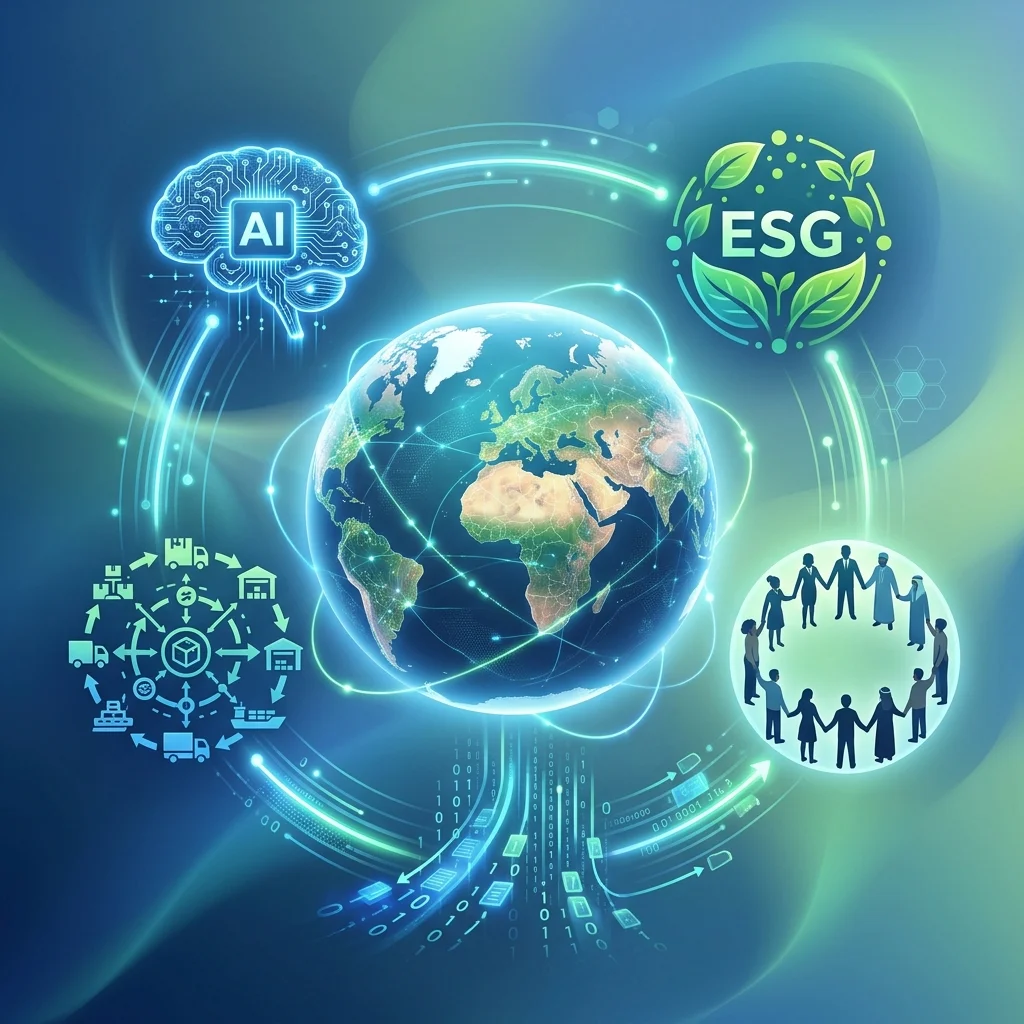
[IMAGE: An overlapping Venn diagram of the five trends – AI brain, green leaf for ESG, supply chain nodes, diverse silhouettes, and a digital disruption icon – connected by arrows showing mutual reinforcement.]
The global business landscape is no longer shaped by isolated forces. Artificial intelligence powers ESG data collection and supply chain optimization; cross-cultural competence determines whether a multinational team can deploy new technology effectively; and rapid technological disruption forces entire business models to be reinvented every few years. For aspiring international leaders, understanding each trend individually is necessary but insufficient. The real competitive advantage lies in grasping how these five megatrends interlock and amplify one another.
The core economic logic is shifting: businesses now compete on their ability to orchestrate AI, sustainability, resilient supply chains, cross-cultural collaboration, and technological disruption simultaneously. This makes the international MBA a crucible for holistic leadership – a program that must evolve from teaching siloed disciplines to cultivating systems thinking. Forward-looking institutions, including Schiller International University, are redesigning curricula to reflect this interdependence, producing graduates who can navigate complexity rather than just optimize a single function.
Below is a deep audit of each trend, the hidden economic logic that connects them, and the implications for global business education.
---
AI and Data Analytics: The Strategic Engine Behind Every Decision
Artificial intelligence has moved beyond back-office automation into the core of corporate strategy. From predictive supply chain modeling to real-time customer sentiment analysis, AI enables decisions that were impossible a decade ago. Yet for MBA graduates, the critical skill is not building algorithms – it is asking the right strategic questions. Which data sources matter? What are the ethical boundaries of predictive analytics? How do you translate a machine learning output into a boardroom decision?
The true value of AI lies in how it enables the other four trends. ESG reporting, for instance, relies on AI to parse vast amounts of unstructured data – satellite imagery, supplier audits, carbon sensor readings – and transform them into auditable metrics. Supply chain resilience depends on AI-powered scenario planning that simulates disruptions from geopolitical shocks to extreme weather. Cross-cultural teams use AI translation and sentiment analysis to bridge language and communication style gaps. And rapid technological disruption? AI itself is the disruptor, but it also helps companies anticipate the next wave through pattern recognition.
[IMAGE: A dashboard showing AI-driven analytics visualizations – heat maps, predictive curves, and real-time KPI gauges – overlaid on a world map with glowing data nodes.]
For international MBA students, mastering this trend means understanding not just the technical capabilities of AI, but the strategic trade-offs: accuracy versus interpretability, speed versus fairness, automation versus human oversight. Business schools are now embedding AI into every functional area – marketing, finance, operations – to ensure graduates can lead cross-functional teams where data is the common language.
---
Sustainability and ESG: From Compliance to Competitive Advantage
Environmental, Social, and Governance (ESG) criteria have moved from a corporate social responsibility footnote to a core driver of valuation and risk management. Global investors now manage over $30 trillion in ESG-focused assets, and consumers increasingly vote with their wallets for sustainable brands. For international MBAs, the imperative is clear: ESG is not a compliance checkbox – it is a lens for innovation and competitive differentiation.
But here lies a hidden layer of complexity: ESG standards vary dramatically by region. The European Union’s Corporate Sustainability Reporting Directive (CSRD) demands granular disclosures that may not match U.S. SEC rules or China’s evolving green finance framework. A global leader must navigate these regulatory mosaics while respecting local cultural values – for example, “social” in one country may emphasize labor rights, while in another it focuses on community development. This is where cross-cultural competence becomes indispensable. Negotiating a joint venture on sustainability targets requires understanding not only the letter of the law but the unspoken priorities of partners in different markets.
[IMAGE: A split image – on the left, a green factory with solar panels and data dashboards; on the right, a diverse boardroom around a table with sustainability reports and a globe in the center.]
Moreover, AI and analytics are the engines that make ESG credible. Without robust data collection and verification, ESG claims risk being dismissed as greenwashing. MBA graduates must be able to design data-driven sustainability strategies that withstand scrutiny from regulators, activists, and customers. The most forward-thinking companies already treat ESG as a profit center – using circular economy principles to reduce costs, renewable energy to hedge against carbon taxes, and social metrics to improve talent retention.
---
Supply Chain Resilience: Diversification in an Age of Disruption
The COVID-19 pandemic, the Suez Canal blockage, the war in Ukraine, and escalating climate extremes have shattered the assumption that global supply chains should prioritize cost efficiency above all else. Companies are now pivoting to resilience: diversifying suppliers, building regional hubs, and investing in inventory buffers. For international MBAs, this trend demands a fundamental rethinking of operations strategy.
The hidden logic of supply chain resilience is that it cannot be achieved by logistics alone. It requires sophisticated AI-powered scenario modeling – the ability to simulate thousands of disruption scenarios and identify the most robust network design. It also requires cross-cultural leadership. Diversification means managing suppliers across multiple countries, each with different business practices, regulatory environments, and communication norms. A negotiation in Vietnam is not the same as one in Germany or Brazil. Trust, built across cultures, is the lubricant of a resilient supply chain – and it cannot be programmed into an algorithm.
[IMAGE: A network diagram of global supply chain nodes – factories, ports, warehouses – connected by colored lines, with some nodes glowing to indicate alternative routes or backup suppliers.]
Furthermore, resilience intersects with ESG. Ethical sourcing, carbon footprint reduction, and local community engagement are increasingly tied to supplier selection criteria. An MBA who can design a supply chain that is both resilient and sustainable – using AI to optimize for cost, carbon, and risk simultaneously – will be invaluable. This integrated approach is what distinguishes future-ready leaders from those who optimize a single variable.
---
Cross-Cultural Competence and Technological Disruption: The Twin Pillars of Global Leadership
The final two trends – cross-cultural competence and rapid technological disruption – are often treated separately, but in practice they are inseparable. Technology adoption across global organizations fails more often because of cultural mismatch than because of technical limitations. A new AI tool may be rejected by a team in Japan due to hierarchical decision-making norms, while the same tool is embraced in a flat-structured Israeli startup. Understanding these nuances is the secret weapon of the global manager.
Rapid technological disruption – from generative AI to quantum computing to biotech – demands that business models be reinvented every few years. This creates a paradox: the faster the technology changes, the more important human skills become. Empathy, adaptability, and the ability to build diverse, inclusive teams are not soft skills – they are hard requirements for navigating disruption. Cross-cultural competence enables leaders to spot opportunities in different markets, anticipate regulatory responses, and co-create solutions with partners who see the world differently.
[IMAGE: A diverse group of professionals from different backgrounds collaborating around a holographic display of a new product prototype, with digital data streams flowing between them.]
The convergence of these two trends creates a powerful feedback loop. Technological disruption often originates in one region (e.g., Silicon Valley for software, Shenzhen for hardware) but must be adapted globally. A culturally competent MBA can lead the localization process, ensuring that a product or service resonates with local consumers and complies with local norms. Meanwhile, technology itself can enhance cross-cultural collaboration – through real-time translation tools, virtual reality meetings, and asynchronous collaboration platforms – but only if teams are trained to use them inclusively.
For business education, this means that international MBA programs must go beyond traditional international business courses. They must embed cross-cultural experiences – immersive projects, global residencies, and diverse cohort composition – alongside cutting-edge courses on digital transformation. Schiller International University, with its multi-campus model across Europe and the United States, exemplifies how global exposure and digital fluency can be woven into a single curriculum. Graduates emerge not just with knowledge of trends, but with the practiced ability to operate across borders and across technologies.
---
Conclusion: The Integrated MBA for an Interconnected World
The five global business trends – AI and data analytics, ESG and sustainability, supply chain resilience, cross-cultural competence, and technological disruption – are not separate lanes on a highway. They are strands of a single rope, each reinforcing the other. AI enables ESG reporting and supply chain optimization. Cross-cultural competence is essential for deploying technology globally. Resilience demands both data modeling and trust-building across cultures. And sustainability is now a competitive necessity that touches every function.
For international MBA students, the path to leadership lies in mastering this integration. The programs that succeed will be those that simulate real-world complexity rather than simplifying it into textbook cases. They will challenge students to design a sustainable supply chain for a multinational using AI tools, then negotiate its implementation with a diverse team from four continents. They will teach that the most important question is not “Which trend is most important?” but “How do these trends interact in my specific context?”
The future belongs to leaders who can see the whole picture – and act on it. an international MBA that delivers that perspective is not just a degree; it is a strategic investment in navigating the decades ahead.
[IMAGE: A globe at the center of an interconnected web of glowing icons – AI brain, green leaf, supply chain nodes, diverse people, and a thunderbolt symbolizing disruption – with a soft blue-green gradient background, no text, no watermarks.]
``
Trade Metrics
Related Datasets
Q4 Cross-Border Logistics Report
PDF • 4.2 MB
Automotive Parts Supply Chain Index
CSV • 1.1 MB