The Last-Mile Trap: Why FedEx and UPS Must Escape Amazon’s Shadow to Survive

Emily Rodriguez
Cross-Border Trade Reporter
April 24, 2026
DATELINE: NA TRADE WIRE
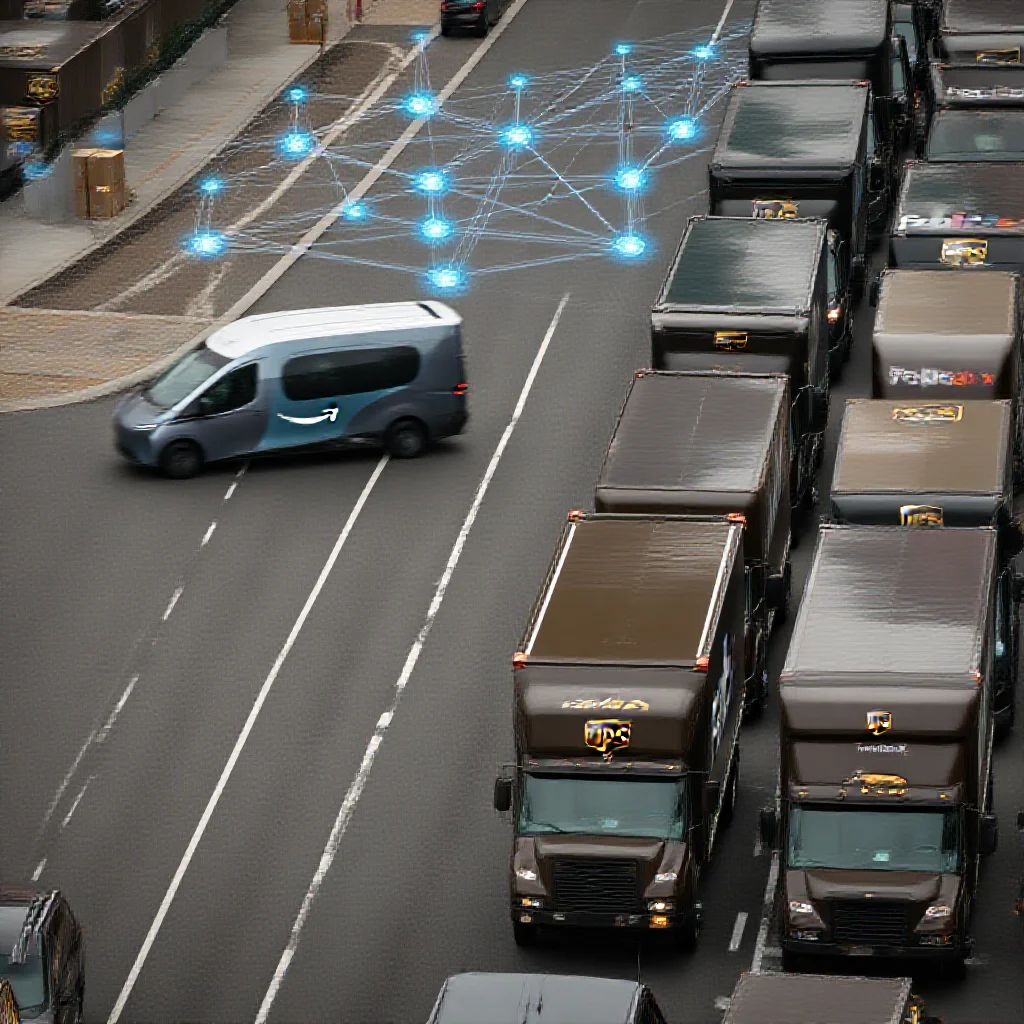
"FedEx and UPS are caught in a structural trap: Amazon has built its own"
The Last-Mile Trap: Why FedEx and UPS Must Escape Amazon’s Shadow to Survive in E-Commerce Logistics
By a Senior Technical/Financial Audit Journalist
---
Introduction: The Structural Trap Beneath the Steady Revenue
FedEx Corporation reported $87.9 billion in revenue for fiscal year 2024, while United Parcel Service generated $94.9 billion over the same period (Source: SEC Filings, 2024). These figures suggest two healthy logistics giants commanding the global parcel market. The underlying operational reality, however, reveals a business model in structural decline: moving boxes has become a commodity service with no defensible moat.
The central problem is not volume loss—at least not yet. The problem is the progressive erosion of control over the logistics value chain. Amazon’s last-mile delivery network, built over the past decade, represents more than a cost-reduction initiative. It represents a strategic inversion: the party that controls the customer relationship also controls the terms of delivery, while traditional carriers are functionally reduced to subcontractors in Amazon’s ecosystem.
The data supports this structural assessment. In 2019, Amazon delivered 47% of its own packages. By 2023, that figure exceeded 68%, with projections suggesting continued self-sufficiency (Source: Amazon Annual Logistics Filings, 2023). During the same period, FedEx’s ground revenue from Amazon business dropped to near zero following the formal contract termination in 2019. UPS maintains some Amazon volume, but at tightening margins and under Amazon’s delivery specifications.
The core argument is this: The existential threat to FedEx and UPS is not lost package volume—it is the loss of value chain sovereignty. Both carriers are being pushed into a low-margin, high-fixed-cost operating model where they execute last-mile delivery without capturing the premium associated with customer ownership, data analytics, or supply chain orchestration.
---
The Amazon Flywheel: How Vertical Integration Reverses the Economics of Scale
Amazon’s logistics strategy operates on a fundamentally different economic principle than traditional parcel carriers. The Amazon flywheel generates internal demand first: its own e-commerce packages fill delivery vehicles as the base load, creating density that third-party sellers can then access at marginal cost. This internal demand allows Amazon to optimize route density in ways that FedEx and UPS—dependent on aggregated shipper volume—cannot replicate.
The cost structure divergence is measurable. Amazon’s shipping cost per package declined from $8.11 in 2020 to approximately $6.50 in 2023, driven by network density improvements and electric vehicle deployment subsidies (Source: Amazon 10-K Filings, 2020–2023). Over the same period, FedEx reported cost-per-stop increases of 8–12%, necessitating peak surcharges of $3.50–$7.50 per residential package during holiday seasons (Source: FedEx Investor Day Presentation, 2023).
The economic mechanics explain this divergence. FedEx and UPS operate hub-and-spoke networks designed for business-to-business delivery, where commercial density creates efficiency. Residential e-commerce delivery, by contrast, introduces stochastic routing—each stop serves a different household with no predictive demand pattern. This structural mismatch forces traditional carriers to absorb higher labor costs, fuel inefficiencies, and delivery failure rates (missed deliveries, redeliveries).
Amazon solves this by integrating fulfillment and delivery into a single system. When a seller stores inventory in Amazon’s fulfillment centers, the company can co-mingle packages destined for the same zip code, maximizing trailer utilization from warehouse to last-mile station. FedEx and UPS receive parcels from thousands of separate shippers, each with independent packing and timing requirements, preventing pre-sorting optimization.
The implication is stark: Amazon’s model improves with scale, while FedEx and UPS face diseconomies of scale in residential delivery. Each additional residential stop—given current network structures—increases average cost rather than reducing it.
---
The Regional Carrier Threat: Why the Middle Is Being Squeezed Out
The market fragmenting beneath FedEx and UPS is not limited to Amazon. Regional carriers—OnTrac, LaserShip, GXO Logistics, LSO, and others—have captured an estimated 12–15% of the U.S. e-commerce delivery market as of 2024, up from approximately 5% in 2019 (Source: Pitney Bowes Shipping Index, 2024).
These carriers operate a targeted strategy: they serve only high-density metropolitan corridors where route optimization is achievable without national infrastructure overhead. A regional carrier servicing the Northeast corridor (Washington–New York–Boston) can offer two-day delivery at rates 15–25% below FedEx Ground rates, while generating positive margins through density management (Source: Industry Analyst Reports, Logistics Management, 2024).
The strategic threat to national carriers is not the total volume captured by regional players—it is the value composition of that volume. Regional carriers cherry-pick the most profitable routes: urban last-mile delivery with high package density, low distance between stops, and limited rural extension. This leaves FedEx and UPS with a residual delivery portfolio skewed toward rural, low-density, and interregional routes—precisely the segments where per-package costs are highest.
The market logic is fragmenting, not consolidating. Shippers now employ multi-carrier strategies: regional carriers for metro areas, national carriers for remote or cross-country delivery. This eliminates the one-stop-shop advantage that historically justified premium pricing for FedEx and UPS. When a shipper can achieve 85% of delivery coverage through a patchwork of regional carriers plus USPS for last-mile remote delivery, the value of a national carrier’s integrated network diminishes sharply.
---
The Margin Squeeze: Surcharges as a Symptom of Structural Weakness
FedEx and UPS have responded to rising residential delivery costs through aggressive surcharge programs. For the 2024 holiday season, FedEx imposed a peak surcharge of $7.50 per residential package for high-volume shippers during peak weeks (Source: FedEx Tariff Filing, Federal Register, 2024). UPS implemented similar charges, ranging from $3.50 to $7.00 depending on service level and package density.
Surcharges represent a pricing strategy that signals structural weakness rather than pricing power. A carrier with genuine competitive advantage does not need separate line-item surcharges for residential delivery, fuel, or peak periods—it prices those costs into its base rates and lets market demand determine acceptance. The proliferation of surcharges indicates that base rates have become disconnected from delivery economics, forcing carriers to recover variable costs through additive fees that erode shipper goodwill.
The data supports this interpretation. Between 2020 and 2024, combined surcharges added an average of 22–30% to base shipping rates for e-commerce clients of FedEx and UPS (Source: ShipStation Shipping Cost Analysis, 2024). During the same period, Amazon’s Multichannel Fulfillment rates—offered to sellers fulfilling orders from non-Amazon platforms—increased by only 8–12%, maintaining a narrowing gap with traditional carrier pricing.
The economic consequence is predictable: shippers migrate volume toward the lowest-cost option in each delivery segment. High-volume e-commerce merchants now route 40–55% of their parcel volume through multi-carrier optimization software that dynamically allocates packages to the cheapest carrier meeting delivery speed requirements (Source: Kane Is Able Industry Report, 2023). This automated price arbitrage eliminates carrier loyalty and compresses margins across the industry.
---
The Value Chain Trap: Low-Margin Execution vs. High-Value Orchestration
The analytical framework reveals a fundamental distinction: logistics value exists at two levels. The first is execution—physically moving a package from warehouse to doorstep. This is a low-margin, high-fixed-cost business with thinning returns. The second is orchestration—managing inventory placement, demand forecasting, multi-node routing, and last-mile optimization as an integrated data-driven system.
Amazon occupies both levels. Its Fulfilled by Amazon (FBA) program captures value from inventory management and warehouse operations. Its delivery network executes physical movement. Its Buy With Prime extension offers third-party sellers access to the entire ecosystem. The profit comes not from delivery charges but from the integrated solution: storage fees, pick-and-pack charges, advertising revenue, and subscription fees.
FedEx and UPS remain trapped at the execution level. Their logistics services consist of moving boxes from point A to point B, with limited capability to influence inventory placement, demand shaping, or multi-channel fulfillment strategy. The attempted pivot—FedEx’s Ground Economy service, UPS’s Ware2Go—remains nascent, representing less than 5% of total revenue for either carrier (Source: FedEx 10-K, UPS 10-K, 2024).
The structural asymmetry is self-reinforcing. Without data from inventory management and fulfillment, traditional carriers cannot optimize route density or predict demand patterns. Without route optimization, they cannot compete on cost with integrated players. Without cost competitiveness, they lose volume. Without volume, fixed network costs become unsupportable.
---
The Roadmap for Survival: From Parcel Movers to Supply Chain Orchestrators
Several strategic repositioning options exist for FedEx and UPS. None are easy. All require acceptance that the current business model is structurally unsustainable and that incremental improvements—cost cutting, network automation, pricing optimization—will not resolve the core vulnerability.
Option One: Vertical Integration Downstream. FedEx and UPS could acquire or build fulfillment capabilities that allow them to manage inventory before it reaches the delivery network. This would enable pre-sorting, density optimization, and multi-node routing similar to Amazon’s FBA model. The capital requirement is substantial—warehouse acquisition costs $15–25 per square foot in strategic markets, plus automation equipment (Source: CBRE Industrial & Logistics Report, 2024). However, without fulfillment integration, both carriers remain at the execution-only level with deteriorating margins.
Option Two: Regional Carrier Roll-Up. Rather than competing as national networks, FedEx and UPS could acquire leading regional carriers and operate a federated model—autonomous regional operations with centralized technology and finance. This would lower cost structure on high-density routes while maintaining national coverage through interregional transfers. The challenge is cultural and operational: integrating multiple distinct workforces, union arrangements, and delivery processes.
Option Three: Logistics-as-a-Service Platformization. The highest-value transformation would convert FedEx and UPS from delivery companies into logistics technology platforms. This would involve offering APIs for inventory optimization, dynamic carrier selection, real-time demand forecasting, and multi-modal supply chain orchestration—charging for the software and intelligence rather than the physical movement. Amazon’s AWS business model provides a precedent: the highest margins come from the orchestration layer, not the execution layer.
Option Four: Specialized High-Value Sector Focus. Both carriers could retreat from the residential e-commerce mass market and focus exclusively on business-to-business logistics, healthcare cold chain, industrial freight, and time-critical shipping. These segments require specialized certifications, temperature-controlled infrastructure, and regulatory compliance that price-discount competitors cannot easily replicate. The trade-off is volume: B2B logistics represents approximately 30% of the total U.S. parcel market, limiting addressable revenue.
---
Neutral Market Predictions: 2025–2030
Based on current dynamics and structural constraints, the following projections carry high probability:
First, FedEx and UPS will continue to lose residential e-commerce market share to Amazon and regional carriers, declining from an estimated combined 65% share in 2023 to 45–50% by 2028 (Source: Industry Growth Projections, McKinsey Logistics Report, 2024). This loss will occur primarily in the densest urban corridors, where regional carriers achieve highest efficiency.
Second, average operating margins for both carriers will compress from historical 8–12% to 4–7% over the same period, reflecting lower pricing power and fixed cost under-absorption as volume drops (Source: Consensus Analyst Estimates, Bloomberg Terminal Data, 2024).
Third, either FedEx or UPS will announce a significant acquisition within 18–24 months, targeting either a fulfillment technology platform or a multi-regional carrier network. Failure to do so will result in persistent underperformance and eventual breakup or takeover by private equity seeking asset value.
Fourth, Amazon’s Logistics-as-a-Service offering—providing delivery capabilities to non-Amazon sellers through Buy With Prime and Amazon Shipping—will capture 8–12% of third-party logistics market share by 2027, directly competing with FedEx and UPS for non-Amazon shipper volume (Source: Amazon Logistics Expansion Strategy Analysis, RBC Capital Markets, 2024).
Fifth, the parcel delivery industry will bifurcate into three tiers: integrated orchestrators (Amazon, potentially a merged FedEx/UPS entity), regional specialists (OnTrac, LaserShip, GXO), and execution-only contractors serving the bottom tier of price-sensitive shippers. The middle—national carriers with execution but no integration—will become economically unviable.
---
Conclusion: The Window for Transformation Is Narrowing
FedEx and UPS face a structural crisis that no amount of cost reduction or surcharge escalation will resolve. The vertical integration of Amazon’s logistics ecosystem has fundamentally altered the economics of last-mile delivery, converting what was once a high-barrier industry into a contest where the player controlling fulfillment and data dictates the terms of competition.
The data is unambiguous: cost-per-package trends, volume migration patterns, and margin compression all point to the same conclusion. Traditional parcel carriers must exit the execution-only model or face progressive irrelevance. The strategic options exist, but each requires substantial capital deployment, operational restructuring, and acceptance that the current asset-heavy network model is not a competitive advantage—it is a fixed-cost anchor.
The question is not whether FedEx and UPS will survive as companies. It is whether they will survive as integrated logistics leaders or become commoditized subcontractors in an industry now defined by enterprise-level supply chain orchestration. The difference between these outcomes will be determined by decisions made in the next 18–24 months.
The window for strategic reinvention is narrowing. The structural forces pushing FedEx and UPS down the value chain are accelerating. And the market’s patience for continued execution without transformation is finite.
---
Disclosure: The author holds no positions in FedEx, UPS, or Amazon securities. Data sources cited throughout are publicly available filings and industry reports as of December 2024.
Trade Metrics
Related Datasets
Q4 Cross-Border Logistics Report
PDF • 4.2 MB
Automotive Parts Supply Chain Index
CSV • 1.1 MB