Cross-Border Trucking in Turmoil: How Tariff Shocks and Regulatory Changes

Emily Rodriguez
Cross-Border Trade Reporter
June 3, 2026
DATELINE: NA TRADE WIRE
"A wave of tariff hikes, stricter non-tariff barriers, and the looming USMCA"
Cross-Border Trucking in Turmoil: How Tariff Shocks and Regulatory Changes Are Reshaping North America’s Supply Chains
The smooth, tariff-free corridors that once defined North American trade are being fractured by policy shifts, forcing trucking companies, exporters, and logistics providers to rethink decades-old routes and cost structures.
[IMAGE: Map of North America with thick arrows showing truck flows between US, Mexico, and Canada, overlaid with red warning lines and percentage signs.]
Introduction: The Cracks in North America’s Integration Highway
For nearly three decades, cross-border trucking has been the silent engine driving North America’s integrated economy. Since the North American Free Trade Agreement (NAFTA) took effect in 1994, and later under its successor, the United States-Mexico-Canada Agreement (USMCA), the trilateral supply chain operated on a foundation of zero-tariff movement for most goods. Mexican produce, Canadian auto parts, and U.S. machinery crisscrossed the borders with remarkable predictability. That era of seamless, low-cost logistics is now under severe strain.
A wave of tariff hikes, stricter non-tariff barriers, and the looming 2025 USMCA review are disrupting the very networks that once made cross-border trade a model of efficiency. No longer insulated by preferential trade agreements, a substantial share of Mexican and Canadian exports now face tariffs of 25% on key goods, with steel and aluminum duties climbing to as high as 50%. Meanwhile, new language requirements for truck drivers and stepped-up state-level inspections—notably in Texas—are adding operational friction at the border. The result is a perfect storm: rising costs, route realignments, and a potential long-term shift toward nearshoring and regionalized logistics that could permanently alter the geography of North American supply chains.
This article goes beyond the headlines to examine the structural impact of these changes, drawing on analysis from the International Road Transport Union (IRU), the American Trucking Associations (ATA), and trade advisors who are grappling with the new cross-border reality.
---
1. The End of Tariff-Free Predictability
Under NAFTA and the early years of the USMCA, zero tariffs slashed transport and production costs, benefiting consumers and creating hundreds of thousands of jobs in logistics, warehousing, and related sectors. The economics were simple: a truckload of auto parts from Monterrey to Detroit could cross the border without customs duties, allowing manufacturers to run lean, just-in-time inventories that minimized warehousing costs. The same logic applied to Canadian lumber, Mexican avocados, and U.S. grains—all moved freely.
[IMAGE: Graph showing historical tariff rates on key goods from 1994 (NAFTA) to 2025, with a sharp spike after 2024.]
That predictability is unraveling. While the USMCA technically preserves zero-tariff treatment for goods that meet strict rules of origin, an increasing number of products are falling outside those preferences. Recent U.S. trade actions have imposed 25% tariffs on a broad range of non-USMCA-compliant goods, and sector-specific tariffs on steel and aluminum have reached levels of 50% in some cases. For the trucking industry, this creates immediate chaos. A company hauling Canadian steel into the United States now faces a tariff bill that can exceed the value of the freight itself, forcing renegotiation of shipping contracts and distribution of cost burdens.
The impact is particularly acute in the automotive and construction sectors, which rely heavily on cross-border just-in-time deliveries. A 50% steel tariff not only raises the price of raw materials but also disrupts the delicate timing of supply chains. Trucking firms that once bid on long-term contracts based on stable tariff assumptions now find themselves scrambling to adjust rates quarterly—or even monthly. According to the ATA, the uncertainty is already leading some carriers to reduce exposure to border-sensitive lanes, preferring domestic routes where tariff volatility does not apply.
The USMCA’s own rules of origin, once seen as a safeguard, are now becoming a compliance burden. Exporters must prove that their goods qualify for zero tariffs, a process that becomes more expensive as documentation requirements tighten. For small and mid-sized trucking companies, the administrative overhead can be prohibitive, pushing them out of the cross-border business altogether.
---
2. Non-Tariff Barriers: The Hidden Friction
If tariffs are the visible shock, non-tariff barriers are the slow-acting poison that saps efficiency from cross-border trucking. These regulatory and administrative hurdles, often overlooked in trade headlines, compound the cost of tariffs and make border crossings less predictable than ever.
One of the most contentious emerging policies is a proposed U.S. requirement that all commercial truck drivers operating across the border demonstrate a higher level of English language proficiency. While safety is the stated goal, the practical effect is to reduce the pool of available drivers—especially on the Mexican side, where English proficiency is not a standard requirement for domestic trucking. The American Trucking Associations has pointed out that the industry already faces a severe driver shortage, and adding language barriers will only worsen capacity constraints. Canadian carriers, too, may be affected, as many French-speaking drivers from Quebec cross into the United States daily.
[IMAGE: Photo of a Texas border inspection station with a line of trucks and inspectors in fluorescent vests. Subtle motion blur to suggest long wait times.]
State-level enforcement adds another layer of friction. Texas, which handles the majority of U.S.-Mexico truck trade, has intensified its inspection regime at ports of entry. Commercial vehicles are now subject to more frequent and thorough safety checks, leading to longer wait times—sometimes exceeding eight hours at busy crossings like Laredo. The Texas Department of Public Safety has stated the inspections are necessary to ensure compliance with weight and safety regulations, but trucking companies argue that the extra scrutiny disproportionately targets Mexican carriers and disrupts time-sensitive shipments.
These non-tariff measures do not operate in isolation. Combined with tariff shocks, they create a compounding effect that makes cross-border trucking operations less reliable and more expensive. A shipment that faces both a 25% tariff and a six-hour inspection delay loses its cost advantage over domestic alternatives. For perishable goods, such as fresh produce, delays can lead to spoilage, wiping out profit margins entirely. The IRU has warned that the cumulative effect of these barriers could reduce cross-border trucking volumes by 10–15% within two years if not addressed.
---
3. Ripple Effects on Trucking Operations and Costs
The combined pressure of tariffs and non-tariff barriers is forcing trucking companies to rethink every aspect of their cross-border operations. The most immediate response is cost pass-through: carriers are raising rates to cover higher duties, inspection fees, and compliance costs. But rate hikes alone cannot solve the structural disruption. Companies must also adapt their route planning, capacity management, and customer commitments.
Route realignments are already visible. Some carriers are shifting traffic away from the most congested border crossings—like Laredo and El Paso—to less-used ports of entry in Arizona or New Mexico, where inspections are less stringent. Others are consolidating loads into fewer, fuller trucks to reduce per-unit costs, effectively abandoning the just-in-time model for a more consolidated, slower network. For example, automotive parts that used to move in daily trucks are now being shipped twice a week, forcing manufacturers to hold larger buffer inventories.
Demand forecasting has become a nightmare. Tariff changes can be announced with little warning, and regulatory shifts often take effect without transition periods. A trucking company that invests in extra capacity for a particular lane may find that demand evaporates overnight because the tariff has made the goods uncompetitive. Conversely, a sudden tariff exemption for a certain product category can create a surge in orders that overwhelms available capacity. The result is a cycle of overcapacity followed by shortages, raising costs and reducing service reliability.
Client service commitments suffer as well. Long-term contracts that guarantee fixed rates are becoming rare; instead, carriers are insisting on short-term agreements with tariff adjustment clauses. Some logistics providers are even refusing to quote rates for cross-border lanes that involve tariff-sensitive goods, preferring to focus on domestic or intra-USMCA compliant routes. This uncertainty is undermining the trust that underpins cross-border supply chains.
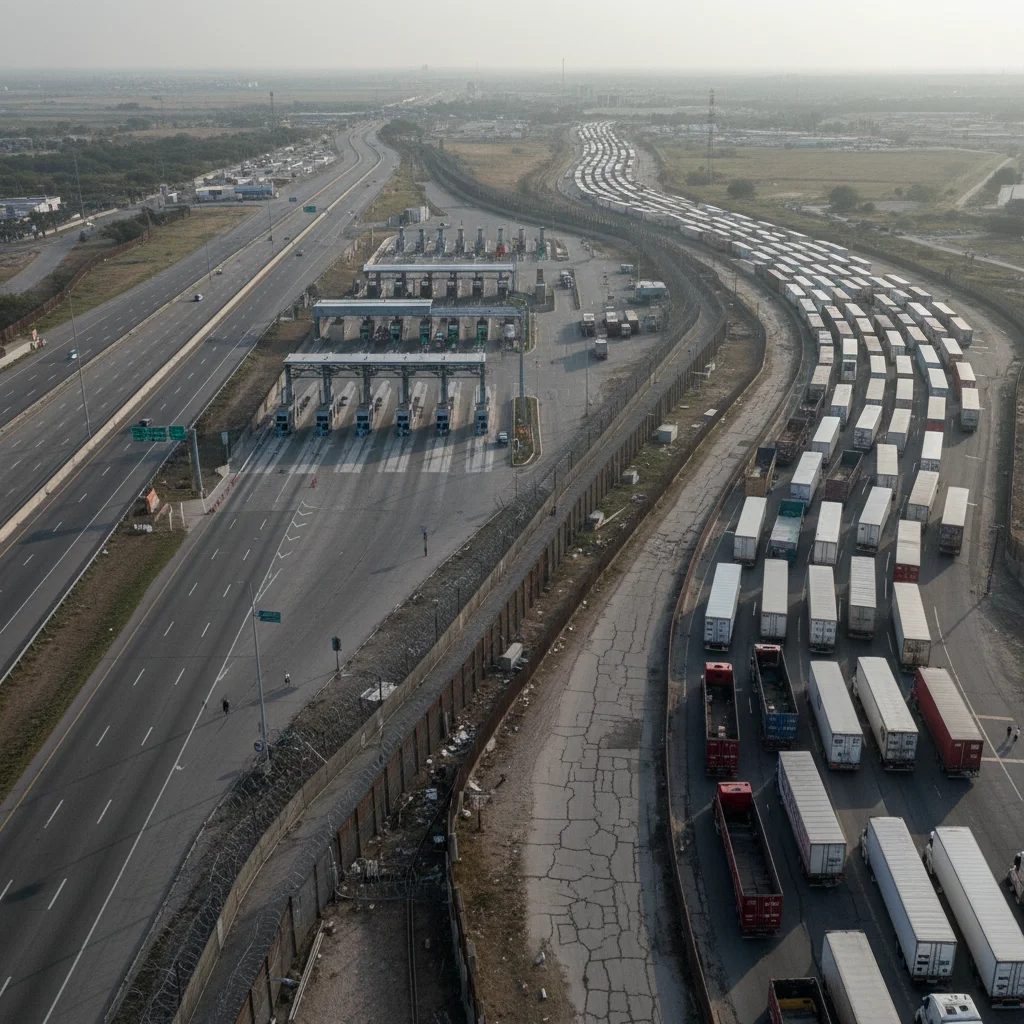
[IMAGE: Aerial view of a busy border crossing between the US and Mexico with a long line of semi-trailer trucks waiting under a hazy sky. Giant metal barriers and customs booths are visible. Contrast of smooth highway behind them and chaotic queue ahead.]
The longer-term structural shift, however, may be the most consequential. As the cost and unpredictability of cross-border trucking rise, manufacturers are increasingly exploring nearshoring and regionalized logistics. Instead of sourcing from China, some are moving production to Mexico or the southern United States to shorten supply chains. But if the U.S.-Mexico border itself becomes an obstacle, even nearshoring loses its appeal. Companies that invested in Mexican factories to serve U.S. markets may now reconsider and relocate production entirely within the United States, reducing the need for cross-border trucking altogether.
---
Conclusion: Navigating a Fractured Landscape
The North American cross-border trucking industry is facing its most turbulent period since the NAFTA era began. Tariff shocks, regulatory friction, and the ambiguity surrounding the 2025 USMCA review are eroding the cost advantages that once made trilateral supply chains a global model. For businesses that depend on cross-border movement—whether they are trucking companies, exporters, or manufacturers—the key to survival is adaptability.
Short-term strategies include diversifying crossing points, consolidating loads, and building tariff-adjustment clauses into contracts. Medium-term strategies may involve investing in compliance software to better navigate rules of origin or shifting to less tariff-sensitive product categories. But the most significant decisions will be strategic: whether to continue investing in cross-border capacity or to pivot toward more localized, domestic supply chains.
The USMCA review in late 2025 offers a potential opportunity to restore predictability, but the political climate suggests no easy path. Until then, cross-border trucking will remain in turmoil, and the supply chains that rely on it must learn to operate in a world where the highway is no longer smooth.
Trade Metrics
Related Datasets
Q4 Cross-Border Logistics Report
PDF • 4.2 MB
Automotive Parts Supply Chain Index
CSV • 1.1 MB