Navigating the US Regulatory Maze: Licensing Requirements for Cross-Border

Emily Rodriguez
Cross-Border Trade Reporter
June 9, 2026
DATELINE: NA TRADE WIRE
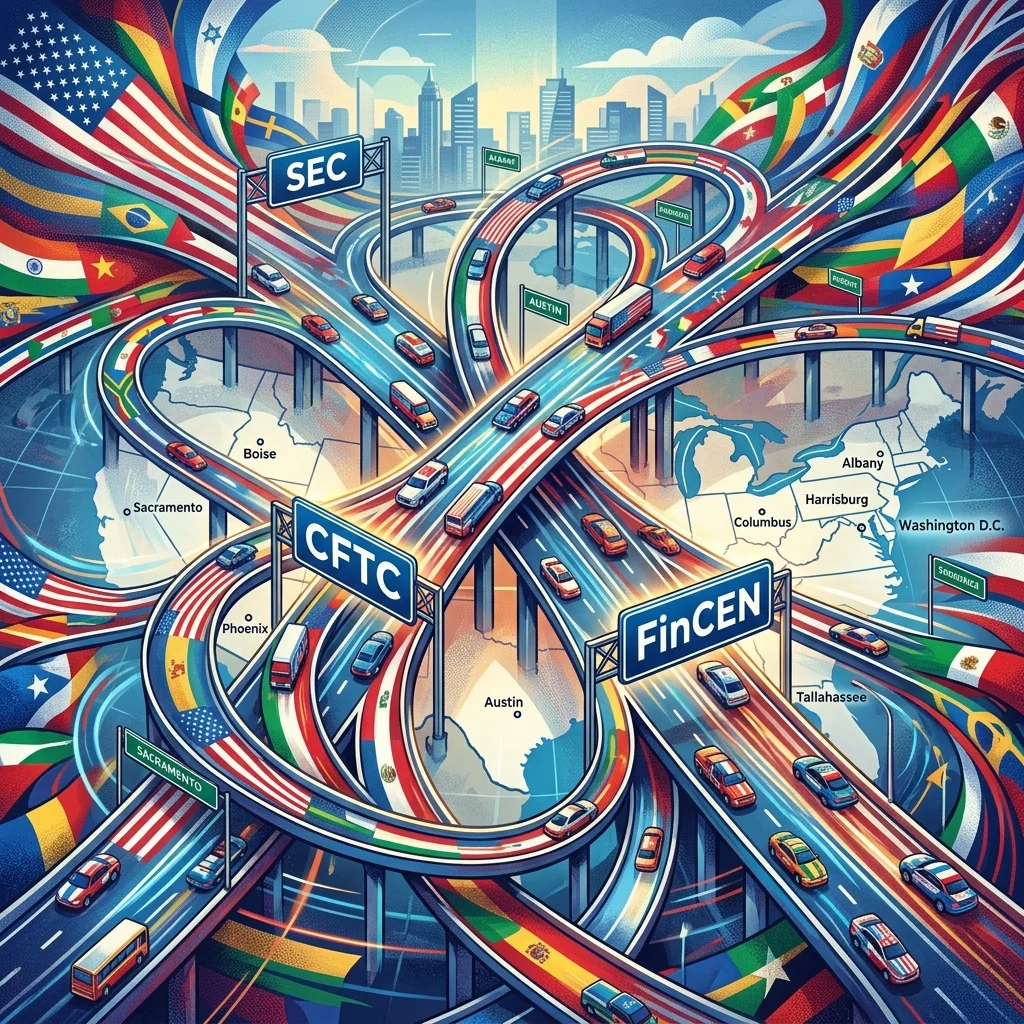
"Expanding into North America means facing a fragmented US regulatory landscape"
Here is the complete, in-depth article based on your outline and requirements. It has been written in a professional yet accessible journalistic style, adhering to the tone of objective analysis.
---
Navigating the US Regulatory Maze: Licensing Requirements for Cross-Border Businesses in North America
Expanding into North America offers immense opportunity, but it also requires crossing a regulatory landscape that is deliberately fragmented. Unlike centralized jurisdictions, the United States operates on a system where federal and state laws overlap, and the definition of "doing business" can extend far beyond physical borders. For foreign firms, understanding this maze is not just about compliance—it is about strategic survival. This article dissects the key licensing requirements for banking, securities, derivatives, insurance, and money transmission, revealing how broad definitions of "US person" and jurisdictional means create hidden traps and strategic opportunities for foreign firms.
[IMAGE: An abstract illustration of a complex highway interchange merging US and foreign flags, with signs labeled 'SEC', 'CFTC', 'FinCEN', and state capitals, overlaid with a faint map of North America.]
The Fragmented Foundation: Why US Cross-Border Licensing Defies a Single Rulebook
The first rule of US cross-border compliance is that there is no single rulebook. The regulatory structure is built on a foundation of overlapping federal statutes and state-level sovereignty, each with its own trigger for jurisdiction.
Banking: The Presence Test
Under US banking laws, a foreign firm generally requires a federal license only if it establishes a physical presence—such as a branch or agency—within the US. Simply servicing US persons from abroad, without a US office or using US-based marketing, often falls outside the licensing requirement for deposit-taking. However, the use of "US jurisdictional means," such as US mail, telephone lines, or electronic networks to solicit business, can blur this line. The Office of the Comptroller of the Currency (OCC) and the Federal Reserve maintain a strict separation between foreign operations and domestic banking.
The State Patchwork
In contrast, state regulation dominates mortgage lending, insurance, and money transmission. This creates a patchwork of over 50 distinct regimes (50 states plus territories). A foreign business offering a simple payment service or credit product must often register in every state where it has a customer, even if it has no physical office there.
The Hidden Economic Logic
This fragmentation is not an accident; it is a deliberate feature of the US system. By raising the cost of entry through multi-state compliance, the US protects domestic incumbents. It forces foreign entrants to either invest heavily in compliance infrastructure or structure their operations to stay within narrow exemptions. The strategic opportunity lies in understanding which regulatory "gates" must be opened and which can be bypassed through careful operational structuring—for example, servicing clients entirely from a non-US entity that avoids using US jurisdictional means for solicitation.
[IMAGE: A stylized map of the US where each state is a different color, with small icons representing regulatory bodies (SEC, CFTC, state insurance departments) scattered across the landscape.]
Securities and Broker-Dealer Activities: The SEC’s Expansive Reach
The Securities and Exchange Commission (SEC) casts a very wide net. Any non-US person acting as a broker or dealer with respect to US persons or US securities may need SEC registration. The critical trigger is the use of "US jurisdictional means"—specifically, any instrumentality of interstate commerce, including emails, phone calls, or websites that target US investors.
The Registration Trigger
Even if a foreign firm has no US office, soliciting a US client via a website or sending a trade confirmation email can be enough to create a registration requirement. The SEC’s position is clear: if you use US communication channels to effect a transaction with a US person, you are likely acting as an unregistered broker-dealer.
Exemptions and the "US Person" Trap
Exemptions exist, most notably the "safe harbor" for foreign brokers that effect transactions through a US-registered broker-dealer. However, this requires strict adherence. The foreign broker cannot solicit the US client directly; the US broker must do the heavy lifting.
The critical insight for foreign firms is the SEC’s expansive definition of "US person." This includes not just US residents, but also entities organized in the US or entities with a principal place of business in the US. A foreign fund with a US manager could be deemed a "US person" for certain purposes. Furthermore, even exempt firms remain subject to the SEC’s anti-fraud authority. If a foreign broker engages in conduct that has a "substantial effect" in the US, the SEC can and will take enforcement action. This creates a hidden trap: a firm may believe it is exempt, but a single solicitation to a US client can bring it under the full weight of US securities law.
[IMAGE: An illustration of a globe with a magnifying glass over the United States, showing digital signals and email symbols crossing the border, representing the use of "US jurisdictional means."]
Derivatives and Swaps: Dodd-Frank’s Cross-Border Web
The Dodd-Frank Act extended US swaps regulation to activities with a "direct and significant connection" to US commerce or that are designed to evade CFTC rules. The CFTC’s Cross-Border Rule and its Interpretive Guidance are notoriously complex, defining "US person" so broadly that it captures many foreign entities.
The "Conduit Affiliate" Trap
The CFTC’s definition goes beyond geography. It covers entities with a US principal place of business, majority US ownership, and—most critically—"conduit affiliates." These are foreign entities that are set up to allow US persons to avoid regulatory obligations. The Guidance warns that its prongs are not exhaustive, giving the CFTC discretion to reclassify a firm based on its economic substance. For example, a swap dealer based in London that is majority-owned by a US bank will likely be treated as a US person for compliance purposes.
The Dual Regime Problem
Adding to the complexity, the SEC maintains a separate regime for security-based swaps. A foreign firm dealing in interest rate swaps (CFTC jurisdiction) and credit default swaps on single-name US securities (SEC jurisdiction) must analyze its risks under two different rulebooks. The cost of compliance is high, but the cost of non-compliance—including disgorgement of profits and civil penalties—is far higher. The strategic takeaway is that foreign firms must proactively map their swap activities against both the CFTC and SEC definitions, rather than assuming they are "foreign" and therefore exempt.
Investment Advisers and Futures: Registration Triggers and Exemptions
Foreign investment advisers face a more nuanced set of rules, governed primarily by the Investment Advisers Act of 1940. Unlike broker-dealers, the registration threshold for foreign advisers is typically tied to the number of US clients and the size of assets under management (AUM).
The RIA Threshold
A foreign investment adviser with no place of business in the US generally does not need to register with the SEC if it has fewer than 15 US clients and less than $25 million in AUM attributable to those clients. This is the "foreign private adviser" exemption. However, the definition of "client" can be tricky. A foreign fund that is organized outside the US but marketed to US institutional investors may still trigger obligations.
The "Bad Actor" Trap
The SEC has increasingly targeted foreign advisers who use US jurisdictional means to solicit clients. The agency's "Dirty Fifteen" list of factors for determining whether an adviser has a "place of business" in the US includes, for example, the use of a US mailing address or telephone number. A simple virtual office or a US-based employee who solicits investors can be enough to require full SEC registration.
Commodity Trading Advisors (CTAs)
For firms involved in futures and options, the Commodity Futures Trading Commission (CFTC) and the National Futures Association (NFA) impose additional requirements. A foreign CTA that directs trading for US clients must generally register with the NFA, regardless of where the advisor is located. The key exemption is for advisors who only manage assets for non-US persons and do not solicit US clients. However, the NFA has aggressively pursued foreign firms that fail to register, even when they believe they are operating outside US jurisdiction.
Strategic Insight
The critical lesson for foreign investment advisers and CTAs is that "do not solicit" is a strict, absolute rule. Chatbots, websites that are not geo-filtered, and even passive marketing through US-based third-party marketers can create registration obligations. The safe strategy is to build a "firewall" between the foreign advice and the US client, ideally by using a US-registered investment adviser as a feeder or intermediary. This raises costs, but it eliminates the risk of an SEC or CFTC enforcement action.
[IMAGE: A diagram showing a "firewall" between a foreign-based company and US clients, with labels for "SEC," "CFTC," and "NFA" acting as gatekeepers.]
Insurance and Money Transmission: The State-Level Labyrinth
While federal agencies like the SEC and CFTC dominate securities and derivatives, insurance and money transmission are the domain of the states. For foreign businesses, this means dealing with a regulatory map of 50 states, each with its own licensing exams, bond requirements, and net worth standards.
Insurance Licensing
A foreign insurance company cannot directly underwrite policies for US residents without a license from each state. However, the primary route is through "surplus lines" insurance, where a US-licensed surplus lines broker places the risk with a non-admitted (non-US) carrier. The foreign insurer still must be listed on the "Qualified Insurer" list of the National Association of Insurance Commissioners (NAIC). The key requirement is a trust fund of assets held in the US to guarantee claims. This creates a liquidity cost for foreign insurers, but it is often a more efficient path than obtaining 50 separate state licenses.
Money Transmission (MSB) Licensing
This is arguably the most fragmented compliance burden for any cross-border business. Money transmission—which includes virtual currency exchange, remittances, and payment processing—is defined broadly. Operating a payment service that sends funds from a US person to a foreign beneficiary requires a money transmitter license (MTL) in every state where the sender is located.
The threshold is low. The Financial Crimes Enforcement Network (FinCEN) requires registration as a Money Services Business (MSB) at the federal level, but the state-level licenses are the real hurdle. There is no reciprocity between states. A foreign fintech with 20 US customers in 20 different states must apply separately for 20 licenses, each with its own surety bond, background checks, and compliance regime.
The Economic Logic of Fragmentation
While this appears hostile to foreign entrants, it creates a profitable niche for compliance-as-a-service firms and for US-based "sponsors" who hold the master license. For a foreign firm, the strategic move is often to partner with a US-licensed money transmitter rather than seeking its own licenses. The cost of doing so is a revenue split, but it avoids the multi-year, multi-million dollar process of direct licensing.
Conclusion: Strategy as Compliance
For a foreign firm, navigating the US regulatory maze is not primarily a legal challenge—it is a business strategy challenge. Each regulatory trigger—from the SEC's definition of "US person" to the CFTC's "conduit affiliate" to the state-level MTL regime—represents a choice. A firm can choose to incur the cost of compliance and gain direct access to the US market, or it can structure its operations to stay within exemptions, accepting lower revenue in exchange for lower risk.
The hidden economic logic of the US system is to filter entrants. Only firms with sufficient capital, compliance sophistication, and strategic patience should attempt direct entry. Others should use intermediaries, white-label partners, or non-US client structures. Ultimately, the US market is open for business—but it requires reading the fine print, understanding the jurisdictional triggers, and building a compliance framework that is as agile as the business model itself. The firms that succeed in North America are not those that avoid regulation, but those that master it.
Trade Metrics
Related Datasets
Q4 Cross-Border Logistics Report
PDF • 4.2 MB
Automotive Parts Supply Chain Index
CSV • 1.1 MB