How Chinese E-commerce Giants Are Reshaping North America's Cross-Border Trade

Emily Rodriguez
Cross-Border Trade Reporter
May 19, 2026
DATELINE: NA TRADE WIRE
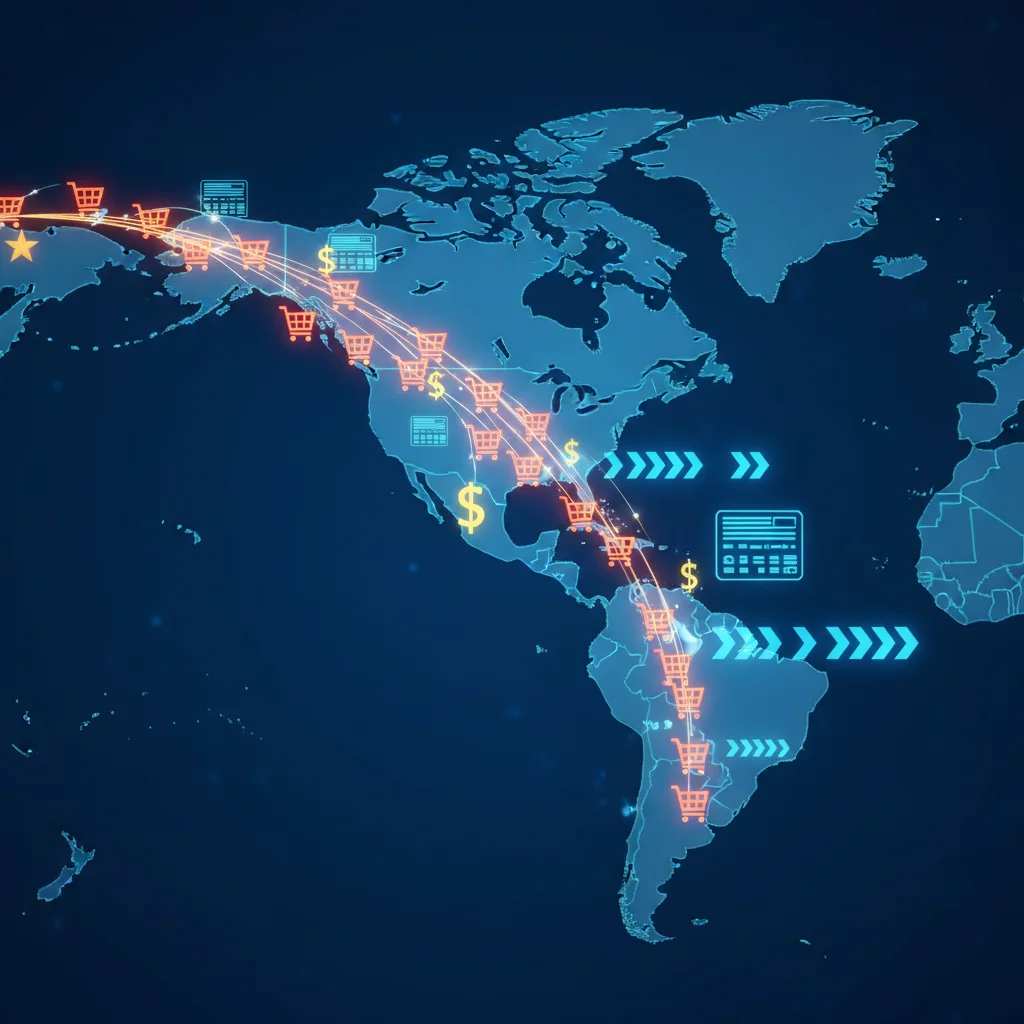
"In 2023, a tipping point emerged in North American cross-border e-commerce:"
How Chinese E-commerce Giants Are Reshaping North America's Cross-Border Trade
Subtitle: In 2023, a tipping point emerged in North American cross-border e-commerce: Mexican consumers bought more goods from China than from the US and Canada combined, while over half of all US foreign e-commerce orders now go to Chinese websites.
---
Introduction: The Silent Takeover of North American E-commerce
The year 2023 will be remembered as a watershed moment for cross-border retail in North America — not because of any new trade agreement or regulatory overhaul, but because of a quiet, data-driven shift in consumer behavior that caught many industry observers off guard. For the first time, Mexican consumers imported more goods from China than from the United States and Canada combined, according to Statista. Simultaneously, in the United States, more than half of all foreign e-commerce orders were placed on Chinese websites — a figure that has more than doubled since 2020.
This is not a story about trade wars or geopolitical maneuvering. It is a story about price sensitivity, supply-chain innovation, and the accelerating impact of platforms like SHEIN and Temu that have turned the cost-of-living crisis into a competitive advantage. As North American retailers struggle to maintain margins, Chinese e-commerce giants are quietly redrawing the map of cross-border business in the region.
[IMAGE: Graph showing growth of Chinese e-commerce share in US and Mexico from 2020 to 2023.]
---
The Data Behind the Shift
The numbers are unequivocal. In 2023, Statista reported that Mexico’s imports from China in the e-commerce segment — spanning consumer electronics, apparel, home goods, and toys — exceeded the combined value of imports from its two North American neighbors. This marked a historic first, reflecting not only China's manufacturing scale but also the aggressive pricing and logistics strategies of its digital retailers.
Meanwhile, in the United States, Chinese e-commerce platforms now account for over 50% of all foreign online orders. To put that in perspective, in 2019 that figure was below 20%. The surge was driven by a confluence of factors: pandemic-era digital adoption that normalized cross-border shopping, inflation that squeezed household budgets, and the emergence of ultra-low-cost platforms that made “fast fashion” and “fast consumer goods” accessible to virtually everyone.
[IMAGE: Map of North America with arrows showing trade flow sizes between China, Mexico, US, and Canada.]
The timeline context is crucial. Between 2020 and 2023, the share of US foreign e-commerce orders going to Chinese websites grew steadily each quarter, with no signs of plateauing. In Mexico, the trend was even sharper, as the country’s large, price-sensitive middle class turned to Chinese apps for everything from clothing to electronics.
---
Why Chinese Platforms Are Winning
The reasons behind this shift are multifaceted, but the core driver is price. SHEIN and Temu have built business models that allow them to offer products at 30–50% lower prices than Amazon, Walmart, or local Mexican retailers. During a period when inflation eroded purchasing power across North America, these platforms became a lifeline for budget-conscious consumers.
Supply-Chain Agility
SHEIN’s on-demand manufacturing model is a case study in efficiency. Instead of producing millions of units in advance and hoping they sell, Chinese factories — many located in Guangdong province — produce small batches based on real-time demand. This reduces inventory risk and allows for rapid trend replication. Temu, owned by Pinduoduo, takes a different approach but achieves similar cost advantages: it aggregates small suppliers and ships directly to consumers using low-cost logistics.
A key enabler is the US de minimis rule, which allows duty-free entry for packages valued under $800. This threshold, originally designed to simplify customs for personal imports, has become a major competitive advantage for Chinese e-commerce. Most Temu and SHEIN orders fall well below $800, meaning they avoid tariffs that domestic retailers must pay on wholesale imports.
UX and Gamification
Beyond price, Chinese platforms have engineered addictive shopping experiences. Temu’s app uses gamification — flash sales, referral bonuses, and “spin-to-win” mechanics — to drive engagement and repeat purchases. SHEIN’s algorithm pushes new styles daily, creating a sense of urgency and novelty that traditional retailers struggle to match. The result is a user experience that feels less like browsing and more like playing a game where the reward is a bargain.
[IMAGE: Side-by-side comparison of average item prices on Temu vs. Amazon and Walmart.]
---
Impact on North American Retailers and Supply Chains
The rise of Chinese e-commerce is not just a consumer trend — it is reshaping the competitive landscape for North American retailers, manufacturers, and logistics providers.
Traditional Retailers Under Pressure
Walmart and Amazon have responded by launching their own ultra-low-cost lines. Amazon’s “Haul” store, introduced in late 2023, directly competes with Temu by offering items under $20 with intentionally slow shipping to mimic the delivery times of Chinese imports. Yet these efforts have been reactive rather than transformative. Margins are razor-thin, and domestic retailers cannot match the production costs of Chinese suppliers without sacrificing quality or profitability.
Small and medium-sized businesses in the US and Mexico are the most vulnerable. Local boutiques, specialty shops, and even regional e-commerce platforms are losing market share to Chinese direct-to-consumer flows. A Mexican artisan who once sold handmade goods on Mercado Libre now competes with a $3.99 Temu version of the same product made in a Chinese factory.
Mexico’s Mixed Position
Mexico’s manufacturing sector presents a paradox. On one hand, Chinese goods flowing through Mexico — often via logistics hubs in Lázaro Cárdenas or Manzanillo — can benefit local distributors and warehouses. On the other hand, Chinese e-commerce increasingly bypasses Mexican intermediaries entirely, shipping directly to consumers. This undermines the logic of nearshoring, which was supposed to boost Mexican production and employment.
The USMCA trade framework, designed to encourage regional supply chains within North America, is being tested. If consumers in Mexico and the US continue to prefer direct Chinese imports, the “Buy North America” incentives embedded in USMCA may lose their relevance.
[IMAGE: Infographic showing erosion of US domestic e-commerce market share by Chinese platforms.]
---
Policy and Regulatory Implications
As the data becomes undeniable, policymakers in Washington, Mexico City, and Ottawa are beginning to take notice. Several regulatory flashpoints could reshape the future of cross-border business.
The De Minimis Debate
The US de minimis exemption — currently $800 — is under serious scrutiny. Lawmakers from both parties have proposed lowering the threshold to $100 or even eliminating it for certain types of goods. Such a change would directly impact Temu and SHEIN, whose business models rely on duty-free small packages. If implemented, it could raise costs for consumers by 10–20% on many items, potentially slowing growth.
Mexico’s Trade Alignment
Mexico is also reevaluating its posture. In 2024, the Mexican government raised tariffs on steel, aluminum, and textiles from China, signaling a willingness to protect domestic industries. If Chinese e-commerce continues to surge, Mexico may impose broader restrictions or tighten customs enforcement for low-value imports. This could strain the USMCA spirit of free trade within North America, as Mexico might face pressure from the US to align on China-related trade measures.
Data Privacy and Product Safety
Beyond tariffs, regulators are focusing on data privacy and product safety. Temu and SHEIN have faced lawsuits in the US over alleged data collection practices and patent infringement. The European Union has already imposed stricter rules on Chinese e-commerce platforms under the Digital Services Act. Similar actions in North America could introduce compliance costs that eat into the price advantage.
[IMAGE: Document with stamps 'Tariff Review' and 'De Minimis Reform' on a map of North America.]
---
Future Outlook: Continued Growth or Backlash?
Looking ahead, the trajectory of Chinese e-commerce in North America is not a straight line. Short-term demand for cheap goods will likely remain strong, especially if inflation persists or economic uncertainty grows. Temu has already expanded into Canada and is testing Mexico further, targeting a combined market of over 500 million consumers. SHEIN continues to add local distribution centers in the US to shorten delivery times.
However, the regulatory landscape is shifting. The US de minimis reform is a genuine threat, and if passed, it could slow but not stop the Chinese platforms — they may respond by opening local warehouses and fulfilling orders from US inventory, which would erode their cost advantage but preserve their market presence.
Longer-term, the wildcard is consumer sentiment. Geopolitical tensions between the US and China could spill over into boycotts or preference shifts, as seen with some Western brands in China. But so far, price has trumped politics for most North American shoppers.
A New Normal for Cross-Border Business
What is clear is that the North American cross-border business landscape has been permanently altered. The era when US and Mexican retailers could rely on geographic proximity and trade agreements to dominate local e-commerce is over. Chinese platforms have built a parallel supply chain that delivers cheap goods directly to consumers, bypassing traditional wholesale and retail channels.
For policymakers, the challenge is to balance consumer benefits — lower prices, wider choice — with the protection of domestic industry and labor standards. For retailers, the imperative is to innovate on logistics, product differentiation, and customer experience rather than trying to win a race to the bottom on price.
One thing is certain: the silent takeover is no longer silent. The data is in, and the conversation about cross-border trade in North America has just begun.
---
This article was written based on data from Statista, US Customs and Border Protection, and industry reports. All statistics cited are publicly available as of 2024.
Trade Metrics
Related Datasets
Q4 Cross-Border Logistics Report
PDF • 4.2 MB
Automotive Parts Supply Chain Index
CSV • 1.1 MB