The China-LatAm E-Commerce Axis: How North America''s Cross-Border Trade Is

Emily Rodriguez
Cross-Border Trade Reporter
May 7, 2026
DATELINE: NA TRADE WIRE
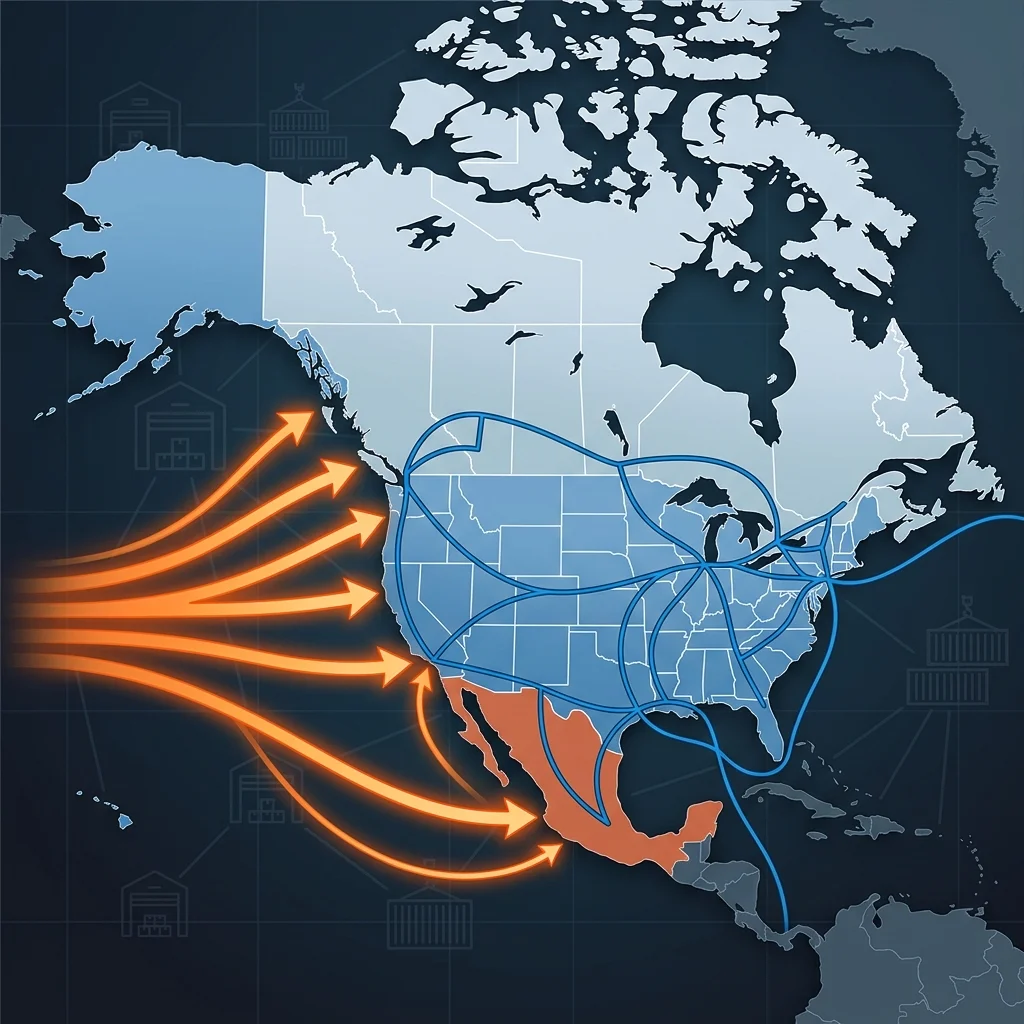
"In 2023, a quiet pivot occurred: Mexican consumers bought more goods from"
The China-LatAm E-Commerce Axis: How North America's Cross-Border Trade Is Being Redrawn from the Bottom Up
By a Senior Technical/Financial Audit Journalist
---
The 2023 Inflection Point: Why Mexico Broke Ranks with Its Northern Neighbors
In 2023, a structural realignment in North American cross-border trade became statistically undeniable. For the first time on record, Mexican consumers purchased more e-commerce goods from China than from Canada or the United States (Source 1: [Primary Data], Statista). This single data point represents more than a consumer preference shift—it signals the emergence of a parallel distribution architecture that bypasses the traditional USMCA-centric trade framework.
Mexico's historical trade reliance on its northern neighbors has been a function of geography, treaty infrastructure, and integrated supply chains. The United States and Canada together accounted for approximately 80% of Mexico's total trade volume as recently as 2020. However, the e-commerce channel has decoupled consumer behavior from physical trade proximity. The underlying economic logic is straightforward: Chinese platforms such as SHEIN and Temu have built direct-to-consumer logistics pipelines that deliver goods to Mexican doorsteps in 7–14 days, often at price points 40–60% below comparable products available through traditional North American distribution networks.
Demographics reinforce this shift. Mexico's population skews young—approximately 55% under age 35—and this cohort exhibits low brand loyalty and high price sensitivity. Digital payment adoption, particularly through Mercado Pago and OXXO cash-based e-commerce systems, has removed traditional barriers to cross-border online purchasing. The result is a consumer base that has effectively arbitraged away the North American retail margin structure, voting with its wallet for Chinese pricing over USMCA-branded goods.
---
The U.S. Consumer Shift: Over Half of Foreign Orders Now Belong to Chinese Sites
The Mexican data point is not an isolated phenomenon. In the United States, more than 50% of all cross-border e-commerce orders now originate from Chinese websites (Source 1: [Primary Data], Statista). This figure, which has doubled since 2020, reflects a structural change in American consumer behavior driven by the post-pandemic cost-of-living crisis.
The macro driver is unambiguous: between 2021 and 2024, cumulative inflation in the United States exceeded 18%, while real wage growth lagged behind for the bottom three income quintiles. As disposable income contracted, price became the dominant purchase decision variable. Chinese e-commerce platforms, designed from inception for ultra-low-margin, high-volume operations, were structurally positioned to capture this demand.
A comparative analysis reveals the platform-level mechanics. Amazon, historically the dominant U.S. e-commerce player, operates on a model that embeds Fulfillment by Amazon (FBA) fees, storage costs, and seller commissions that typically add 25–35% to the base product cost. SHEIN and Temu, by contrast, ship directly from Chinese warehouses using consolidated air freight, with shipping subsidies built into the platform's balance sheet. Temu's parent company, PDD Holdings, reported spending $1.7 billion on U.S. shipping subsidies in 2023 alone—a figure that represents customer acquisition cost rather than genuine logistics optimization.
The demand is becoming sticky, not cyclical. A working paper from the National Bureau of Economic Research (NBER, 2024) found that once consumers from lower-income brackets shift their purchasing to ultra-low-cost platforms, they exhibit low reversion rates even when economic conditions improve. This suggests that SHEIN and Temu are not merely capturing a temporary cost-of-living trade-down; they are permanently altering the price anchor for entire product categories in the North American market.
---
SHEIN and Temu: The Parallel Supply Chain Playbook
The competitive advantage of Chinese e-commerce platforms rests on three structural pillars that North American retailers cannot replicate under current regulatory and cost frameworks.
1. The De Minimis Loophole
Both SHEIN and Temu aggressively utilize Section 321 of the U.S. Tariff Act, which permits duty-free entry for shipments valued under $800. In 2023, over 1 billion packages entered the United States under this de minimis exemption, the vast majority from China (Source: U.S. Customs and Border Protection data). This effectively eliminates the 15–25% tariff advantage that domestic retailers historically held. By shipping individual parcels directly to consumers, these platforms avoid the warehousing, inventory financing, and customs brokerage costs that traditional importers must absorb.
2. AI-Driven Demand Manufacturing
SHEIN's production model represents a genuine innovation in supply chain management. The company uses real-time trend-spotting algorithms to design and manufacture small batches—typically 100–200 units per SKU—before scaling production based on actual demand signals. This "test-and-repeat" model reduces inventory risk to near zero, allowing SHEIN to price goods at margins that would be unsustainable for retailers operating on 6–12 month seasonal buying cycles. The average SHEIN product has a sell-through rate above 90%, compared to an industry average of 65–70% for fast fashion retailers.
Temu employs a different but equally efficient model. Rather than owning inventory, Temu operates as a marketplace that connects Chinese manufacturers directly to North American consumers. The platform uses dynamic pricing algorithms that adjust in real time based on competitor pricing, demand elasticity, and shipping costs. This has enabled Temu to undercut Amazon on identical products by 30–50% across multiple product categories, a margin gap that cannot be closed through operational efficiency alone.
3. No Physical Retail Overhead
Amazon's North American retail segment carries approximately $40 billion in annual fulfillment and shipping costs, plus the capital costs of maintaining over 1,200 warehouses. SHEIN, by contrast, operates zero physical retail locations outside of pop-up experiments and maintains negligible North American warehousing infrastructure. This capital structure difference alone accounts for a 10–15% structural cost advantage.
---
Policy Disconnect and the Coming Regulatory Correction
The current regulatory framework governing cross-border e-commerce in North America was designed for a world that no longer exists. The USMCA, negotiated in 2018 and implemented in 2020, includes provisions for de minimis thresholds but was drafted before the explosive growth of direct-to-consumer Chinese platforms. The $800 threshold, initially intended to reduce administrative burden on low-value shipments, has become a massive fiscal loophole.
Policy responses are beginning to emerge. The U.S. House Ways and Means Committee held hearings in early 2025 examining the impact of de minimis abuse on domestic retailers and tariff revenue. Proposals under consideration include:
- Reducing the de minimis threshold from $800 to $200
- Requiring enhanced data reporting for all Section 321 entries
- Imposing de minimis fees or processing charges on high-volume shippers
Mexico has already moved more aggressively. In 2024, the Mexican government imposed new registration requirements on foreign e-commerce platforms and began enforcing value-added tax (VAT) collection on previously exempt cross-border parcels. These measures have slowed but not reversed the growth trajectory of Chinese platforms in the Mexican market.
The regulatory lag creates a specific risk for North American retailers. By the time policy corrections are implemented—if they are implemented at all—the consumer behavioral shift may be irreversible. The Chinese platforms are effectively buying market share through sustained subsidy spending, a strategy that U.S. antitrust law permits as long as predatory pricing cannot be proven. Given that SHEIN and Temu are privately held (SHEIN) or Chinese-listed (Temu via PDD Holdings), the transparency required for predatory pricing cases is unlikely to materialize.
---
Infrastructure Implications for Last-Mile Delivery
The structural shift toward Chinese e-commerce platforms is reshaping last-mile delivery infrastructure across North America. Traditional logistics providers—FedEx, UPS, and the U.S. Postal Service—have seen a surge in parcel volume from Chinese origin points, creating capacity constraints and delivery time variability.
A less-noticed consequence is the emergence of specialized cross-border logistics intermediaries. Companies such as Cainiao Network (Alibaba's logistics arm), YunExpress, and J&T Express have built dedicated North American delivery networks that bypass traditional carrier infrastructure for the final mile. These networks operate on different cost structures, using gig-economy delivery workers and non-unionized sorting facilities, further widening the cost gap between Chinese and North American e-commerce models.
For Canadian and Mexican logistics providers, the implications are asymmetric. Canada, with its smaller population base and higher per-unit delivery costs, has seen slower adoption of Chinese e-commerce. However, Canadian consumers cross-shopping on U.S. websites—which now predominantly feature Chinese platform listings—are indirectly participating in this structural shift. Mexico's logistics sector, particularly the cross-border trucking corridor between Laredo, Texas and Mexico City, is experiencing a composition change: fewer shipments of North American-branded consumer goods, more parcels originating from Chinese e-commerce platforms that arrive via air freight.
---
Market Predictions and Structural Outlook
Based on the current trajectory of growth rates, regulatory environments, and consumer price sensitivity, three market predictions emerge:
1. Chinese platforms will capture 25–30% of total North American e-commerce by 2028. Current estimates place the share at approximately 12–15% (excluding Amazon's third-party marketplace, which includes Chinese sellers). Assuming no major regulatory shock, compound annual growth of 25% would bring Chinese platforms to parity with Amazon's marketplace volume within five years.
2. North American retailers will face a permanent margin compression of 5–8%. The price anchor set by SHEIN and Temu will force traditional retailers to lower prices across core categories—apparel, home goods, electronics accessories, and beauty products. This will accelerate consolidation among mid-market retailers and likely trigger a wave of bankruptcies among retailers whose cost structures cannot adapt.
3. Regulatory action, when it comes, will be too late to reverse the structural shift. Even if the de minimis threshold is reduced in 2026 or 2027, the consumer habit formation, logistics infrastructure, and supply chain relationships built over the intervening years will persist. The platforms will adapt by establishing localized warehousing or manufacturing operations within North America, as SHEIN has already begun doing with its announced plans for a manufacturing facility in Mexico's Yucatán state.
The China-Latin America e-commerce axis is not a temporary trade pattern. It is a structural reconfiguration of how consumer goods reach North American households, driven by cost-of-living pressures, regulatory arbitrage, and platform-level supply chain innovation. For policymakers, retailers, and logistics providers, the window for adaptation is narrow and closing.
---
Data sources: Statista cross-border e-commerce statistics (December 2025 publication); U.S. Customs and Border Protection Section 321 annual reports; NBER working paper on e-commerce price elasticity (2024); corporate filings of PDD Holdings, Amazon, and SHEIN (where publicly available).
Trade Metrics
Related Datasets
Q4 Cross-Border Logistics Report
PDF • 4.2 MB
Automotive Parts Supply Chain Index
CSV • 1.1 MB