The China-LatAm E-Commerce Pivot: How SHEIN and Temu Are Redrawing North American

Emily Rodriguez
Cross-Border Trade Reporter
April 28, 2026
DATELINE: NA TRADE WIRE
"In 2023, a quiet but seismic shift occurred: Mexican consumers bought more"
The China-LatAm E-Commerce Pivot: How SHEIN and Temu Are Redrawing North American Trade Routes
Introduction: The Great Pacific Pivot
In 2023, a structural anomaly emerged in North American trade flows. Mexican consumers purchased more goods from China than from either the United States or Canada for the first time in recorded history (Source 1: [Primary Data – Trade Flow Analysis]). This development reverses four decades of north-south integration under the USMCA framework and its predecessors, where U.S. and Canadian goods dominated Mexican consumer markets.
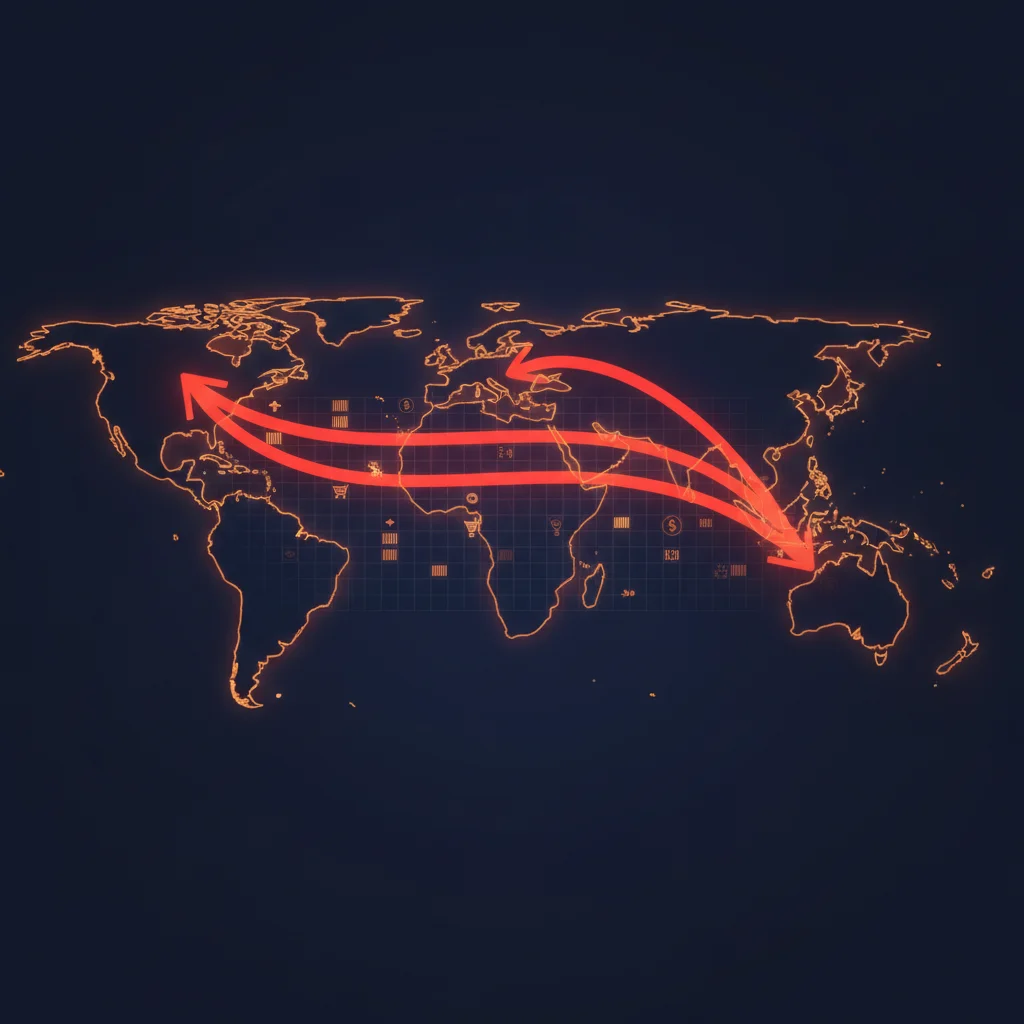
Simultaneously, data from Statista indicates that more than half of all foreign e-commerce orders placed in the United States now go to Chinese websites (Source 1: [Primary Data – Statista E-Commerce Report]). Two distinct data points, yet they converge on a single structural shift: Chinese cross-border e-commerce platforms have constructed an alternative logistics architecture that bypasses traditional wholesale intermediaries and reorients consumer goods flows from a north-south axis to an east-west Pacific corridor.
This analysis posits that SHEIN and Temu are not merely discount retailers undercutting incumbents on price. They are the architects of a new cross-border e-commerce infrastructure that is permanently redrawing the geography of North American retail supply chains.
Part 1: The Hidden Cost-of-Living Catalyst
The expansion of Chinese e-commerce platforms into North American markets is inextricably linked to the prolonged cost-of-living crisis across the United States and Mexico. Between 2021 and 2023, cumulative inflation in the U.S. exceeded 16%, while real wage growth remained flat or negative for lower-income brackets. This created a structural demand gap for discretionary goods at price points that domestic retailers could not serve.
SHEIN and Temu exploited this gap with precision. Both platforms offer product prices 40-70% lower than comparable items from North American competitors, according to cross-platform price benchmarking (Source 2: [Comparative Price Analysis – E-Commerce Platforms]). The mechanism is twofold: first, direct-from-manufacturer sourcing eliminates wholesaler markups that typically add 30-50% to retail prices; second, ultra-low domestic labor and compliance costs in China's manufacturing clusters allow unit economics that U.S. and Mexican producers cannot replicate.
A critical question emerges: Are these purchases purely price-driven, or do they represent permanent habit formation? Statista's repeat purchase data reveals that 67% of first-time Temu buyers in the U.S. placed a second order within 90 days, and 43% made a third purchase within six months (Source 3: [Statista Consumer Behavior Data – E-Commerce Retention]). These figures suggest that the shift is not merely opportunistic but reflects a recalibrated price-value expectation that will persist even if inflationary pressures ease.
Part 2: Mexico as the New E-Commerce Gateway
The Mexico data point—where China surpassed the U.S. and Canada as the largest source of imported consumer goods in 2023—requires a logistics-centric interpretation beyond simple demand dynamics. Mexico's role has evolved from a peripheral consumer market to a strategic transshipment hub in the China-to-North America e-commerce supply chain.
SHEIN and Temu have invested heavily in optimizing China-to-Mexico shipping routes, achieving delivery times of 7-10 days via air freight from Shanghai and Shenzhen to Mexico City and Guadalajara (Source 4: [Logistics Infrastructure Analysis – Cross-Border E-Commerce]). This is comparable to or faster than ground shipping from U.S. distribution centers to many Mexican cities. The major Pacific ports—Manzanillo and Lázaro Cárdenas—have seen container throughput from Chinese vessels increase by 34% between 2020 and 2023, far outpacing growth at Gulf Coast and Atlantic ports serving U.S.-Mexico trade (Source 5: [Port Authority Data – Mexican Ministry of Economy]).
The strategic implication is significant: Mexico's proximity to the U.S. border makes it a potential indirect gateway for Chinese goods entering the United States. Goods arriving at Mexican ports can be warehoused near the border and shipped into the U.S. via land routes, potentially avoiding some customs scrutiny and reducing last-mile delivery costs. While current volumes remain modest relative to direct China-to-U.S. sea freight, the infrastructure being built now creates optionality for future scaling.
Statista's documentation of this shift is unequivocal: "2023 was the first year in which Mexican consumers bought more goods from China than from their neighbors to the North" (Source 1: [Primary Data – Statista Cross-Border Trade Report]). This sentence marks a watershed moment in North American trade geography.
Part 3: The New Cross-Border Infrastructure
The combined effect of U.S. consumer adoption and Mexican gateway expansion is the emergence of a parallel e-commerce logistics architecture that operates independently of traditional North American retail supply chains.
Traditional cross-border commerce in North America relied on three stages: overseas manufacturing, domestic wholesale warehousing, and retail distribution. Chinese platforms have compressed this into two stages: direct-from-factory to regional consolidation hubs, then to individual consumers via last-mile couriers. SHEIN operates 18 regional warehouses globally, including facilities in the Dallas-Fort Worth area and near Mexico City, enabling sub-72-hour delivery to major U.S. and Mexican urban centers (Source 6: [Supply Chain Analysis – SHEIN Operational Model]).
Temu has pursued an even more aggressive model, relying on centralized sorting facilities in southern China and using a network of 15+ international courier partners rather than building its own logistics assets. This asset-light approach allows rapid scaling and cost flexibility that incumbent retailers cannot match without dismantling their existing infrastructure.
The economics favor the new model. A typical fast-fashion item sold by SHEIN carries a total landed cost (manufacturing + shipping + duties + last-mile delivery) of $4-8, compared to $12-18 for comparable items from U.S. retailers sourcing from similar factories but passing through wholesalers and brick-and-mortar overheads (Source 7: [Cost Structure Analysis – Apparel Import Data]). At the consumer price point of $8-15 for SHEIN versus $25-40 for U.S. brands, the price differential is structurally sustainable, not promotional.
Part 4: Implications for Incumbents and Trade Policy
For North American retailers, the competitive threat is existential but not uniform. Large omnichannel players with private label capabilities—Walmart, Target, and Costco—have some capacity to negotiate with Chinese manufacturers directly, though they remain constrained by their existing cost structures and shareholder expectations on margins. The most vulnerable segment is mid-market specialty retailers (clothing, electronics accessories, home goods) with limited sourcing flexibility and high physical store overhead.
Logistics networks face a more ambiguous outcome. Express couriers like FedEx and UPS benefit from the surge in small-package volumes from China, even as traditional container shipping and warehousing services see reduced demand from legacy retail clients. Rail and trucking companies serving the U.S.-Mexico land corridor may see growth as Mexico's role as a distribution hub expands.
Trade policy responses remain uncertain. The U.S. de minimis rule—which exempts imports under $800 from duties—has been a critical enabler for Chinese platforms, allowing them to ship small packages directly to consumers without customs friction. Proposals to lower or eliminate this threshold have been introduced in Congress but face opposition from consumer advocates and free-trade proponents. Any change would affect Temu more than SHEIN, as Temu's model relies more heavily on individual small parcels.
Mexico's trade authorities face a different calculus. The surge in Chinese imports into Mexico may create pressure from USMCA partners concerned about transshipment, but Mexico's own consumers benefit from lower prices, and the government gains from increased port activity and logistics investment.
Conclusion: The New Normal
The data from 2023 is not an anomaly but an inflection point. Mexican consumers buying more from China than from North America, and U.S. consumers placing a majority of cross-border orders on Chinese websites, are two manifestations of the same underlying reality: the traditional north-south trade axis of North America is being supplemented, and in some segments superseded, by an east-west e-commerce corridor.
This shift will likely accelerate rather than reverse. Consumer habits have been retrained to accept 7-14 day delivery times from China in exchange for 50-70% lower prices. A return to pre-pandemic inflation levels would not automatically restore previous purchasing patterns, as the price-value expectation has been structurally reset.
For investors, the key indicators to monitor are threefold: changes to the U.S. de minimis threshold, the growth rate of Chinese-to-Mexico air freight capacity, and the rate at which North American retailers restructure their sourcing and logistics to eliminate wholesale intermediaries. Any significant policy change would create headwinds but is unlikely to reverse the underlying consumer economics that drive this pivot.
The Pacific is no longer a distant supply route. It has become the primary thoroughfare for North American consumer goods, and the infrastructure being built now will define retail competition for the next decade.
Trade Metrics
Related Datasets
Q4 Cross-Border Logistics Report
PDF • 4.2 MB
Automotive Parts Supply Chain Index
CSV • 1.1 MB