Beyond Warehouses: How Strategic Moves in Canada''s Logistics Sector Signal

Emily Rodriguez
Cross-Border Trade Reporter
April 13, 2026
DATELINE: NA TRADE WIRE
"Recent announcements from major logistics players like Lineage Logistics,"
Beyond Warehouses: How Strategic Moves in Canada's Logistics Sector Signal a Supply Chain Reconfiguration
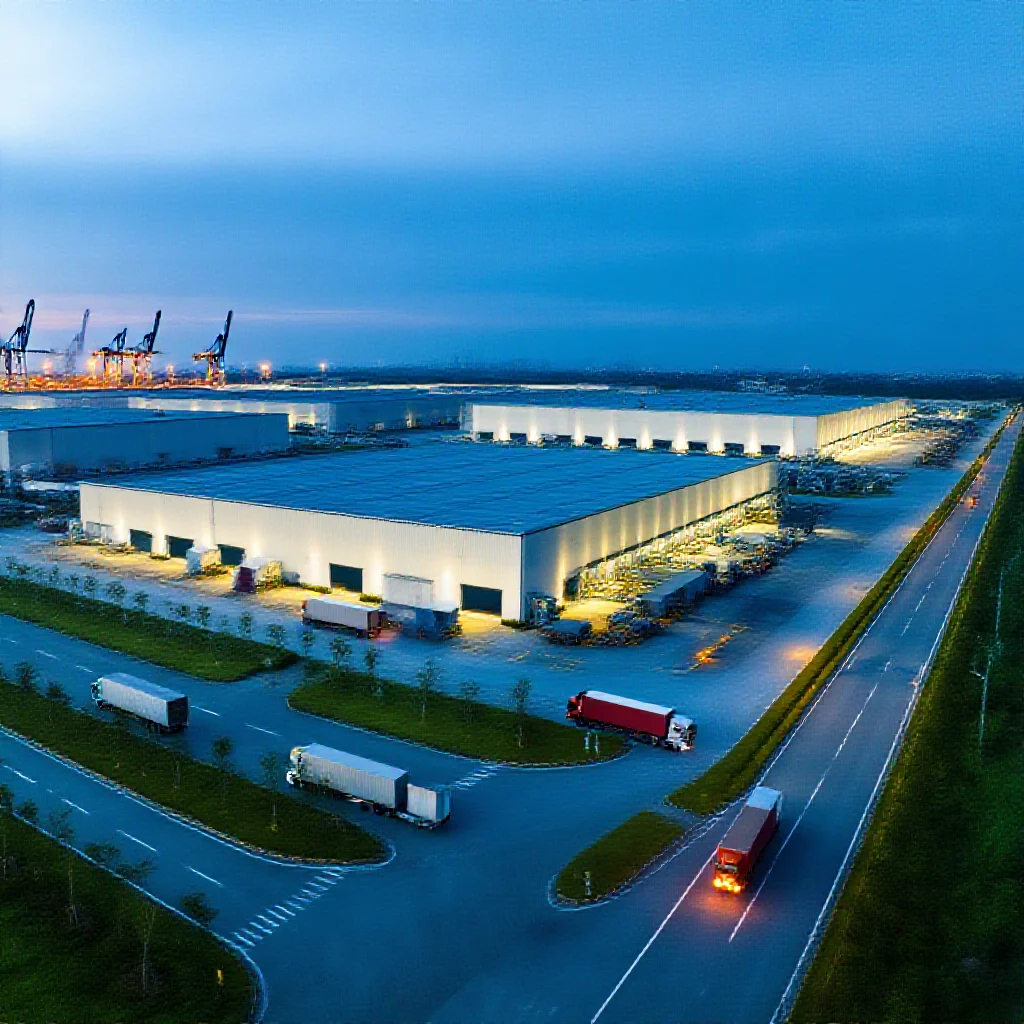
An aerial view of a modern logistics facility, representing the scale and technological integration of recent Canadian infrastructure investments.
Introduction: Decoding the Flurry of Canadian Logistics News
Recent announcements from major logistics firms represent a coordinated strategic shift rather than isolated expansion events. Lineage Logistics has commissioned a 200,000-square-foot automated freezer facility in Calgary and a 140,000-square-foot facility in Montreal. NFI Industries has completed the acquisition of the drayage and transloading operations of J&R Hall Logistics in Vancouver. Concurrently, Mullen Group has launched a new drayage service, Mullen Drayage, in Southern Ontario. The geographic and operational diversity of these moves indicates a broader industry reconfiguration. The underlying thesis is a sector-wide pivot from passive storage provision to active control of integrated, technology-enabled logistics networks, fundamentally reshaping North American goods flow.
!A map of Canada with icons marking Calgary, Montreal, Vancouver, and Southern Ontario.
The Strategic Axis: Controlling the Critical Nodes in a Volatile World
The geographic targeting of these investments reveals a calculated approach to securing control over critical supply chain nodes. Calgary serves as a key agricultural and energy hub, while Montreal is a primary Eastern gateway for transatlantic trade. Vancouver is the indispensable Asia-Pacific portal for North America. The selection of these locations is not coincidental but strategic, aiming to dominate flow at continental entry and distribution points.
The economic logic behind automation, as demonstrated by Lineage Logistics’ facilities, centers on reducing operational dependency on volatile labor markets and enhancing throughput predictability. Automated storage and retrieval systems (AS/RS) in freezer applications ensure consistent temperature control and faster handling, directly addressing shipper demands for reliability in the cold chain. This technological investment mitigates risk and creates a competitive moat based on efficiency and scale.
Vertical integration is a parallel strategy. NFI Industries’ acquisition of J&R Hall’s drayage operations moves the company physically and operationally closer to the Port of Vancouver, a known bottleneck. By internalizing a segment historically managed by third-party carriers, NFI gains direct control over a critical link between the port and its distribution network, reducing exposure to external capacity constraints and scheduling uncertainties.
!An infographic-style diagram showing a container's journey from ship to final warehouse.
The Deep Entry Point: Drayage as the New Strategic Battleground
The focus on drayage—the short-haul movement of containers from ports to nearby rail yards or warehouses—by both NFI and Mullen Group signals its emergence as a strategic battleground. Chronic port congestion at major Canadian gateways like Vancouver and Toronto has elevated the importance of reliable, controlled drayage services. (Source 1: [Industry Analysis on Port Congestion]) Mullen Group’s launch of a dedicated drayage division in Ontario is a direct response to this systemic friction.
The long-term competitive impact is significant. Companies that control drayage assets and operations gain substantial pricing power and schedule certainty. More importantly, they can offer shippers a seamless, integrated "port-to-rack" solution. This disintermediates smaller, independent drayage operators and allows integrated logistics providers to capture more value per shipment by bundling services. Controlling the "first mile" from the port becomes a lever to secure the entire long-haul transportation and warehousing contract.
!A ground-level photo of a busy container terminal with trucks lined up.
Evidence and Verification: Building a Resilient Network
The strategic rationale for these moves is supported by broader market data. The Canadian cold chain logistics market is projected for steady growth, driven by food security concerns and evolving consumer demand for perishables. (Source 2: [Cold Chain Market Projections]) Simultaneously, industry reports consistently highlight dwell times and congestion at Canadian ports as a persistent cost and reliability drain for importers and exporters.
These corporate investments align with macro-trends beyond immediate congestion. The post-pandemic shift toward holding higher inventory levels (the "just-in-case" model) increases demand for sophisticated warehousing. Furthermore, nearshoring initiatives and trade diversification policies increase the complexity of freight flows, favoring logistics partners with resilient, multi-node networks. The investments in automation, geographic expansion, and drayage integration are collectively a hedge against future market volatility, building redundancy and control into previously fragmented supply chain segments.
Conclusion: The Integrated Network as the New Competitive Standard
The collective actions of Lineage Logistics, NFI Industries, and Mullen Group establish a new competitive template for the logistics sector. The era of competing on warehouse square footage alone is being superseded by competition based on network density, technological integration, and control over critical transfer points. The strategic end-state appears to be the creation of fortified, closed-loop systems where a single provider manages the container from port arrival through to final storage or cross-dock.
Neutral market analysis suggests this trend will accelerate. Future mergers and acquisitions are likely to target remaining independent drayage firms, technology startups specializing in port logistics visibility, and operators in secondary markets like Halifax or Prince Rupert. The reconfiguration of Canada’s logistics landscape will ultimately result in a market dominated by large, integrated players capable of offering guaranteed capacity and resilience, potentially at the expense of market flexibility and spot-rate variability. The flow of goods across North America is being rewired, with these strategic moves defining the new architecture.
Trade Metrics
Related Datasets
Q4 Cross-Border Logistics Report
PDF • 4.2 MB
Automotive Parts Supply Chain Index
CSV • 1.1 MB